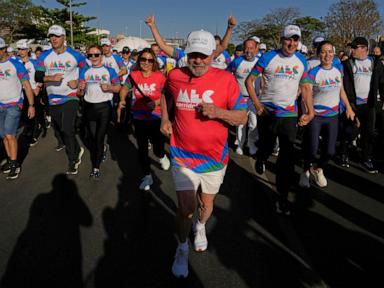
Luiz Inácio Lula da Silva is running against the clock. At 80, the Brazilian President is no longer just fighting opposition parties or economic headwinds; he is locked in a public struggle against the biological reality of his own aging. Recent footage of Lula jogging on a treadmill and engaging in vigorous gym sessions isn't a hobby. It is a calculated political maneuver designed to project vitality to a skeptical electorate.
The strategy is simple. If the public sees a leader sweating, they are less likely to focus on the tremors of a long political career or the cognitive slip-ups that critics weaponize. Brazil is currently navigating a polarized environment where the President's health is a matter of national security. By making his physical regimen a public spectacle, Lula is attempting to decouple his chronological age from his functional capacity.
This isn't just about optics. It is about the survival of the PT (Workers' Party) project.
The Body Politic as a Marketing Asset
In Brazilian politics, the "strongman" image has historically relied on bravado and physical presence. Lula’s predecessor, Jair Bolsonaro, frequently used images of himself riding motorcycles or horses to signal a raw, populist masculinity. Lula is countering with a more disciplined, modern version of strength: the resilient octogenarian.
The treadmill videos are distributed with surgical precision across social media platforms. They serve a dual purpose. First, they provide a visual rebuttal to rumors regarding his health after a series of minor medical procedures and a hip surgery in late 2023. Second, they appeal to a growing demographic of older Brazilians who see their own aspirations for longevity reflected in the President’s persistence.
However, a treadmill cannot outrun the actuarial tables. The "Grandfather of the Nation" persona works until it doesn't. Every time Lula stumbles over a word or requires a chair during a long ceremony, the carefully constructed image of the "Athletic President" takes a hit. The administration is betting that the sight of a 200-pound man lifting weights will overshadow the reality of a leader entering his ninth decade.
Behind the Scenes of the Presidential Fitness Plan
Reliable sources within the Planalto Palace suggest that Lula’s routine is far more than a PR stunt. It is a grueling necessity. His medical team, led by Roberto Kalil Filho, has long emphasized that the President’s ability to handle the stresses of the office depends entirely on his physical conditioning.
The regimen typically includes:
- Weight Training: Focused on maintaining bone density and muscle mass, which are critical for preventing falls and maintaining posture during long diplomatic summits.
- Cardiovascular Work: High-intensity intervals on the treadmill to improve heart health and lung capacity.
- Physical Therapy: Targeted exercises to ensure the 2023 hip replacement remains mobile and pain-free.
But the "how" is less important than the "why." Political analysts note that Lula is hyper-aware of the global trend regarding aging leaders. He watched the debates in the United States surrounding Joe Biden’s age with intense interest. He saw how a single moment of perceived frailty could derail a campaign. For Lula, the treadmill is a defensive fortification against similar attacks from the Brazilian right.
The Economic Impact of a Leader’s Health
Markets hate uncertainty. In Brazil, where the executive branch holds significant power over fiscal policy, the President’s health is a direct variable in economic stability. When Lula appears fit, it signals a stable transition toward his 2026 goals. When he appears tired, the "succession talk" begins, which inevitably leads to volatility in the Real and the Bovespa.
The business community isn't looking for a marathon runner; they are looking for a guarantor of the status quo. If Lula can convince the elite that he has four or eight more years of high-octane governance in him, he maintains his leverage. If he is seen as a lame duck with a failing heart, his ability to pass difficult tax reforms or environmental regulations evaporates.
The Age Divide in the Brazilian Electorate
The data suggests a generational split in how Lula’s age is perceived.
| Demographic | Perception of Lula's Age | Priority |
|---|---|---|
| Ages 16-24 | Skeptical; see him as a relic of the past. | Job market and technology. |
| Ages 25-50 | Concerned about stability and succession. | Inflation and housing. |
| Ages 50+ | Find his activity levels inspiring or relatable. | Pensions and healthcare. |
The treadmill videos are specifically targeted at that middle bracket—the 25-to-50-year-olds who are worried about the long-term future of the country. By showing he can outwork people half his age, Lula attempts to bridge the gap between his 20th-century roots and 21st-century demands.
The Succession Vacuum
The desperation behind the fitness campaign highlights a deeper problem: the lack of a clear successor within the Workers' Party. Lula is the sun around which the entire Brazilian left orbits. If he fades, the system collapses. This creates a dangerous reliance on one man's biology.
Potential heirs like Fernando Haddad or Simone Tebet are constantly measured against Lula’s charisma. None have yet matched his ability to command a crowd. This makes Lula’s health not just a personal matter, but a structural vulnerability for the government. The treadmill isn't just keeping a man fit; it’s keeping a political party relevant.
Mental Acuity vs Physical Vigor
While the President’s legs are moving, critics are focusing on his mouth. There is an ongoing debate about whether physical fitness translates to mental sharpness in a high-pressure environment. Lula has made several controversial statements regarding foreign policy—specifically regarding the conflicts in Ukraine and Gaza—that have required immediate "clarification" from the Ministry of Foreign Affairs.
Is this the result of a deliberate, if risky, geopolitical strategy, or are these the "gaffes" of an aging mind? The treadmill videos don't answer that question. They are a distraction from it. By focusing the conversation on his ability to run a mile, the administration shifts the focus away from his ability to navigate the complexities of a multipolar world without causing diplomatic incidents.
The Global Context of Aging Autocrats and Democrats
Lula is part of a global phenomenon. From the United States to India to Cameroon, the world is being governed by a gerontocracy. This raises fundamental questions about the nature of modern leadership. Is experience the ultimate asset, or is the pace of the modern world too fast for those born before the advent of the transistor?
In Brazil, the memory of the military dictatorship (1964-1985) still lingers. Many voters prefer an aging democrat they know to a younger, unpredictable alternative. But that preference is conditional. It depends on the perception that the leader is still "in the game."
The Inevitability of the Wall
Every athlete knows about "the wall." It’s the point where the body simply refuses to go further. In politics, the wall is often invisible until you hit it.
Lula’s insistence on publicizing his workouts shows he is acutely aware of the wall. He is trying to push it back through sheer force of will and professional-grade medical support. But there is a risk of overcompensation. If the President pushes too hard and suffers a public injury or a health scare in the gym, the entire strategy backfires. It turns a sign of strength into a sign of vanity or, worse, desperation.
The Brazilian public is watching this performance with a mix of admiration and anxiety. They see a man who has survived prison, cancer, and the loss of his wife, now battling the most relentless opponent of all: time.
The Verdict of the Street
Walk through the markets of São Paulo or the beaches of Rio, and the conversation about "O Veio" (The Old Man) is nuanced. People recognize the grit required to lead a nation at 80. They also recognize that a country of 215 million people shouldn't be entirely dependent on the heart rate of one octogenarian.
The treadmill is a symbol of a presidency that is constantly in motion but often running in place. Lula is moving fast, but he is staying in the same room, trapped by the expectations of his supporters and the vitriol of his enemies.
To maintain control, the President must ensure that the image of the running man remains the dominant narrative. He needs the public to believe that as long as his legs are moving, the country is moving with him. It is a fragile illusion that requires daily maintenance and a very high incline.
If you want to understand the future of Brazilian power, stop looking at the polls and start looking at the Presidential gym’s logbook.