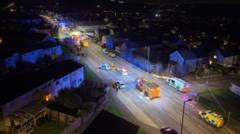
Three families are currently arranging funerals while three suspects sit in police custody following a devastating high-speed collision that wiped out half a dozen lives in an instant. The incident, which occurred on a major arterial route under the cover of darkness, has been framed by local authorities as a tragic confluence of speed and poor judgment. However, viewing this solely through the lens of individual error ignores a much darker pattern emerging on our infrastructure. We are witnessing a systemic breakdown where vehicle power, crumbling enforcement, and a culture of impunity meet at a deadly intersection.
The mechanics of the crash were violent and absolute. When two vehicles collide at speeds exceeding eighty miles per hour, the physics of kinetic energy take over, rendering even the most advanced safety "shells" largely irrelevant. The three men killed were pronounced dead at the scene, their lives extinguished before emergency services could even deploy their extraction tools. Meanwhile, the three individuals facing charges—ranging from dangerous driving to suspicion of vehicular manslaughter—represent a growing demographic of drivers who view traffic laws as optional suggestions rather than life-saving boundaries.
The Physics of Fatality
We often talk about road safety in abstract terms, but the reality is governed by the formula for kinetic energy, where velocity is squared. This means a small increase in speed results in a massive increase in the force of impact.
Modern cars are marketed as rolling fortresses. We are told that side-curtain airbags, crumple zones, and reinforced steel pillars make us invincible. This is a dangerous lie. These features are designed for standardized crash tests, usually conducted at speeds around thirty-five to forty miles per hour. When a driver pushes a two-ton machine into the triple digits, they are effectively operating outside the design parameters of the vehicle's safety systems. The human internal organs, suspended in fluid, cannot survive the g-forces of a near-instantaneous stop against a stationary object or another moving vehicle.
The Erosion of Deterrence
The arrests made in the wake of this triple fatality suggest a quick police response, but they also highlight a reactive rather than proactive approach to road policing. Over the last decade, we have seen a visible retreat of highway patrols in favor of automated enforcement. While cameras catch speeders, they cannot detect a driver’s impairment, aggressive behavior, or the erratic lane-weaving that precedes a catastrophic event.
Criminals and reckless drivers have noticed this vacuum. There is a palpable sense of lawlessness on the roads after midnight. The three men arrested in this case will likely face the full weight of the judicial system, but their prosecution does nothing to address the thousands of others currently treating public highways like private racetracks. We have traded the psychological deterrent of a cruiser in the median for a mailbox full of automated tickets that many simply treat as the "cost of doing business."
The Infrastructure Gap
We must also look at the stage where these tragedies perform. Many of our primary roads were engineered for the traffic volumes and vehicle capabilities of the 1970s. Today, even a base-model family sedan possesses acceleration and top-end speed that would have rivaled a supercar forty years ago. Our roads have not kept pace with the sheer lethality of modern horsepower.
Inadequate lighting, poorly marked construction zones, and the lack of physical barriers between opposing lanes of traffic turn simple mistakes into death sentences. If the road in question had been equipped with modern cable barriers or better-defined runoff areas, those three men might be in a hospital today instead of a morgue. We continue to build for speed and volume while treating safety as an afterthought or a budgetary burden to be trimmed during the next fiscal cycle.
Toxic Driving Culture and the Search for Thrills
There is an uncomfortable truth that many analysts refuse to touch: driving has become an outlet for redirected aggression and performative risk-taking. Social media has created a subculture where "high-speed runs" are filmed and shared for clout. This isn't just about getting from point A to point B anymore. For a specific subset of the population, the car is a weapon used to assert dominance on the asphalt.
The three men arrested are now part of a legal narrative, but before the crash, they were likely part of this broader cultural drift. When we celebrate "hustle" and "breaking rules" in every other facet of life, we shouldn't be surprised when that attitude carries over into the driver’s seat. The consequences, however, are not digital. They are made of twisted metal and shattered glass.
The Legislative Silence
Why hasn't there been a massive federal or regional push to cap vehicle speeds via software? The technology exists. Speed limiters could be tied to GPS data, making it physically impossible to exceed 80 miles per hour on a public road. Yet, the automotive lobby and a vocal minority of "freedom-oriented" drivers have successfully killed these conversations before they reach the floor of any legislature.
We accept three deaths in a single night as a "tragedy," but if a plane went down killing three people every single week, the entire industry would be grounded until a solution was found. On our roads, we simply sweep the glass away and wait for the next notification.
The investigation into this specific crash will eventually conclude. The lawyers will argue over brake marks and toxicology reports. The three suspects will likely serve time, and the families of the deceased will be left with a permanent, gaping void. But until we stop treating road deaths as an inevitable tax on our mobility, the body count will continue to climb. We are currently choosing speed over life, and as this latest incident proves, the price is far too high.
Check your own local traffic fatality data and demand to know why speed-limiting technology isn't mandatory in every new vehicle sold in your jurisdiction.