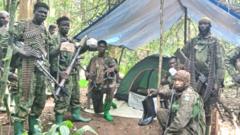
The Congolese military recently announced the rescue of over 200 civilians from the clutches of the Allied Democratic Forces (ADF), an insurgent group with deepening ties to the Islamic State. While these headlines offer a rare glimmer of hope in a region defined by decades of bloodshed, they mask a grim reality. The rescue, conducted in the dense forests of North Kivu and Ituri, is a tactical success in a losing war of attrition. For every captive returned, the underlying infrastructure of the ADF remains untouched, flourishing in the vacuum left by a weak state and a complex web of regional rivalries.
The ADF is no longer a localized rebel outfit. It has transformed into the Islamic State Central Africa Province (ISCAP), a franchise that utilizes sophisticated financing and a brutal recruitment cycle to stay ahead of the joint operations between the Democratic Republic of Congo (DRC) and Uganda. This latest operation, while significant in human terms, represents a drop in the ocean of a conflict that has displaced millions and shows no sign of cooling.
The Mechanics of an Insurgent Resurgence
To understand why 200 rescues do not equal victory, one must look at the ADF’s operational evolution. Originally a Ugandan rebel group, they have spent thirty years embedding themselves into the social and economic fabric of eastern DRC. They do not just hide in the bush; they manage timber trade, tax local gold miners, and maintain supply lines that stretch across borders.
When the military moves in, the ADF melts away. They prioritize the preservation of their core combatants over the retention of captives. The civilians rescued are often those who could no longer keep up with the rapid movements required to evade drone surveillance and long-range artillery. By "allowing" these rescues, the ADF sheds the weight of non-combatants who consume rations and slow down their retreat. It is a cynical, strategic shedding of baggage.
The military's reliance on "Operation Shujaa"—the joint offensive with the Ugandan People’s Defence Forces (UPDF)—has pushed the rebels further into the interior. However, this displacement often results in the slaughter of civilians in previously "safe" areas. The ADF responds to military pressure with asymmetrical cruelty. They target soft spots—villages with no military presence—to prove that the state cannot protect its citizens.
The Islamic State Connection and the Financial Lifeline
The branding of the ADF as an Islamic State affiliate changed the stakes. This is not mere window dressing or a desperate plea for relevance. It has brought in a steady stream of technical expertise and funding. Evidence found in recent raids includes instructions for more complex improvised explosive devices (IEDs) and evidence of digital financial transfers that bypass traditional banking monitors.
Money flows through informal "hawala" networks, often disguised as legitimate trade in small-town markets. This financial independence means that even when the DRC military captures a camp or rescues a group of women and children, the group's ability to buy new weapons and recruit new fighters remains intact. The recruitment is rarely ideological at the start. It is born of poverty. A young man with no job and no future is an easy target for a group that can offer a monthly stipend, however small, and a sense of belonging.
The international community often views this as a religious war. It is not. It is a resource war fought with religious slogans. The ADF controls access to fertile land and mineral deposits. By terrorizing the population, they clear the land for their own exploitation. The 200 people recently brought back to safety are survivors of a forced labor system that fuels a global appetite for Congolese resources.
The Failure of the Protective State
The Congolese army, the FARDC, suffers from systemic issues that no single successful operation can fix. Soldiers are frequently underpaid, under-equipped, and sometimes complicit in the very illegal trade they are sent to stop. There have been documented cases where military intelligence leaked operation details to rebel leaders in exchange for a cut of the gold trade.
When a rescue happens, it is usually the result of intense pressure from Kinshasa or the Ugandan government, rather than a sustained, bottom-up security strategy. The local population knows this. They live in a state of permanent "pre-displacement." They keep their few belongings packed, knowing that the soldiers who rescued their neighbors today might be gone tomorrow, leaving them vulnerable to the inevitable ADF retaliation.
The UN peacekeeping mission, MONUSCO, is currently withdrawing from the country. This exit creates a massive security gap. While the DRC government has called for their departure, citing their perceived ineffectiveness, the replacement—primarily a force from the Southern African Development Community (SADC)—lacks the historical knowledge and the logistical footprint to cover the vast, mountainous terrain where the ADF operates.
The Refugee Cycle and the Regional Shadow War
Every conflict in eastern Congo is a regional conflict. Uganda’s involvement is officially about security, but it is also about protecting their interests in a planned oil pipeline and ensuring their own border remains stable. Rwanda, though not directly involved in the fight against the ADF, remains the elephant in the room. The tension between Kigali and Kinshasa over the M23 rebels in the south draws resources and attention away from the ADF front.
The ADF thrives in this friction. They are masters of the borderlands. They use the lack of cooperation between regional capitals to move men and materiel with relative ease. The 200 rescued civilians are now entering a secondary crisis: the humanitarian vacuum. There is no "aftercare" in a war zone. These survivors return to villages that have been burned, with no crops to harvest and no schools for their children. Without a massive investment in local governance and economic stability, these survivors remain vulnerable to re-kidnapping or being forced into other armed groups just to eat.
A Victory of Optics Over Substance
We must stop measuring success by the number of people rescued or the number of camps burned. These are metrics of a stalemate. Real victory would look like a functioning judiciary in Beni and Butembo that prosecutes the financiers of the ADF. It would look like a military payroll that actually reaches the soldiers on the front lines, removing the incentive to collaborate with the enemy.
The current strategy is a game of "Whac-A-Mole" played with human lives. The military pushes, the rebels move, the media celebrates a rescue, and the cycle resets. The ADF’s leadership, including figures like Musa Baluku, remains elusive. They operate from mobile command centers that are better connected to the global jihadist network than the Congolese government is to its own rural outposts.
The international community’s obsession with "Islamic extremism" often misses the point that the ADF is a symptom of a failed state, not just an external infection. If the DRC cannot provide basic security and a path to a livelihood, groups like the ADF will always have a pool of recruits. The rescue of 200 people is a humanitarian win, but it is a strategic irrelevance as long as the corridors of power in Kinshasa remain more interested in the wealth of the east than the people who live there.
The forest eventually grows back over the charred remains of a rebel camp. Unless the root system—the corruption, the illegal resource extraction, and the regional meddling—is pulled out, the ADF will simply plant their flag in the next clearing. Security is not an event; it is a condition. Right now, eastern Congo is a long way from achieving it.
Identify the middlemen. The real fight isn't in the jungle; it's in the markets where the ADF's gold and timber are laundered into the global supply chain. Stop the money, and the "rescuing" won't be necessary because the kidnapping will no longer be profitable.