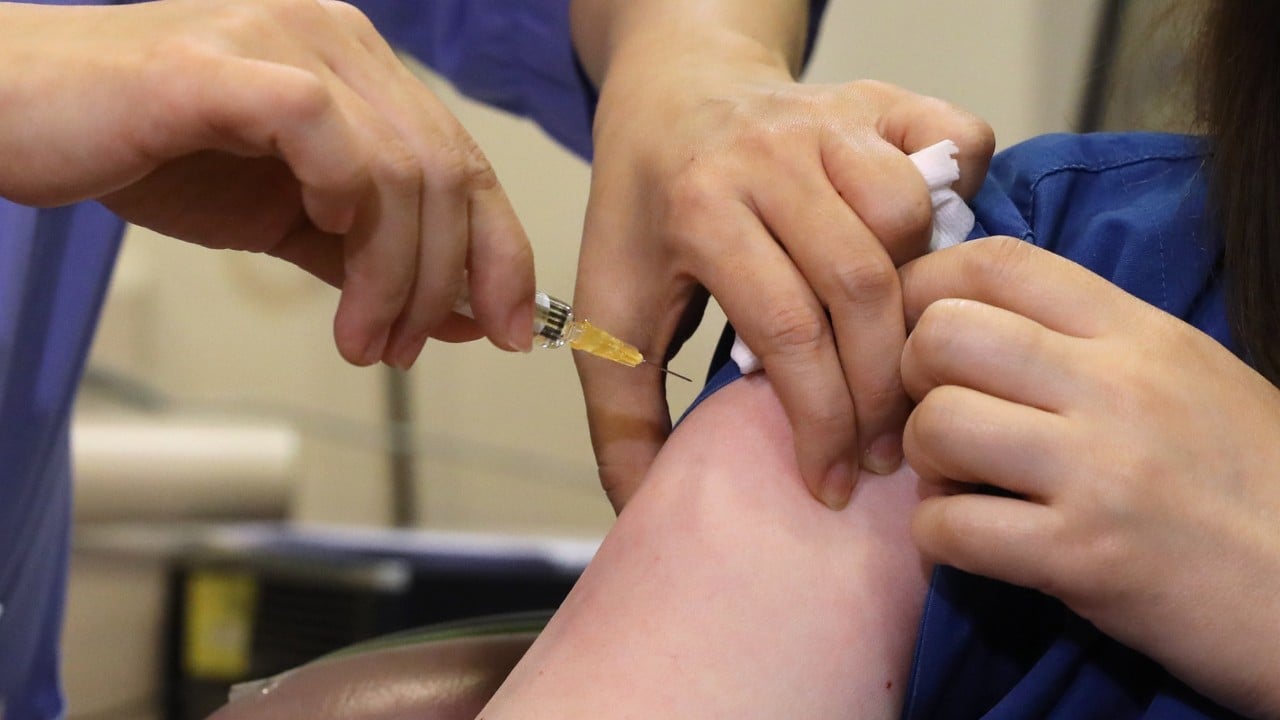
Public health officials love a good photo op involving a needle and a nervous employee. It looks like action. It feels like safety. When the Hong Kong authorities rushed to offer free measles vaccinations to airport staff following a handful of cases, the media played its part perfectly, framing the move as a proactive "bid to prevent an outbreak."
They are wrong. For a more detailed analysis into similar topics, we suggest: this related article.
Throwing a few thousand vaccines at ground staff after the virus has already entered the terminal is the epidemiological equivalent of trying to put out a forest fire with a water pistol while the arsonist is still walking around with a torch. It is reactive, logically flawed, and ignores the structural reality of modern global transit.
The Myth of Terminal-Based Containment
The "lazy consensus" suggests that if you vaccinate the people standing behind the check-in counters, you create a firewall. This assumes the airport is a static environment where the staff are the primary vectors. To get more context on this topic, in-depth analysis is available at National Geographic Travel.
It ignores the basic math of measles.
The $R_0$ (basic reproduction number) for measles is typically cited between 12 and 18. In a packed, recirculated-air environment like a modern international terminal, that number doesn't just hold; it thrives. Measles is airborne and can linger in the air for up to two hours after an infected person has left the room.
By the time a "cluster" is identified and a vaccination booth is set up in the staff lounge, the virus has already hitched a ride on five different flights to three different continents. Vaccinating the person who scanned the boarding pass three days after the exposure isn't prevention. It’s PR.
Why Staff Vaccines are the Wrong Lever
I have spent years looking at operational risk in high-density hubs. The reflex to "do something" usually results in targeting the easiest demographic rather than the most effective one.
- The Immunity Gap: Most airport staff in Hong Kong are already immune. Hong Kong’s childhood immunization program is one of the most rigorous in the world. Testing for antibodies (titer tests) would show that the vast majority of these "emergency" jabs are going into arms that don't need them.
- The Window of Failure: Vaccines take approximately 10 to 14 days to induce a protective immune response. If an outbreak is currently moving through a terminal, a jab given today offers zero protection against an exposure that happens tomorrow.
- The Transit Vector: The real threat isn't the guy selling duty-free perfume. It’s the 75,000 passengers moving through the gates every day. You cannot vaccinate a transient population.
The Air Filtration Fallacy
We are told that modern aircraft and terminals have HEPA filters that make the air "cleaner than a hospital operating room." This is a half-truth used to maintain consumer confidence.
While HEPA filters are incredibly efficient at capturing particles, they only work if the air actually passes through them. In a terminal, air circulation patterns are chaotic. Large open spaces with high ceilings create "dead zones" where air can stagnate.
Furthermore, the risk isn't the air coming out of the vent; it's the person standing two feet away from you in the security line coughing. No amount of staff vaccination fixes the proximity issue of ten thousand strangers from ten thousand different vaccination regimes standing in a serpentine queue for forty minutes.
The Brutal Truth About Global Immunity
The "outbreak" in Hong Kong isn't a Hong Kong problem. It’s a global maintenance problem.
We are seeing a resurgence of measles because of "immunity debt" and the erosion of herd immunity in previously "safe" Western nations. When you operate a global hub like HKIA, you are essentially a giant petri dish for every localized failure of public health across the globe.
If you want to actually prevent an outbreak, you don't start at the airport. You start with mandatory digital health credentials for international travel—a concept that makes civil libertarians scream but is the only logical solution to a virus this contagious.
"Trying to stop measles at a port of entry without pre-arrival vaccination requirements is like trying to stop the wind with a chain-link fence."
The Economic Theater of Safety
Why do they do it? Because the cost of the vaccine doses is negligible compared to the cost of a drop in traveler confidence.
If the public perceives the airport as a "hot zone," they stop flying. If they stop flying, the economy of a city like Hong Kong—which thrives on being the world's "super-connector"—collapses. The free jabs are a marketing expense. They are "Safety Theater," much like the 3.4-ounce liquid rule. It makes the traveler feel cared for while doing almost nothing to mitigate the actual biological risk.
The Downside of the Current Approach
There is a hidden cost to this reactive posturing.
- Resource Diversion: Medical staff and supplies are pulled from primary care to man airport booths for a low-risk population.
- False Sense of Security: It leads the public to believe the threat is contained, causing them to ignore symptoms or skip their own boosters.
- Scientific Illiteracy: It reinforces the idea that vaccines are a "cure" you take after the fact, rather than a preventative foundation.
Stop Asking if the Staff are Safe
People always ask: "Is it safe to fly through Hong Kong right now?"
That is the wrong question. The right question is: "Why is our global transit system still predicated on 19th-century quarantine logic?"
We live in an era of $M_1$ and $M_2$ money supply, instant global communication, and hyper-loops, yet our biological defense strategy is still "stick a needle in the guy at the gate."
The Uncomfortable Solution
If we were serious about biosecurity at transport hubs, we would stop the PR stunts and implement the following:
- Mandatory Titer Testing: Don't just jab everyone. Test for existing immunity. It’s more expensive, but it provides actual data on where the vulnerabilities lie.
- Dynamic Airflow Management: Instead of static HVAC, use real-time CO2 monitoring and targeted ultraviolet germicidal irradiation (UVGI) in high-traffic bottlenecks like immigration and security.
- Pre-Flight Verification: Shift the burden of proof to the point of origin. If you cannot prove immunity to high-contagion respiratory viruses, you don't get on a 12-hour metal tube with 300 other people.
The Reality of the "Bid"
The competitor's headline calls this a "bid to prevent an outbreak."
In reality, it’s a bid to prevent a headline.
The outbreak is already a mathematical certainty if the conditions are right. Measles doesn't care about a government press release or a free clinic in the breakroom. It follows the laws of physics and biology.
Until we stop treating airports as static buildings and start treating them as the high-speed biological pipelines they are, we are just playing a very expensive game of pretend.
Vaccinating airport staff after the fact isn't leadership. It’s an admission that you’ve already lost control of the perimeter.
Stop looking at the needle. Look at the air.