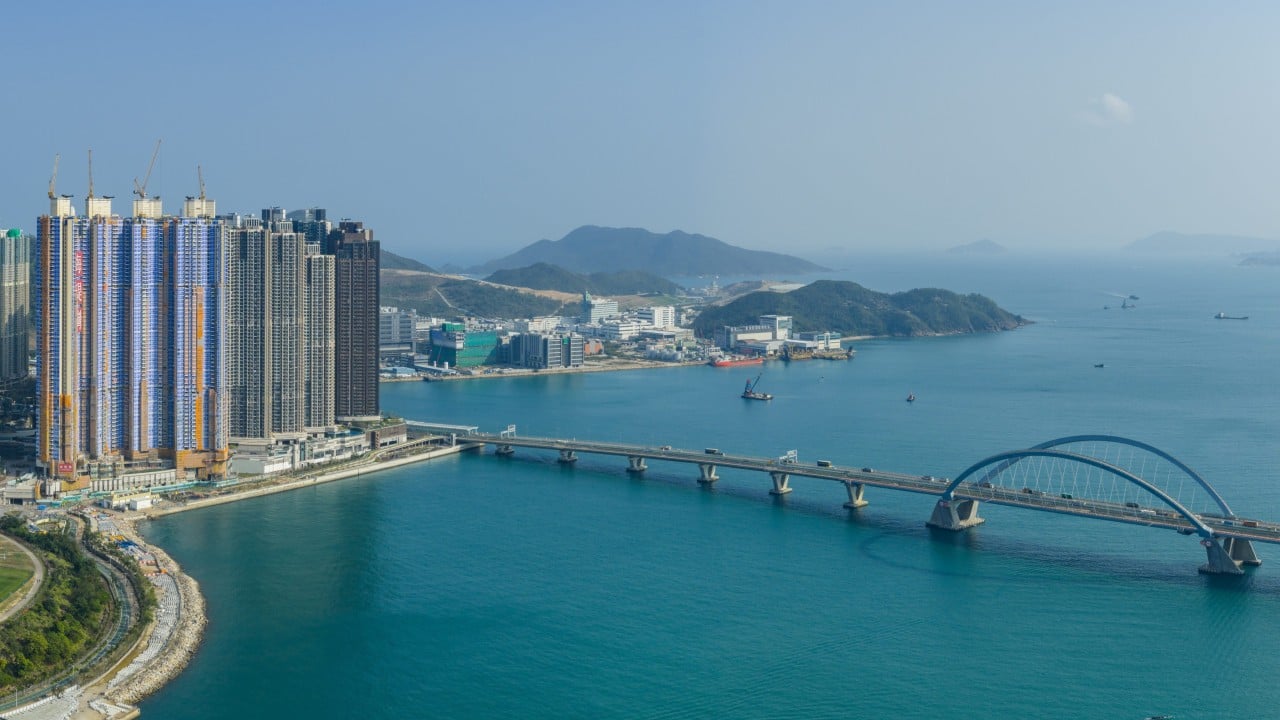
The recent surge in Hong Kong residential property transactions—specifically the rapid absorption of new project launches—is not a signal of renewed market exuberance, but rather a calculated response to a rare alignment of price correction and policy relaxation. When buyers "pile into" new launches, they are executing a risk-arbitrage strategy based on the narrowing gap between secondary market valuations and subsidized primary market pricing. This behavior occurs against a backdrop of elevated borrowing costs and geopolitical volatility, suggesting that the "piling in" effect is a function of supply-side desperation rather than demand-side FOMO (Fear Of Missing Out).
To understand the current state of the Hong Kong property market, we must analyze the three mechanical levers driving these volumes: the Cost of Carry, the Liquidity Premium, and the Policy Inflection Point.
The Mechanism of Discounted Primary Pricing
Developers in Hong Kong are currently operating under a "Volume over Margin" mandate. This shift is driven by the high interest rate environment, which increases the holding costs for unsold inventory. When a developer launches a new project at a price point significantly below the prevailing secondary market rates in the same district, they are effectively offering a "safety margin" to the buyer.
The pricing strategy follows a specific logic:
- Inventory De-stocking: Large developers need to recycle capital to service debt.
- Price Discovery: By setting prices at levels last seen in 2016 or 2017, developers are testing the floor of the market.
- Incentive Structures: High-profile launches often include flexible payment plans, stamp duty subsidies, or first-mortgage arrangements that are unavailable in the secondary market.
This creates a bifurcation. The secondary market remains frozen because individual owners are unwilling or unable to realize 20% to 30% losses. Meanwhile, the primary market sees high turnover because developers have the institutional capacity to absorb these losses as part of a broader corporate de-leveraging strategy.
The Cost of Carry vs. Rental Yield Compression
The fundamental math of Hong Kong property has shifted from capital appreciation to a grueling assessment of the cost of carry. For a decade, the "negative carry" was ignored because price growth outpaced interest expenses. That era ended with the normalization of the US Federal Reserve’s funds rate, which the Hong Kong Monetary Authority (HKMA) must mirror due to the USD-HKD peg.
The current cost function for a prospective buyer is defined by the relationship between the HIBOR-based mortgage rate and the Net Rental Yield.
$$Total Cost = (Principal \times Mortgage Rate) + Maintenance + Taxes - Rental Income$$
Currently, mortgage rates for many buyers hover around 4.125%, while rental yields in some districts remain below 3%. This is a structural Negative Carry.
The rationale for buying into this environment is based on the expectation of a specific path for interest rates. The market is pricing in a 2024–2025 pivot, which would reduce the cost of carry. However, this logic ignores the persistent inflationary pressures and the potential for a "higher-for-longer" rate environment. This makes the current buyers "interest rate speculators" who are betting on the Federal Reserve’s future decisions more than the local property market’s fundamentals.
The Geopolitical Risk Premium and Asymmetric Information
The reference to "Middle East tensions" in recent news cycles is often treated as a secondary factor, but it has a primary impact on the Capital Flight and Safe Haven dynamics.
Hong Kong’s property market has historically functioned as a store of value. When global volatility increases—whether from the Middle East or Eastern Europe—capital tends to seek assets that are both liquid and tangible. Yet, the current geopolitical landscape introduces a new variable: The Renminbi (RMB) Depreciation Risk.
Investors from Mainland China have historically been the backbone of the Hong Kong primary market. For these buyers, Hong Kong property is an offshore asset that provides a hedge against the depreciation of the RMB. This creates an asymmetric information gap:
- Local buyers see high interest rates and falling prices as a reason for caution.
- Mainland buyers see a 20% price correction as a generational entry point for an asset denominated in a currency (the HKD) that is pegged to the USD.
This creates a floor for prices. While the local population faces affordability constraints, the "piling in" effect is partially driven by external capital seeking a "discounted" entry into a USD-linked asset class.
The Policy Lever: The Removal of the 'Spicy Measures'
The HKMA and the Hong Kong government’s decision to remove the "spicy measures"—extra stamp duties designed to curb speculation—has fundamentally altered the Transaction Velocity.
Previously, the cost of entry for a non-first-time buyer was prohibitive. By removing the Special Stamp Duty (SSD), the Buyer's Stamp Duty (BSD), and the New Residential Stamp Duty (NRSD), the government has effectively reduced the immediate transaction cost for investors by as much as 15% to 30%.
This is not a "booster" for the economy; it is a Liquidity Injection. By removing these barriers, the government is facilitating the transfer of assets from developers to the private sector. The "piling in" is the result of pent-up demand from investors who were sidelined for over a decade. However, this creates a Supply-Side Risk: the more successful these launches are, the more likely the secondary market is to remain stagnant, as there is no longer a tax penalty for holding a property for less than two years.
The Bottleneck: The Secondary Market Stagnation
The secondary market is the true measure of a real estate market's health, and it is currently in a state of Structural Paralysis.
The mechanics of this paralysis are straightforward:
- The Negative Equity Trap: A significant number of owners who bought between 2019 and 2021 are now in a negative equity position. They cannot sell without bringing cash to the closing table.
- The Mortgage Stress Test: Despite some relaxation, the HKMA’s stress tests still limit the pool of eligible buyers.
- The Valuation Gap: Banks are conservative in their valuations of secondary properties. A buyer may agree to a price with a seller, but if the bank’s valuation is 10% lower, the buyer must cover the difference in their down payment.
New launches avoid these bottlenecks because developers often offer their own financing or can influence bank valuations through large-scale, standardized pricing. This creates a market where the only "active" segment is the one controlled by the large developers, leading to a distorted view of overall market health.
The Strategic Play: Capital Allocation and Exit Velocity
For an institutional or high-net-worth investor, the current environment in Hong Kong property requires a pivot from Growth-Oriented Investing to Yield-Centric Accumulation.
The strategy is not about timing the bottom, as the "bottom" in a high-interest-rate environment is a plateau, not a V-shaped recovery. Instead, the strategic play involves:
- Focusing on Yield-Positive Segments: High-density urban centers where the rental demand from the "Top Talent Pass Scheme" (the government's initiative to attract professionals) is concentrated.
- Prioritizing New Launches with High LTV (Loan-to-Value) Flexibility: Using developer-backed financing to bridge the gap until interest rates normalize.
- Assessing the Exit Velocity: Investors must calculate their exit based on a 5-to-10-year horizon, assuming that the secondary market will only regain liquidity once the current primary market supply is fully absorbed and the inventory overhang from developers is cleared.
The "piling in" we see today is a tactical window. It is the result of developers pricing for the present reality while buyers are pricing for a future hope. As long as that gap exists, volume will continue. The moment developers stop discounting, or the moment the Federal Reserve signals a pause in rate cuts, the current momentum will evaporate, revealing a market that is still struggling with the fundamental transition from a low-rate, high-growth era to a high-rate, stability-focused one.
The move is to treat Hong Kong property not as a speculative vehicle, but as a long-term, USD-denominated income play, with the understanding that the "safety margin" provided by current developer discounts is the only protection against further downside risk.