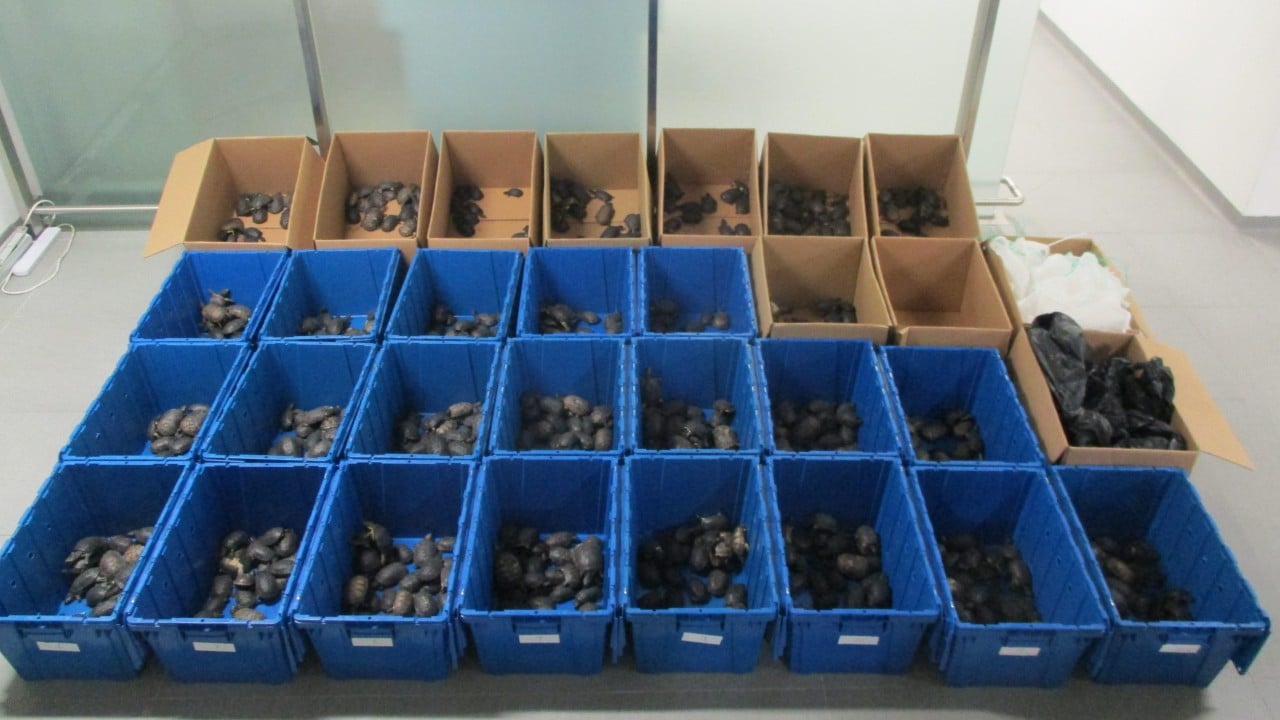
Hong Kong customs just intercepted a massive haul of nearly 1,000 smuggled turtles. The street value sits at roughly HK$1 million. It's a staggering number, but if you've been watching the borders lately, it’s also entirely predictable. While the city prides itself on being a premier logistics hub, that same efficiency makes it a magnet for the multi-billion dollar wildlife black market. This isn't just about a few reptiles in a suitcase. It’s a systemic crisis involving organized crime, high-value biodiversity, and a legal framework that often struggles to keep pace with the sheer volume of illicit traffic.
Customs officers at the Hong Kong-Zhuhai-Macao Bridge made the discovery during a "routine" inspection of an outbound truck. They found 990 turtles crammed into boxes, hidden behind stacks of declared goods. These weren't your garden-variety pets. The shipment included endangered species like the Asian Box Turtle and the Black Marsh Turtle. Both are protected under the Convention on International Trade in Endangered Species of Wild Fauna and Flora (CITES).
The mechanics of a million dollar haul
Smugglers don't usually gamble on a million-dollar shipment unless they think the odds are in their favor. In this specific case, the turtles were destined for mainland China, where the demand for exotic pets and traditional medicine continues to drive prices through the roof.
Think about the logistics for a second. Moving 1,000 living creatures requires a specific kind of cold-blooded indifference. They are often taped shut, stuffed into mesh bags, and layered in crates with zero ventilation or hydration. By the time customs cracks the seal, a significant percentage are usually dead or dying. The ones that survive are often permanently traumatized or riddled with infections from the cramped conditions.
The HK$1 million valuation is actually a conservative estimate. Once these animals hit the "grey market" in Tier-1 cities across the border, collectors will pay a massive premium for rarer specimens. Some of these turtles can fetch thousands of dollars individually if they have specific markings or are of a certain age.
Why Hong Kong is the perfect transit point
You have to look at the geography to understand why this keeps happening. Hong Kong is the gateway. Its status as a free port means a dizzying amount of cargo moves through its terminals every single day. Customs officials are elite, but they are also outnumbered by the sheer scale of global trade.
Criminal syndicates use a "scatter" strategy. They send ten shipments knowing five might get seized. If the other five make it through, they've already doubled their investment. The profit margins in wildlife trafficking are comparable to narcotics but, historically, the jail time has been much lighter. That is a calculation the bad guys make every day.
We also have to talk about the "laundering" of wild-caught animals. Smugglers often try to pass off poached turtles as captive-bred. They forge paperwork or mix a few legal animals with hundreds of illegal ones. It’s a shell game—pun intended—that requires specialized knowledge from customs agents to debunk on the spot.
The high cost of the exotic pet obsession
The demand side of this equation is where things get messy. Why do people want these turtles? In many cases, it’s pure ego. Owning a rare, endangered species is a status symbol in certain circles. It’s the reptile equivalent of a limited-edition supercar.
Biodiversity under fire
When you remove 1,000 turtles from the wild, you aren't just taking individuals. You're gutting a local ecosystem. Many of these species grow slowly and have low reproductive rates. Taking a thousand breeding-age adults out of a habitat can lead to a localized extinction event in just a few seasons.
The health risk nobody talks about
Smuggled animals don't go through quarantine. They carry pathogens, parasites, and viruses that can jump to local wildlife or even humans. We've spent the last few years learning exactly how dangerous zoonotic diseases are, yet the wildlife trade continues to bypass the very safeguards designed to protect public health.
Loopholes and the legal battleground
Hong Kong has tightened its laws recently. The city moved wildlife crime under the Organized and Serious Crimes Ordinance (OSCO). This was a massive win for conservationists. It allows authorities to go after the "big fish" by freezing assets and investigating money laundering, rather than just arresting the low-level mule driving the truck.
However, the enforcement gap is still wide. Identifying 1,000 turtles isn't easy. It requires herpetologists and DNA testing to confirm species, especially when dealing with juveniles that look remarkably similar. While customs has improved its tech, the smugglers are also using encrypted apps and decentralized payment methods to stay one step ahead.
What happens to the survivors
The 990 turtles seized aren't just "evidence." They are living beings that need immediate care. Usually, they're handed over to the Agriculture, Fisheries and Conservation Department (AFCD) or local NGOs like the Kadoorie Farm and Botanic Garden.
The goal is always repatriation—sending them back to their country of origin. But that's a diplomatic and financial nightmare. Who pays for the flights? Which habitat is safe enough to ensure they won't just be poached again next week? Often, these animals end up living out their lives in rescue centers or accredited zoos because their "home" no longer exists or isn't secure.
Stopping the flow at the source
If you want to help, stop buying "exotic" pets without ironclad proof of their origin. "Captive-bred" is a label that gets slapped on everything. Demand to see CITES permits. Ask for the breeder's history. If the price seems too good to be true for a rare species, it’s probably because that animal was ripped out of a swamp in Southeast Asia two weeks ago.
Report suspicious listings on social media marketplaces. These platforms are the primary storefronts for illegal trade today. Most smugglers have moved off the dark web and onto mainstream apps where they hide in plain sight using coded language.
Check the official Hong Kong Customs and Excise Department website for updates on recent seizures. Staying informed about the specific species being targeted helps conservation groups pivot their resources to the areas that need it most. Supporting organizations like the Wildlife Conservation Society (WCS) or the World Wildlife Fund (WWF) provides the funding necessary for the ground-level intelligence that leads to these million-dollar busts in the first place.


