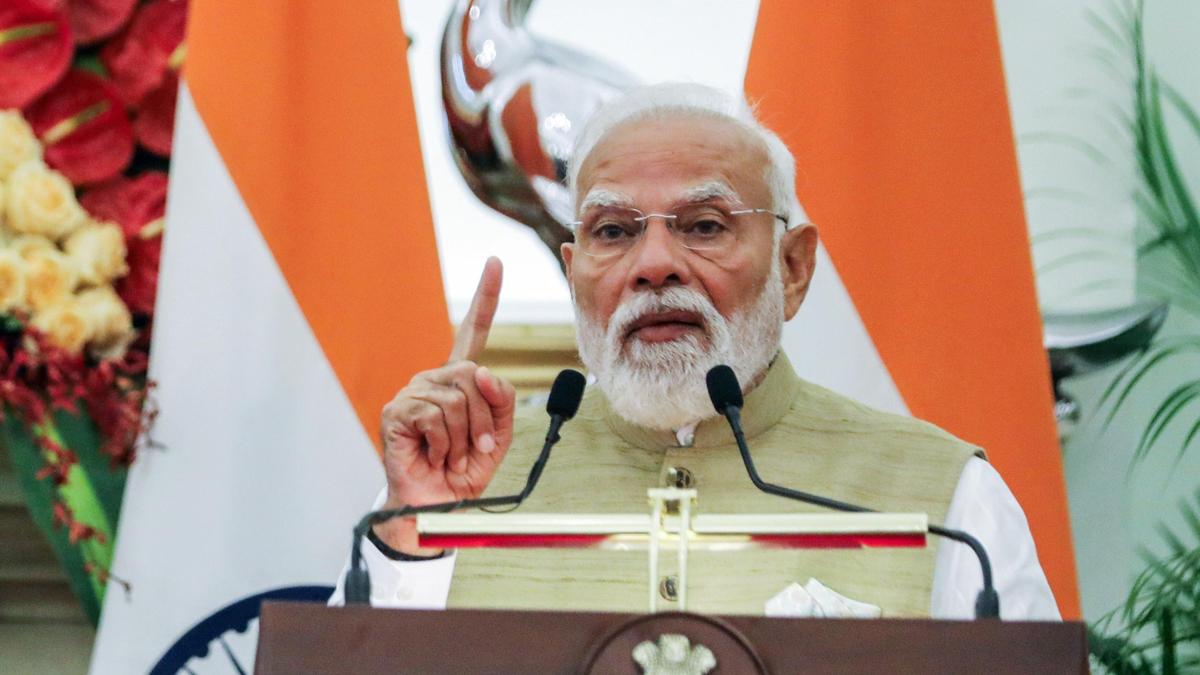
The shadow war between Israel and Iran just became a grim reality for India. It’s no longer just a series of distant explosions seen on a social media feed. The death of an Indian national in Northern Israel has shifted the entire narrative for New Delhi. This isn't just about geopolitics anymore. It’s about the safety of millions of Indian workers who form the backbone of the Gulf economy and the burgeoning labor force in Israel. Prime Minister Narendra Modi is now on the phone with regional leaders because the stakes have never been higher.
For months, the Indian government tried to walk a diplomatic tightrope. They balanced a strategic partnership with Israel against a deep-seated energy and diaspora dependency on the Arab world and Iran. That tightrope just snapped. When the first casualty was reported—a 31-year-old from Kerala named Patnibin Maxwell—the abstract threat of "regional instability" turned into a domestic political emergency.
The Phone Calls That Matter
Narendra Modi didn't wait for the dust to settle. He reached out to leaders across the Middle East, specifically targeting the UAE, Qatar, and Saudi Arabia. Why? Because these nations hold the keys to regional de-escalation. But more importantly, they house over 8 million Indian expats. If this conflict expands, we aren't looking at a minor evacuation. We're looking at a humanitarian crisis of historic proportions.
Modi’s conversation with UAE President Sheikh Mohamed bin Zayed Al Nahyan wasn't just a courtesy call. The UAE is India’s third-largest trading partner. It’s also a country that has successfully normalized relations with Israel while maintaining a cautious dialogue with Tehran. India is leaning on the UAE to act as a stabilizer. The message is clear: the safety of Indian nationals is a "red line" that cannot be ignored.
The Prime Minister also touched base with leaders in Qatar. Given Qatar's role as a primary mediator between Hamas and Israel, their insight is invaluable. India needs to know if the situation is going to get worse before it gets better. They need to know if the "tit-for-tat" missile strikes are about to evolve into a full-scale regional conflagration.
Why the First Casualty Changes Everything
Patnibin Maxwell was working on a farm in Margaliot, a community in Northern Israel, when a Hezbollah-fired anti-tank missile struck. He wasn't a combatant. He was a migrant worker trying to send money back to his family in Kollam. Two other Indians, Bush Joseph George and Paul Melvin, were also injured in the same attack.
This changes the internal math for the Ministry of External Affairs (MEA). Until now, the government encouraged—or at least didn't stop—thousands of Indian workers from heading to Israel to fill the labor void left by Palestinian workers whose work permits were revoked. Critics are now asking: is the promise of high wages worth the risk of a missile strike?
- Economic Desperation vs. Physical Safety: Many of these workers come from states like Haryana and Uttar Pradesh. They're fleeing unemployment for a chance at earning ₹1.5 lakh a month.
- The Recruitment Question: The government-to-government (G2G) agreements that facilitated these moves are now under intense scrutiny.
- The Insurance Gap: Most of these workers don't have the kind of comprehensive high-risk insurance required for a literal war zone.
The Iranian Factor and the Strait of Hormuz
While the immediate threat to life is in Northern Israel, the strategic threat to India's economy lies in the Persian Gulf. Iran’s influence over the Strait of Hormuz is a knife to the throat of global trade. About 40% of India's oil imports pass through that narrow waterway.
If Iran decides to fully weaponize its proxy network—Hezbollah in Lebanon, the Houthis in Yemen, and militias in Iraq—India’s "Link West" policy falls apart. We've already seen the Houthis targeting merchant vessels in the Red Sea. Some of those ships had Indian crews. Some were carrying cargo destined for Indian ports.
India's relationship with Iran is complicated. We helped build the Chabahar Port to bypass Pakistan and reach Central Asia. We have a long history of "civilizational ties." But Iran’s direct involvement in a war against Israel puts New Delhi in a spot where it might eventually have to choose a side. For now, the strategy is "radical neutrality," but neutrality doesn't protect a worker from a Hezbollah missile.
The Massive Scale of the Diaspora Problem
To understand why the Prime Minister is so focused on the Gulf leaders, look at the sheer numbers. This isn't like the evacuation from Ukraine where a few thousand students were brought home.
Indian Populations in the Danger Zone
- United Arab Emirates: ~3.5 million
- Saudi Arabia: ~2.5 million
- Kuwait: ~1 million
- Qatar: ~800,000
- Israel: ~18,000 to 20,000 (growing)
- Iran: ~5,000 to 10,000
If a regional war breaks out, the logistics of "Operation Ajay" (the mission to bring Indians back from Israel) would have to be scaled up by a factor of a hundred. No air force in the world can move 8 million people overnight. Preventing the war is the only viable "evacuation plan."
What India is Doing Right Now
The MEA has issued several travel advisories, but they're often vague. "Exercise caution" doesn't help much when you're in a conflict zone. Behind the scenes, the Indian government is doing three specific things.
First, they're strengthening maritime security. The Indian Navy has deployed several destroyers and frigates in the Arabian Sea and the Gulf of Aden. They're not just there for show; they're actively escorting Indian-flagged vessels and responding to distress calls.
Second, they're using "backchannel diplomacy." India is one of the few countries that can talk to both Netanyahu and the Iranian leadership. While the US has no formal ties with Tehran, India does. National Security Advisor Ajit Doval has been instrumental in these quiet conversations, trying to ensure that Indian interests aren't collateral damage in the Israel-Iran rivalry.
Third, they're re-evaluating the labor export pipeline. There's a growing movement within India to pause the sending of workers to Israel until a formal ceasefire is in place. It's a tough call because the workers themselves often want to go despite the risks.
The Economic Aftershocks for You
You might think this is a "them" problem. It’s not. If the situation between Israel and Iran escalates, the first thing you'll feel is at the petrol pump. Oil prices are incredibly sensitive to Middle Eastern tension. A $10 jump in the price of a barrel of oil can widen India's current account deficit and weaken the Rupee.
Then there's the supply chain. Everything from electronic components to fertilizers moves through these sea lanes. If shipping insurance premiums skyrocket—which they already have—the cost of everything you buy goes up. Inflation isn't just about domestic policy; it's about the stability of the Middle East.
What You Should Do If You Have Family Abroad
If you have relatives working in Israel or the surrounding Gulf nations, don't wait for a crisis to get organized.
- Register with the Embassy: This sounds like a bureaucratic chore, but it’s the only way the government knows you exist during an evacuation. Use the MADAD portal or the specific embassy website.
- Keep Documents Ready: Ensure passports are valid for at least six months. Keep digital copies on a secure cloud drive.
- Emergency Funds: Expats should keep a reserve of liquid cash in both local currency and USD. If banking systems glitch during a conflict, cash is king.
- Stay Updated via Official Channels: Ignore the "war porn" on WhatsApp groups. Follow the official handles of the MEA and the respective Indian Embassies on X (formerly Twitter).
The death of Patnibin Maxwell is a tragic milestone. It signals the end of India's "safe distance" from the Middle Eastern conflict. As Modi continues his diplomatic blitz, the focus remains on one thing: making sure no more Indian families have to receive a phone call like the one the Maxwell family just did.
Check your family's travel documents today and ensure everyone is registered with the Indian Global Diaspora portal. If you’re planning to take a job in the region, vet the location specifically against recent strike zones. Awareness is your best defense right now.


