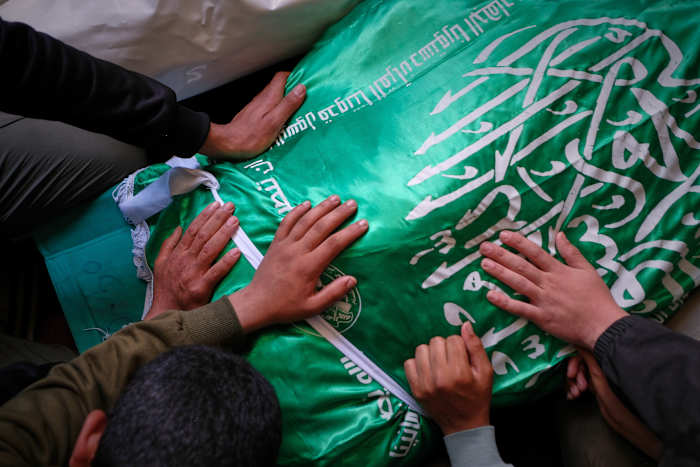
The confirmation that an Israeli airstrike killed Mohammed Deif, the elusive commander of the Izz al-Din al-Qassam Brigades, shatters the myth of invincibility that anchored Hamas's military strategy for three decades. While the group initially denied the outcome of the July 13 strike in Khan Younis, the official acknowledgment of his death underscores a profound systemic crisis within the organization's underground command network. Deif was not merely a commander; he was the primary architect of the operational infrastructure that made the October 7 attacks possible. His removal from the board leaves a highly decentralized but deeply wounded organization facing an unprecedented identity crisis.
For years, regional intelligence agencies treated Deif as a phantom. He survived seven sophisticated assassination attempts, losing an eye and limbs in the process, yet he continuously managed to adapt his personal security protocols. The breakdown that allowed Israeli intelligence to pinpoint his location at a compound alongside Khan Younis Brigade commander Rafa’a Salameh reveals a critical failure in Hamas’s internal counterintelligence framework. Reports indicating the compromise of internal couriers suggest that the absolute operational secrecy the group relied upon has been fundamentally breached.
This development reshapes the entire geography of the conflict. Stripping Hamas of its top military technician changes the calculus for long-term urban warfare in the enclave, exposing structural vulnerabilities that standard combat operations could never reach.
The Mechanization of the Shadow Network
To understand why Deif’s death paralyzes the upper echelons of the movement, one must look at what he built over thirty years. He did not simply order operations from afar; he engineered the mechanical reality of Gaza’s subterranean fortress.
[Decentralized Command Cells] <---> [The Courier Network] <---> [Al-Qassam Brigades Leadership]
                                            |
                                            v
                                [Compromised Security Node]
                                            |
                                            v
                                  [IDF Target Acquisition]
Deif transformed a disparate group of localized militias into a highly disciplined, regimented army. He pioneered the integration of low-tech, locally manufactured weaponry with highly advanced asymmetric tactics. The production of the Qassam rocket series, engineered from civilian industrial piping and smuggled propellant components, was entirely his design framework. Under his watch, the group shifted from rudimentary suicide bombings to sophisticated, synchronized multi-domain salvos designed to saturate Israel's multi-layered air defense systems.
His most enduring legacy is the vast labyrinth of reinforced tunnels crisscrossing the Gaza Strip. This network served multiple strategic functions:
- Secure logistical pipelines for ammunition and personnel transit.
- Hardened command bunkers capable of withstanding deep-penetration munitions.
- Concealed launch positions that allowed teams to engage and vanish before counter-battery fire could organize.
Without his technical oversight, the maintenance, development, and tactical employment of this underground infrastructure face immediate degradation. The institutional knowledge required to coordinate these systems under intense combat pressure cannot be easily replicated by mid-level field officers.
The Internal Friction of Succession
The elimination of a figurehead creates an immediate vacuum that cannot be filled by simply appointing a successor. In asymmetric militant organizations, authority is often tied to personal loyalty, historical prestige, and specific technical capability. Deif possessed all three.
The transition of command to figures like Mohammed Sinwar introduces sharp operational friction. While the younger Sinwar inherits a functional bureaucratic apparatus, he lacks the unifying institutional authority that Deif cultivated across three decades of survival. The leadership must now choose between two distinct organizational trajectories:
Aggressive Decentralization
Field commanders are granted autonomous authority to conduct localized guerrilla operations without central clearance. While this limits the impact of further leadership decapitation, it drastically reduces the strategic coherence of the movement, turning a unified military wing into fragmented insurgent pockets.
Centralized Restructuring
Attempting to rebuild a tight, top-down command hierarchy under the constant surveillance of Israeli drones and signals intelligence. This approach risks exposing new leaders to the exact same tracking mechanisms that compromised Deif's courier network.
This internal friction directly impacts the political branch's ability to negotiate. When the military leadership is destabilized, the alignment between underground combatants and external political negotiators breaks down, making durable diplomatic agreements exceptionally difficult to enforce on the ground.
The Breakdown of Secret Communications
The technical execution of the strike in Khan Younis points to a catastrophic failure in Hamas’s tactical security protocols. For decades, Deif avoided electronic signatures entirely, relying on a complex web of human couriers and hardwired, non-networked communication lines buried deep within the earth.
The reliance on human couriers creates a single, fatal vulnerability: the intercept. If a courier is turned, tracked via advanced aerial surveillance, or intercepted by field intelligence, the entire network unravels from the outside in. The elimination of both Deif and Salameh at a single above-ground compound suggests that Israeli intelligence managed to map the exact intersection points of these human relay systems.
This introduces deep paranoia into the remaining leadership structure. When senior commanders can no longer trust their physical messaging apparatus, internal communication slows down exponentially. Orders that once took minutes to transmit through secure lines now take hours or days via fragmented human chains, completely destroying the operational agility required to counter rapid military maneuvers.
The Asymmetric Imbalance
The loss of Mohammed Deif changes the strategic horizon for both sides of the border. For the Israeli security apparatus, it validates a doctrine of persistent decapitation, proving that no level of operational security can permanently safeguard high-value targets. For Hamas, it signals the end of an era defined by a single, hyper-capable military planner who could bridge the gap between political ideology and raw, destructive engineering.
The organization remains capable of lethal tactical actions, but its capacity to plan, orchestrate, and execute large-scale, strategic offensives has been severely compromised. The shadow network still exists, but the mind that mapped its trajectory is gone.