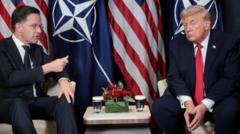
The pretense of a unified Western front shattered on Wednesday afternoon behind the heavy doors of the Oval Office. After two hours of what Secretary-General Mark Rutte described as "frank and open" dialogue, the verdict from the White House was far more caustic. Donald Trump did not merely criticize the alliance; he characterized it as a failed experiment that had withered under the pressure of the Iran conflict.
The primary tension centers on a reality the Pentagon has whispered about for years but Trump has turned into a public bludgeon. While the 32-member alliance operates on the principle of collective defense, the actual execution of the current U.S.-led campaign against Tehran has revealed deep structural fractures. Specifically, several European nations—including heavyweights like Germany and France—have restricted the use of their airspace for American sorties or declined to commit naval assets to the Strait of Hormuz. For a president who views international relations through a strictly transactional lens, this is more than a policy disagreement. It is a breach of contract.
The Delinquency Trap
The "frankness" Rutte alluded to is essentially diplomatic shorthand for a high-volume confrontation over the 2% defense spending benchmark. While the 2014 Wales Summit established this target, the progress toward it has been uneven and, in Trump's view, performative.
The math behind the friction is stark. By early 2026, despite a decade of warnings, several member states remain tethered to budgets that prioritize social domestic spending over the "hard power" requirements of modern warfare. This creates a reliance on American logistics, satellite intelligence, and heavy lift capabilities—a setup Trump has labeled as "free-riding."
The current administration isn't just looking for higher numbers on a spreadsheet. They are demanding a shift in how those euros and pounds are spent. The White House has expressed "disappointment" that European allies are not sufficiently helpful in Operation Epic Fury, the ongoing military effort against Iran. The argument from Washington is simple: if the U.S. provides the nuclear umbrella and the bulk of the conventional force, the allies must, at the very least, provide the gas stations and the flight paths. When they don't, the value proposition of the alliance evaporates.
The Greenland and Tariff Leverage
To understand why this meeting felt more like a deposition than a summit, one must look at the unconventional tools being used to squeeze Europe. The administration has successfully linked military cooperation to trade policy. In a move that blindsided Brussels earlier this year, the White House floated punitive tariffs on NATO allies participating in Arctic exercises, specifically targeting those who opposed American interests in Greenland.
This isn't just about territory; it is about dominance. By threatening 10% to 25% tariffs on nations like Denmark and Norway, the U.S. is signaling that security guarantees are no longer a sacred, separate pillar of foreign policy. They are now an extension of trade negotiations.
The backlash in Europe has been fierce but paralyzed. There is talk in the European Parliament of activating trade defense instruments or even reclaiming U.S. military bases on the continent. However, the reality of European defense remains grim. Without American intelligence and the massive forward-deployed infrastructure at Ramstein and elsewhere, the continent’s ability to project power or even defend its eastern flank against a resurgent Russia is questionable at best.
Rutte’s Impossible Balancing Act
Mark Rutte finds himself in a position that would have broken his predecessor, Jens Stoltenberg. He must placate a president who openly muses about withdrawing from the alliance while simultaneously managing a European base that is increasingly wary of American "adventurism" in the Middle East.
During his post-meeting interview with CNN, Rutte attempted to bridge this gap by claiming that a "large majority" of Europeans had been helpful. He pointed to logistics and basing as proof of commitment. But his admission that "some" allies had indeed failed the test was a significant concession. It validated Trump’s core grievance: that NATO is a tiered system where only a few are willing to bear the actual risks of combat.
The friction isn't just about Iran or Greenland. It is about a fundamental shift in the American psyche. For seventy years, the U.S. viewed NATO as an investment in global stability. The current White House views it as a drain on American resources for the benefit of competitors.
The Strategic Autonomy Mirage
For years, Paris has championed the idea of "strategic autonomy"—a Europe that can defend itself without calling Washington for help. The current crisis has proven that this remains a fantasy. European procurement is a mess of competing national interests, and the timeline for building a truly independent military capability is measured in decades, not election cycles.
The irony is that Trump’s hostility might be the only thing that actually forces Europe to modernize. The "urgency" Rutte spoke of is born of fear—fear that the American security blanket will be yanked away in the middle of a winter storm. We are seeing a shift where defense spending is no longer a suggestion; it is a survival requirement for maintaining the American relationship.
If the U.S. follows through on threats to withdraw or even "re-evaluate" Article 5 commitments based on participation in specific conflicts like the Iran war, the very foundation of the North Atlantic Treaty is void. A collective defense agreement that is "pick and choose" is not an alliance. It is a temp agency for soldiers.
The meeting on Wednesday didn't solve anything. It merely confirmed that the era of the "automatic" alliance is over. Every flight path, every naval deployment, and every percentage point of GDP is now a line item in a ledger that Washington is checking twice. The "frank" discussion was a warning that the bill is due, and the U.S. is no longer interested in extensions.