The air in Tehran does not carry the scent of gunpowder, but the weight of anticipation. It is a heavy, static thing. For decades, the men who move the pieces on the Middle Eastern chessboard have lived in the cracks between sunlight and shadow, operating under the assumption that if they cannot be seen, they cannot be touched.
That assumption just evaporated. Meanwhile, you can find other events here: The Cold Truth About Russias Crumbling Power Grid.
In the high-stakes theater of intelligence, names are often less important than the roles they inhabit. However, when Israel announced the elimination of Iran’s intelligence chief—a man whose career was spent weaving a web of influence across Lebanon, Syria, and Gaza—it wasn't just a tactical victory. It was a message written in fire. The message was simple: the wall of anonymity has crumbled.
The Hunter and the Ghost
Imagine a man who has spent thirty years perfecting the art of being a ghost. He doesn't take selfies. He doesn't have a LinkedIn profile. His signature is not on a document, but in the specific way a shipment of drones arrives in a desert outpost or the precise timing of a proxy strike in a distant capital. He is an architect of "strategic depth," the Iranian doctrine of fighting wars far from its own borders to ensure the streets of Tehran remain quiet. To see the full picture, we recommend the recent article by NPR.
Then, in a fraction of a second, the architecture collapses.
Precision strikes are often described in clinical, antiseptic terms by military spokespeople. They use words like "neutralized" or "degraded capability." But the reality is a violent collision of technology and intent. To reach a high-value target in the heart of a fortified intelligence apparatus requires more than just a fast jet or a sophisticated missile. It requires a betrayal. It requires the kind of deep-tissue penetration of an enemy’s inner circle that turns every trusted lieutenant into a potential witness for the prosecution.
The killing of a top intelligence official is a unique kind of decapitation. Unlike a frontline general, who can be replaced by the next officer in the chain of command, an intelligence chief is a repository of institutional memory. He holds the private phone numbers, the secret bank account codes, and the personal loyalties of a thousand different agents. When he dies, the map he was drawing goes dark.
The Shattered Mirror of Deterrence
For years, the conflict between Israel and Iran followed a predictable, if bloody, rhythm. It was a "war between the wars," fought in the margins. A cyberattack on a port here; a mysterious explosion at a research facility there. It was a dance of plausible deniability.
That dance has turned into a sprint toward the edge of a cliff.
By intensifying strikes on top leadership, Israel is betting on a psychological breakdown of the opposition. When the people responsible for security realize they themselves are not secure, the entire system begins to stutter. Imagine the atmosphere inside a high-level briefing room in Damascus or Beirut today. You look at the man sitting across from you. You wonder if his phone is a beacon. You wonder if the coordinates of this very room have already been uploaded to a satellite orbiting miles above your head.
Paranoia is a potent weapon. It slows down decision-making. It forces leaders to go into hiding, cutting them off from the very networks they need to command. Communication becomes a liability. Every radio transmission is a death warrant; every courier is a possible double agent.
The Human Cost of High-Altitude Chess
We often talk about these events as if they are movements of abstract entities—"Israel" strikes "Iran." But the reality is human and visceral.
Consider a hypothetical young officer in the Revolutionary Guard. He grew up hearing stories of the invincibility of his commanders. He saw them as masters of the shadows, men who could outmaneuver the West with a flick of the wrist. Now, he watches as those icons are picked off one by one, sometimes in the very heart of the cities they were supposed to control. The myth of invincibility is a fragile thing. Once it cracks, it cannot be glued back together.
On the other side, there is the Israeli intelligence analyst. This person has likely spent years staring at a grainy photograph of the target. They know the names of his children, the brand of cigarettes he smokes, and the way he tilts his head when he’s tired. There is a strange, dark intimacy in the hunter-prey relationship. When the strike is confirmed, there is no cheering in the hallways. There is only a grim, exhausted silence, because everyone in that room knows that the cycle is nowhere near its end.
The Invisible Stakes
Why does this matter to someone living thousands of miles away? Because the Middle East is not a vacuum. The death of an intelligence chief ripples outward through global oil markets, through diplomatic corridors in Washington and Beijing, and through the radicalization of a new generation.
We are witnessing the death of the "Proxy Buffer." For a long time, Iran felt insulated because it used groups like Hezbollah and Hamas to do the heavy lifting. By taking the fight directly to the Iranian leadership, Israel is removing the buffer. They are saying that the "Head of the Snake" strategy is no longer a metaphor; it is an operational reality.
This creates a terrifying volatility. When a cornered power feels its primary survival mechanism—anonymity—being stripped away, its response becomes harder to predict. Does it retreat and rebuild, or does it lash out with everything it has left?
The Weight of the Aftermath
The strikes have intensified because the window of opportunity is perceived to be closing. In the world of high-level geopolitics, there is a concept known as "the kinetic solution." It is the belief that some problems cannot be negotiated, only removed.
But history is a stubborn teacher. It tells us that for every leader killed, there is an ambitious subordinate waiting in the wings, often younger, more radical, and eager to prove his worth through escalation. The "top leaders" being targeted today were themselves the replacements for the men killed a decade ago.
The strategy of targeted killing is a gamble on the idea that talent is not infinite. It assumes that if you kill enough of the "Architects," eventually the building will stop rising. It is a war of attrition played out in the most elite circles of power.
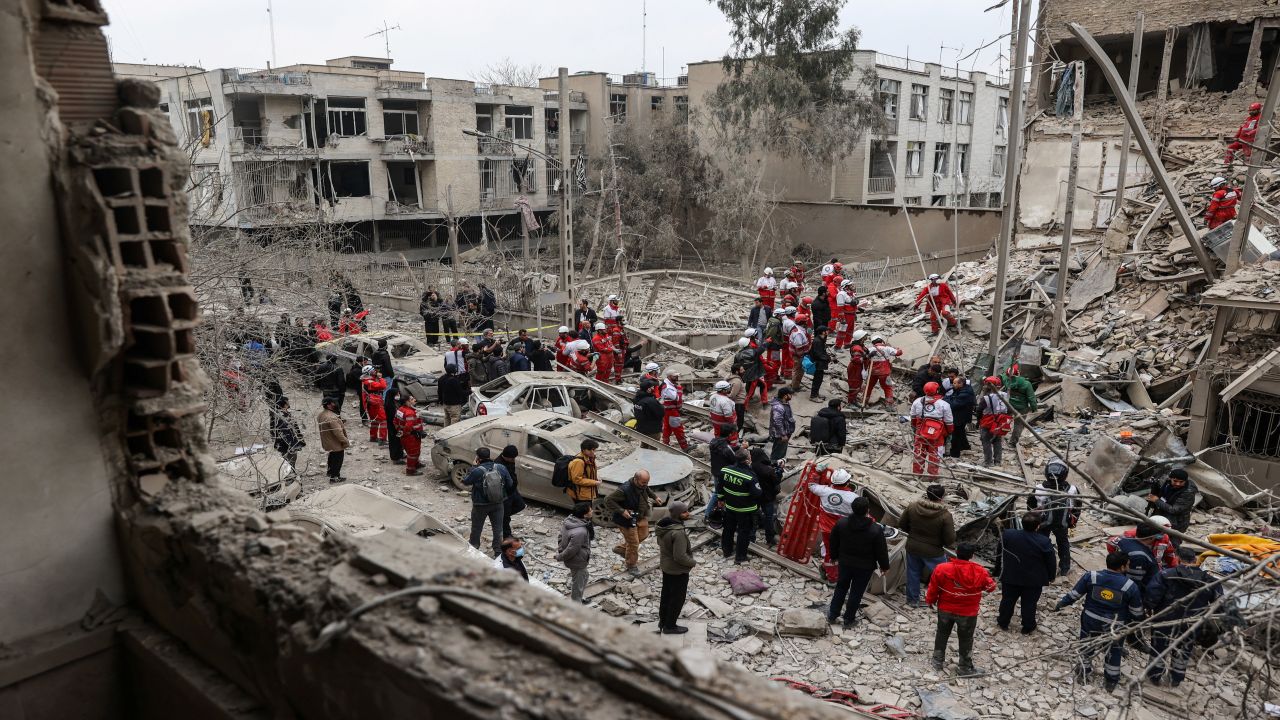
As the dust settles over the latest strike zone, the immediate impact is a scramble for cover. Secure lines are being ripped out. Safe houses are being abandoned. The shadow war is no longer a quiet affair of whispers and codes; it is a loud, screaming confrontation that refuses to stay in the dark.
The man who once controlled the invisible strings of a regional empire is gone. His files are likely being burned, his associates are fleeing, and the map he spent a lifetime drawing is being rewritten in real-time. But the shadows he inhabited are not empty. They are simply waiting for the next occupant to step into the light, unaware of the crosshairs already settling on his chest.
The silence that follows a localized explosion is never truly silent. It is filled with the sound of a thousand gears turning, as an entire region recalibrates its sense of what is possible, and what is permitted. The invisible architect is dead, but the house he built is still standing, and it is beginning to shake.