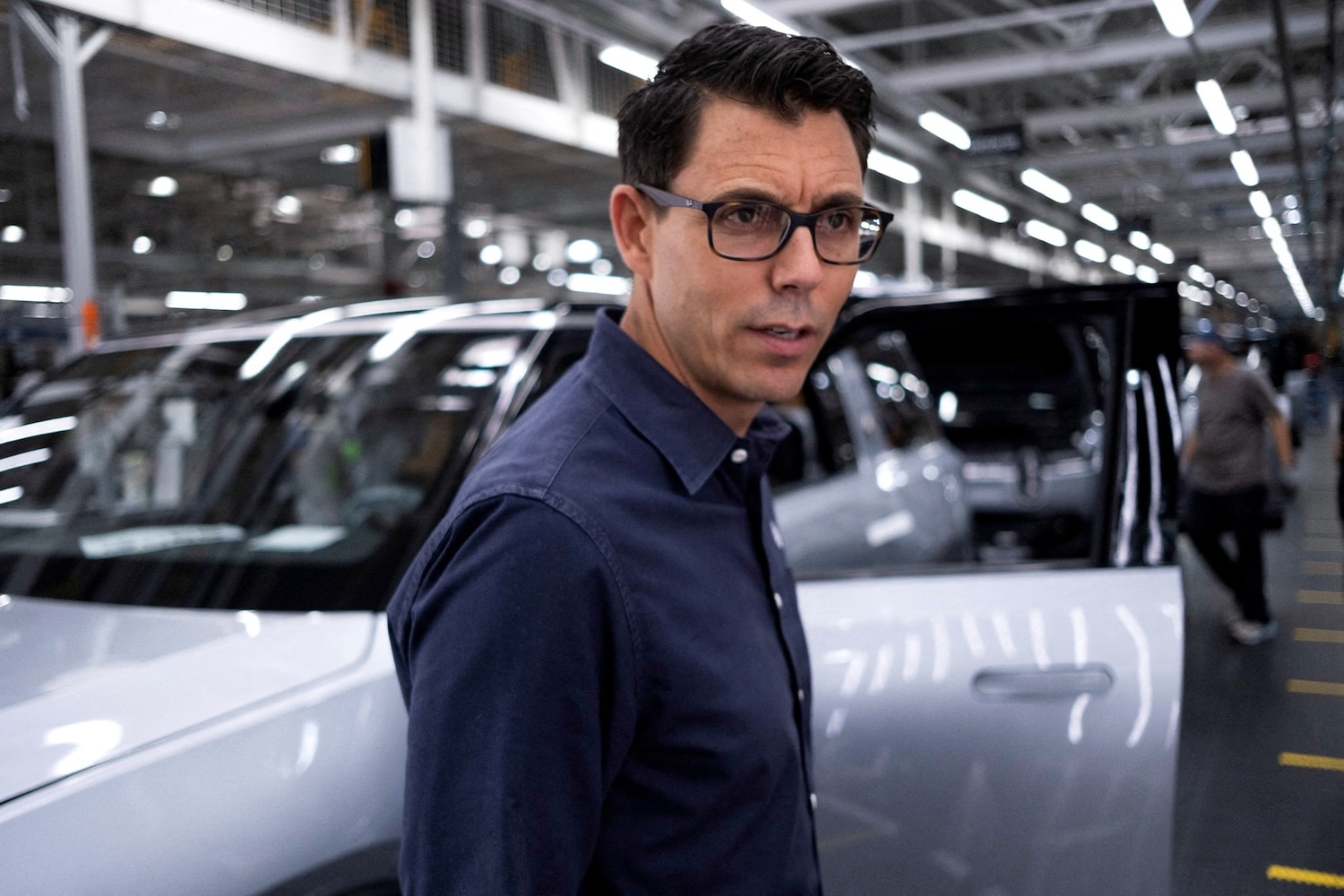
The glass walls of a corporate boardroom in Irvine, California, don't just keep the wind out. They hold in a specific kind of silence. It is the silence of a high-stakes poker game where the chips aren’t plastic, but the entire future of American transportation. In this room, a man named RJ Scaringe sits at the head of a table, and the number attached to his name has sent a tremor through the financial world.
$403.8 million.
To most people, that number is an abstraction. It is a flickering light on a screen, a row of zeros that the human brain isn't wired to truly comprehend. If you stacked four hundred million dollar bills, the tower would reach higher than thirty Burj Khalifas. But in the world of Rivian, the electric vehicle upstart, that number isn't about luxury. It is a lighthouse. Or perhaps, a dare.
While the titans of Detroit—Jim Farley at Ford and Mary Barra at GM—take home paychecks in the low tens of millions, Scaringe has been handed a package that makes their compensation look like a rounding error. To understand why, we have to stop looking at the spreadsheets and start looking at the psychology of the "Moonshot."
The Shadow of the Texas Giant
Every story about electric vehicles eventually has to reckon with the ghost in the room: Elon Musk. Years ago, Tesla pioneered a compensation model that seemed insane at the time. Musk wasn't paid a salary. He was given "milestone-based" stock options. If the company stayed mediocre, he got nothing. If the company changed the world and hit astronomical valuation targets, he became the richest man on Earth.
Rivian is now playing the same game, but the stakes have shifted.
When you look at the $403.8 million figure, it’s a mistake to think Scaringe walked to the bank and withdrew that cash yesterday. He didn't. Most of that value is locked inside restricted stock units (RSUs). These are essentially promises. They are the board of directors saying, "We believe you are the only person who can keep this ship from sinking in the storm, and we will make you a titan if you succeed."
But success in the EV world is currently a brutal, blood-soaked endeavor.
The Valley of Death and the P&L
Consider a hypothetical engineer named Sarah. She works on the assembly line in Normal, Illinois, where Rivian produces its R1T trucks. Sarah doesn't think in terms of $400 million. She thinks in terms of tolerances, battery chemistry, and whether the door handles will freeze in a Chicago winter.
For Sarah and thousands like her, the CEO’s massive pay package is a signal. In the brutal logic of Silicon Valley-style disruption, a massive CEO payout is often used as a "retention hook." The board is terrified that without Scaringe—the visionary founder with the Clark Kent glasses and the relentless focus—the company loses its identity.
But there is a friction here that can’t be ignored. Rivian is currently losing money on every vehicle it delivers. Imagine baking a cake that costs you fifty dollars in ingredients, but you sell it to your neighbor for forty. Now do that ten thousand times a month. That is the "Valley of Death" every EV startup must cross.
The contrast is jarring. How can a captain be rewarded with a king’s ransom while the ship is still taking on water?
The answer lies in the timeline. Ford and GM are legacy powers. They are the old guard, protecting a century of history. They pay their CEOs for stability and incremental growth. Rivian, however, is being valued as a tech company, not a car company. In the eyes of the investors, they aren't buying a truck; they are buying the software, the ecosystem, and the hope of a carbon-free future.
The Cost of Vision
We often talk about "market cap" as if it’s a law of physics. It’s not. It’s a measure of collective belief.
To maintain that belief, a company needs a figurehead who looks like the future. Scaringe’s compensation is a reflection of the "Musk-style" package because it is designed to align his personal wealth entirely with the stock price. If the stock craters, the $403 million evaporates into thin air. It becomes a ghost.
But if Rivian becomes the next Apple of the automotive world? That $403 million will seem like a bargain to the shareholders who saw their own portfolios grow by billions.
There is a human cost to this kind of pressure. To be the person worth $400 million on paper while the world watches your every stumble is a peculiar kind of psychological weight. It’s the weight of thousands of employees' mortgages and the environmental hopes of a generation.
Think about the sheer audacity required to walk into a room and agree to a deal where your value is tied to the impossible task of out-manufacturing the giants of industry. It requires a level of confidence that borders on the messianic.
The Great Divergence
The gap between the "Big Three" CEOs and Scaringe highlights a fundamental split in the American economy.
On one side, you have the earners. Mary Barra earned roughly $28 million last year. Jim Farley earned about $26 million. These are gargantuan sums, the kind of money that buys generational security. But they are still, fundamentally, salaries and bonuses for running an existing machine.
On the other side, you have the "Value Creators" (at least, that is how the venture capitalists describe them). Scaringe’s package isn't a salary; it’s a stake in the kingdom. It signals that Rivian doesn't want a manager. They want a founder who feels the sting of every lost cent and the rush of every gained dollar in his marrow.
This leads to a uncomfortable question: Is any single human being actually "worth" four hundred million dollars?
If you ask a line worker struggling with inflation, the answer is a resounding no. If you ask a hedge fund manager who needs Rivian to hit $100 a share to save their fund, the answer is "whatever it takes to keep him at the desk."
The Invisible Stakes
Behind the headlines about "outrageous pay," there is a quieter story about the fragility of the American dream’s newest iteration. We want the world to change. We want the air to be cleaner and our cars to be smarter. But we have built a system where that change is only possible through extreme concentrations of wealth and risk.
Scaringe is the face of that system. He is the personification of the bet we are all making—that a few brilliant individuals, backed by obscene amounts of capital, can innovate us out of the corners we’ve painted ourselves into.
The $403.8 million is not a reward for work already done. It is a tether. It is the golden chain that keeps a founder bound to his creation during the darkest hours of the manufacturing cycle.
As the sun sets over the California coast, far from the assembly lines of the Midwest, the numbers on the SEC filings remain. They don't tell you about the sleepless nights, the failed prototypes, or the terrifying complexity of building a global supply chain from scratch. They only tell you the price of the gamble.
We watch the stock tickers and the compensation tables because they are the only scorecard we have. But the real story isn't the money. The real story is the audacity of thinking you can reinvent the wheel, and the staggering price the world is willing to pay to see if you can actually do it.
The lights in the Irvine office stay on long after the pundits have finished their evening broadcasts. In the end, Scaringe isn't just building a truck. He is trying to prove that the "Moonshot" still works, even when the cost of the fuel is higher than anyone ever imagined.
Whether he is a visionary or a symptom of a broken financial era depends entirely on what happens when the rubber finally meets the road.
The ledger is open. The chips are in. All that's left is to see if the machine he built can actually carry the weight of its own price tag.