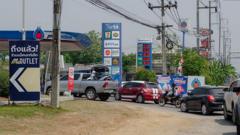
The pre-dawn air in Bangkok usually carries the scent of jasmine and charcoal-grilled pork, but lately, it smells like anxiety and exhaust. Somchai, a delivery driver whose livelihood depends on a beat-up Honda Wave, watches the digital numbers on the fuel dispenser climb with a mechanical indifference that feels like a personal affront. Every extra baht spent on 91-octane gasoline is a baht stolen from his daughter’s school lunch. He is not a macroeconomist. He does not track the Brent Crude index or fret over the geopolitical tensions in the Strait of Hormuz. But he is the living, breathing data point at the end of a global supply chain that is currently being squeezed until it screams.
Across Asia, this scene is repeating in a thousand different dialects. From the sprawling suburbs of Jakarta to the neon-soaked streets of Seoul, the rising cost of energy is no longer a headline in the financial section. It is a kitchen-table crisis.
When global oil prices surge—driven by a volatile cocktail of production cuts, distant wars, and a sudden thirst for fuel in a post-pandemic world—governments in the East face a choice that keeps prime ministers awake at night. They can let the market dictate the price, watching as inflation swallows the middle class whole, or they can step in. They can place a hand on the scale.
The Shield and the Sword
Governments in Thailand, Indonesia, and Vietnam are currently reaching for the shield. Price caps and subsidies are the primary tools of survival in this region. To an economist in a glass tower in London, these measures might look like market distortions or "inefficiencies." To a politician in Manila, they are the only thing preventing a riot.
Consider the mechanics of a fuel cap. It is a promise made by a state to its people: No matter how chaotic the world becomes, you will not pay more than this. It sounds like a lifeline. In many ways, it is. By freezing the price of diesel and petrol, governments provide a temporary oasis of stability. Logistics companies can predict their overhead. Farmers can afford to run their tractors. Somchai can keep his motorbike moving.
But this shield is heavy. It is made of tax dollars and sovereign debt. When the market price of oil hits $90 or $100 a barrel, but the government forces the local price to stay at the equivalent of $70, someone has to pay the difference. That "someone" is the national treasury. In Indonesia, the energy subsidy bill has historically been so massive that it threatens to crowd out spending on healthcare and education. It is a high-stakes shell game where the government borrows from the future to pay for the commute of today.
The Ghost of 1998
The hesitance to let prices float is not just about economics; it is about trauma. Throughout Southeast Asia, the memory of the 1997-1998 financial crisis lingers like a ghost. That era proved that when the cost of living spikes too fast, social contracts burn. Governments fall. Streets fill with protesters.
This historical weight explains why the Malaysian government maintains some of the lowest fuel prices in the region despite being a net importer of certain petroleum products. They understand that fuel is the "master commodity." It is the ingredient that lives inside every other product. If diesel gets expensive, the truck that carries the rice gets expensive, which means the bowl of rice at the street stall gets expensive.
Inflation is a contagion. Fuel is the vector.
By capping prices, these nations are attempting to quarantine the inflation. They are trying to stop the spark at the gas station from becoming a wildfire in the supermarket. However, the longer the cap stays in place, the more "artificial" the economy becomes. Businesses stop innovating because they are insulated from reality. Smugglers begin to thrive, buying cheap, subsidized fuel in one country and trucking it across the border to sell at a profit in a country where the market is free.
The invisible hand of the market doesn't just disappear when you slap a cap on it; it just starts working in the shadows.
The Zero Sum Game of the Pump
There is a cold, mathematical truth at the heart of every price ceiling. Money is finite.
If a government spends $10 billion to keep gasoline cheap, that is $10 billion that cannot be spent on upgrading a power grid or building a high-speed rail line. It is a trade-off between the immediate relief of the citizen and the long-term health of the nation.
We often talk about "energy independence" as if it is a destination we can reach with enough solar panels or wind turbines. But for the developing economies of Asia, the transition is a bridge that must be crossed while the old world is still on fire. They need cheap oil to build the very wealth required to eventually move away from oil. It is a paradox. If they let prices rise now, the economy may stall, and the green transition will lose its funding. If they keep prices low, they remain shackled to the volatility of fossil fuels forever.
The tension is visible in the eyes of the shopkeepers in Hanoi. They watch the news, waiting for the government announcement that the "stabilization fund"—a pot of money used to smooth out price spikes—has run dry. When that fund hits zero, the cap must lift. And when the cap lifts, the jump isn't a gentle slope. It’s a cliff.
A Narrative of Survival
The story of fuel caps in Asia is ultimately a story of the "squeezed middle."
The very wealthy do not care if a liter of petrol goes up by twenty cents. The very poor often don't own vehicles, though they feel the secondary ripples in food prices. It is the person with a small van, the woman running a mobile canteen, and the family that finally saved enough for a second-hand car who are caught in the crossfire. For them, the government's intervention is the difference between solvency and debt.
But we must ask: how long can the shield hold?
Oil is a global tide. You can build a wall against it, but if the tide stays high for years, the wall eventually cracks. We are seeing those cracks now. Some nations are beginning to pivot toward "targeted subsidies," using digital ID systems and banking data to ensure that only the Somchais of the world get the discount, while the luxury SUV owners pay the market rate. It is a more surgical approach, but it is fraught with bureaucratic nightmares and the potential for corruption.
The era of cheap energy provided by a benevolent state is flickering. The transition to a new reality—one where the true cost of carbon is reflected in the price—is necessary, but it is also brutal.
Somchai clicks his kickstand into place and pulls out into the snarling traffic of the Rama IV road. He is moving, for now. The price on the sign behind him stayed the same as it was yesterday, thanks to a desperate decree from a boardroom miles away. He breathes a small sigh of relief, unaware that he is riding on a bubble of debt, fueled by a government's hope that tomorrow, the world might finally be a little less expensive.
The sun sets over the refinery towers on the horizon, their flames licking the darkening sky. They are the eternal torches of an old world, burning through the wealth of nations to keep the wheels of the city turning for one more day.