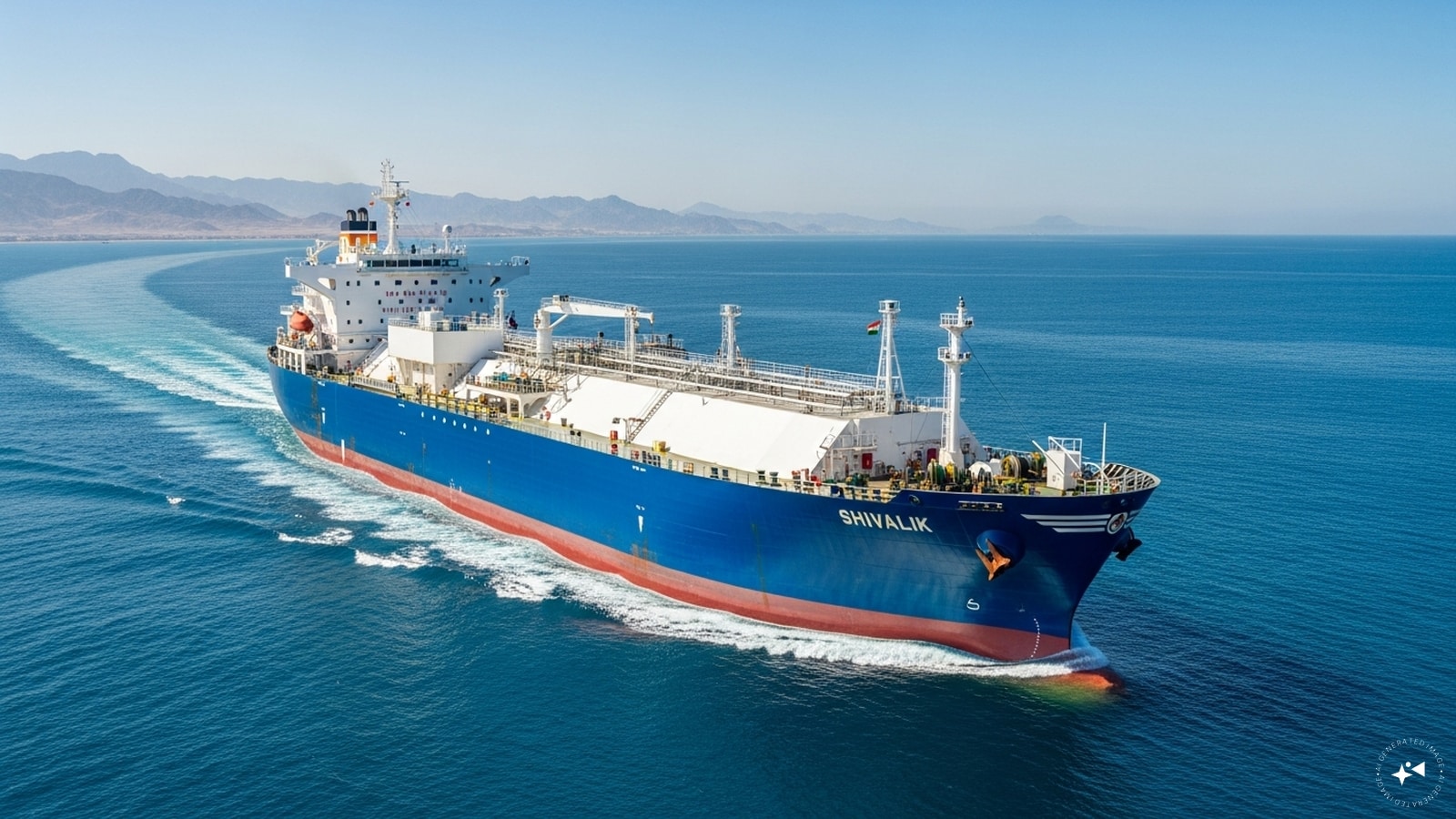
The Strait of Hormuz is the world's most sensitive windpipe, and it is currently tightening. When T.K. Ramachandran, the Secretary of India’s Ministry of Ports, Shipping, and Waterways, confirmed the successful transit of two Indian-flagged Very Large Gas Carriers (VLGCs) through this corridor, he wasn't just providing a logistical update. He was announcing a survival strategy. These vessels, carrying a combined 92,700 metric tonnes of Liquefied Petroleum Gas (LPG), moved through a chokepoint where a single miscalculation can send global energy prices into a vertical climb. This transit signifies a shift in how New Delhi manages its energy security in a region defined by asymmetric warfare and unpredictable maritime seizures.
India depends on the Middle East for roughly 60% of its LPG imports. This is not a luxury; it is a domestic necessity that fuels millions of households. If the flow of these carriers stops, the political and social fallout in India would be immediate. By utilizing Indian-flagged vessels rather than relying on foreign charters, the government is exercising a level of sovereign control that transcends mere shipping logistics. It is an assertion of presence in a waterway that sees 20% of the world’s liquid petroleum consumption pass through its narrowest point of only 21 nautical miles.
The Calculus of Risk in the Chokepoint
Shipping 92,700 tonnes of highly flammable gas through a zone patrolled by the Iranian Revolutionary Guard and shadowed by Western naval task forces is a high-stakes gamble. The primary concern for a VLGC isn't just a kinetic strike. It is the sophisticated "gray zone" tactics that have become the norm in the Persian Gulf. This includes GPS jamming, spoofing of Automatic Identification Systems (AIS), and the ever-present threat of limpet mines.
When an Indian vessel enters these waters, it operates under the protection of "Operation Sankalp." This is the Indian Navy's persistent maritime security operation, launched in 2019 following attacks on tankers in the Gulf of Oman. Unlike many nations that simply provide advisory notices to their merchant fleets, India has positioned destroyers and frigates at the mouth of the Strait. This physical presence provides a "comfort zone" for Indian captains. They know that if their bridge is boarded or their engines are sabotaged, a domestic warship is within striking distance.
The logistics of these two specific carriers—likely the Pratap Gad or similar high-capacity vessels—reflect a broader trend of "flagging in." For years, Indian shipping companies preferred foreign flags (Flags of Convenience) to avoid the bureaucratic friction of the Indian registry. However, the current geopolitical climate has inverted that logic. A foreign-flagged vessel is a pawn in someone else's game. An Indian-flagged vessel is an extension of Indian territory, carrying the full weight of the nation's diplomatic and military apparatus.
Why LPG is the New Maritime Priority
Most geopolitical analysis focuses on crude oil, but LPG is the silent driver of Indian energy policy. The government’s social welfare schemes have connected over 100 million poor households to clean cooking fuel. This makes LPG supply chains a matter of national stability. If a VLGC is seized or delayed in the Strait, the price of a cylinder in a rural village in Uttar Pradesh spikes.
The 92,700 MT shipment is roughly equivalent to the monthly consumption of several small Indian states. To move this volume through Hormuz, the Ministry of Shipping had to coordinate a three-way handshake between the oil marketing companies (OMCs), the shipping lines, and the Navy. This coordination is often invisible to the public, but it represents a massive bureaucratic evolution. The "silo" mentality that once plagued Indian infrastructure is being dismantled by the sheer necessity of avoiding an energy crisis.
The Mechanics of Shadow Transit
Navigating the Strait isn't just about steering a ship. It is about data management. Modern VLGCs are massive targets. They are slow, they have a large radar cross-section, and their cargo is volatile.
- AIS Manipulation: Vessels often turn off their transponders or broadcast false destinations to evade tracking by hostile actors.
- Naval Escorts: The Indian Navy provides "over-the-horizon" protection, where the warship stays out of visual range but maintains a constant radar lock on the merchant vessel.
- Communication Silences: Strict protocols are enforced to ensure that no radio chatter can be used to triangulate the ship’s precise position during the four-hour window of the most dangerous part of the transit.
The Cost of Sovereignty
There is a financial price to this defiance. Insurance premiums for vessels entering the Persian Gulf are not static. They are "war risk" premiums that can fluctuate by the hour. By using Indian-flagged vessels, the government can theoretically underwrite some of these risks through national insurance schemes, reducing the reliance on the London-based P&I (Protection and Indemnity) clubs that dominate the global market.
This move toward self-reliance is a direct response to how Western sanctions on Russia and Iran have weaponized the global shipping and insurance industry. India has watched as fleets were grounded because they lacked Western insurance. By building a robust domestic fleet and a secure transit protocol through Hormuz, India is insulating itself from the whims of foreign policy decisions made in Washington or Brussels.
The 92,700 MT of gas now sitting in Indian ports is a testament to this tactical pivot. It isn't just fuel; it is a data point proving that New Delhi can move its own resources through the most dangerous water on earth without asking for permission.
The Logistics of Vulnerability
The Strait of Hormuz is essentially a two-lane highway. The shipping lanes—one for inbound and one for outbound traffic—are only two miles wide. They are separated by a two-mile wide buffer zone. To the north is the Iranian coast; to the south are the jagged mountains of the Musandam Peninsula, an Omani enclave. There is no room for error.
If a vessel loses power in these lanes, it drifts into Iranian waters within minutes. This happened to the Stena Impero and the Advantage Sweet. The successful transit of the Indian vessels suggests a high level of technical maintenance and "engine room diplomacy." Indian crews are now trained specifically for "high-threat transit" scenarios, which include everything from handling drone swarms to responding to fast-attack craft that harass merchant ships to test their resolve.
Diversification is the Only Real Defense
While these transits are successful, the Indian Ministry of Shipping is aware that the Strait of Hormuz is a single point of failure. There is a frantic push to diversify. This includes looking at long-term contracts with the United States for LNG and exploring the Northern Sea Route through the Arctic in partnership with Russia. But for LPG, the Middle East remains the most economical and logical source.
The strategy is clear: hold the line in the Middle East with military-backed shipping while building out alternatives. The "Two Carrier" announcement is a signal to the markets that the supply chain is resilient. It is a signal to Tehran that India will protect its commercial interests. And it is a signal to the Indian public that the lights—and the stoves—will stay on.
The next time a VLGC enters the Strait, it won't just be carrying gas. It will be carrying the burden of an emerging superpower that has decided it can no longer afford to be a spectator in its own backyard. The maritime world is watching to see if this "Indian Model" of protected commerce becomes the standard for other nations tired of being caught in the crossfire of regional hegemons.
Audit your own energy footprint and consider the path that fuel took to reach you. Every litre of gas represents a victory in a quiet, high-stakes war of logistics.