A barista in Perth pulls a shot of espresso. A farmer in Dubbo checks the fuel gauge on a tractor that smells of red dust and diesel. A nurse in Melbourne starts a car at 5:00 AM, the headlights cutting through a damp fog. None of them are thinking about the jagged, sun-bleached rocks of the Musandam Peninsula or the dark, crowded waters of the Strait of Hormuz. Why would they? The Middle East is a world away, a flicker of static on a news feed, a chaotic geography of ancient grudges and modern drones.
But the world has shrunk. The vast, blue insulation of the Indian Ocean—the distance we once relied upon as a physical shield—has become an illusion. For another look, check out: this related article.
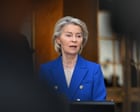
When Ursula von der Leyen, the President of the European Commission, stands before a microphone to speak about the escalating friction between Washington and Tehran, she isn't just delivering a diplomatic script. She is describing a nervous system. If the Strait of Hormuz is the carotid artery of the global energy trade, then Australia is the limb that goes numb the moment that artery is pinched.
The Choke Point
The Strait is barely thirty-three miles wide at its narrowest point. Imagine a shipping lane so congested and vital that a single miscalculation, a stray mine, or a seized tanker sends a literal shockwave through every stock exchange on the planet. This is not a hypothetical fear. It is the reality of a globalized economy that operates on "just-in-time" delivery. Related insight on this trend has been published by NPR.
Iran knows this. The United States knows this. And now, the European Union is making sure Canberra knows it too.
Von der Leyen’s message is stripped of the usual bureaucratic fluff. She is warning that the luxury of being a "lucky country" tucked away in the Southern Hemisphere no longer buys immunity from Northern Hemisphere volatility. We are tethered to the stability of those waters by every liter of refined fuel that arrives at our ports.
A Tale of Two Captains
Consider two hypothetical figures to understand the stakes.
First, meet Captain Arash. He is forty-two, loves Persian poetry, and commands a small patrol boat in the Islamic Revolutionary Guard Corps. He operates in the shadow of sanctions that have throttled his country’s economy for decades. To him, the Strait is a leverage point. It is the only place where he feels powerful against a superpower. When he receives orders to harass a tanker, he doesn't see a global energy crisis; he sees a way to force the West to the negotiating table.
Now, meet Sarah. She manages a logistics firm in Sydney. Her margins are razor-thin. She has fifty drivers relying on her to keep the trucks moving so they can pay their mortgages. If the price of diesel jumps twenty percent overnight because a skirmish broke out 12,000 kilometers away, Sarah doesn't just lose profit. She loses her business. Her drivers lose their livelihoods. The supermarket shelves they restock start to empty.
The distance between Arash’s patrol boat and Sarah’s office is measured in more than miles. It is measured in vulnerability.
The Myth of Isolation
For over a century, Australia’s primary defense strategy was based on "the tyranny of distance." We were too far away to be easily reached, too isolated to be caught in the crossfire of European or Middle Eastern collapses. That era ended the moment we plugged our local economy into a global supply chain that lacks a "delete" button for geopolitical risk.
Von der Leyen is essentially pointing out that the fire in the neighbor's house is already licking at our curtains. She is urging the U.S. and Iran to find a de-escalation path, not out of a sense of altruism, but out of a desperate need for systemic preservation.
When tensions flare—when tankers are shadowed by "limpet mines" or drones are downed over international waters—the cost of insurance for every ship on the ocean climbs. Those costs aren't swallowed by shipping giants. They are passed down. They end up on the price tag of the milk in your fridge and the delivery fee for your new laptop.
The Diplomatic Tightrope
The European perspective is one of exhausted pragmatism. They have watched the U.S. pull out of nuclear agreements and Iran respond with "maximum pressure" of its own. They see a cycle of provocation that has no clear exit ramp.
By addressing Australia, Von der Leyen is acknowledging our growing role as a middle power. We are no longer just a quiet observer in the corner of the map. We are a stakeholder. She is asking for a collective voice to pull the two antagonists back from the ledge.
But why is the U.S. so dug in? From Washington’s perspective, allowing Iran to dictate the terms of passage through the Strait is a surrender of the "freedom of navigation" principle that has underpinned global trade since 1945. If the U.S. flinches there, what happens in the South China Sea? What happens in the Black Sea?
It is a game of dominoes where the first piece is made of oil and the last piece is the stability of our own suburban streets.
The Energy Paradox
There is a bitter irony here. Australia is an energy superpower. We export massive amounts of coal and liquefied natural gas. We have enough sun and wind to power a dozen civilizations. Yet, we remain precariously dependent on imported refined fuel. Our refineries have dwindled, leaving us with a national fuel reserve that is often measured in weeks, not months.
This is the "invisible stake" Von der Leyen is highlighting.
If the Strait of Hormuz closes, even for a few days, the global scramble for remaining supplies would be feral. Australia would find itself at the end of a very long, very expensive line. The "protection" we think we have from our geography would vanish instantly. We would realize, perhaps too late, that our sovereignty is only as strong as the security of a narrow strip of water on the other side of the globe.
The Human Cost of Kinetic Action
We often speak of "geopolitics" as if it’s a game played on a board. It isn't. It’s a human drama.
If diplomacy fails and the situation turns "kinetic"—the military euphemism for killing people and breaking things—the fallout won't just be economic. It will be an environmental and humanitarian catastrophe. A sunken supertanker in the Strait would ruin the desalination plants that provide water to millions in the Gulf. It would destroy ecosystems. It would trigger a refugee crisis that would make previous decades look like a rehearsal.
And Australia, as a treaty ally of the United States and a partner to Europe, would be faced with an impossible choice. Do we send our sailors and our airmen into that furnace? Do we commit our blood to a conflict that started because two regimes couldn't find a way to talk?
Von der Leyen’s warning is a plea for sanity. She is saying that the cost of a "win" in the Strait of Hormuz is higher than anyone can afford to pay.
The Fragile Silence
We live in the quiet gaps between crises. We enjoy the hum of the refrigerator and the steady flow of traffic, forgetting that this rhythm is maintained by a delicate, invisible architecture of treaties and restraint.
The Strait of Hormuz is a place of high heat and higher tension. It is a place where young men with fingers on triggers look at each other through binoculars, waiting for a reason to be the first to fire.
The distance between their trigger fingers and your morning commute is zero.
We are all standing on that sun-bleached rock in the Strait. We are all on that patrol boat. We are all in Sarah’s logistics office. The world is a single room, and the air is getting thin.
A tanker crests the horizon in the Gulf, its hull low in the water, carrying the lifeblood of a dozen distant cities. On the shore, a radar dish rotates with a steady, mechanical click. Somewhere in Canberra, a phone rings in a darkened office. The silence of the Indian Ocean has never been louder.