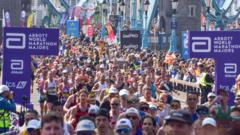
The London Marathon is currently navigating a capacity ceiling that threatens its long-term revenue growth and global standing. With over 840,000 applicants for the 2025 event and only roughly 53,000 starting spots, the event faces an allocation crisis where demand outstrips supply by a factor of 15. Transitioning to a two-day format in 2027 is not merely a scheduling change; it is a fundamental shift in the operational physics of mass-participation endurance events. This expansion seeks to decouple participation volume from the physical constraints of a 26.2-mile linear corridor, yet it introduces a new set of variables regarding urban stasis, volunteer exhaustion, and brand dilution.
The Three Pillars of Capacity Expansion
Expanding a Major World Marathon requires solving for three distinct but interlocking variables: the Course Throughput, the Urban Impact Radius, and the Stakeholder Fatigue Index. If you enjoyed this article, you should check out: this related article.
Course Throughput and the Density Limit
The primary bottleneck for any marathon is the "flow rate" of runners across the start line and through the first six miles. In a single-day event, the start windows are compressed to ensure the final participants finish before sunset and before the city’s arterial roads must reopen. By splitting the event over Saturday and Sunday, the organizers effectively double the temporal window.
This creates a structural advantage in "Wave Management." Instead of launching 50,000+ runners in a four-hour window, the organizers can optimize for a lower runner density per square meter. Lower density reduces the "accordion effect" at water stations and narrow turns, directly improving the participant's "Personal Best" (PB) potential—a key metric for retaining elite and sub-elite demographics. For another look on this development, check out the latest coverage from NBC Sports.
The Urban Impact Radius
London’s geography presents a unique challenge compared to the Chicago or New York City marathons. The course bisects critical transit hubs and residential zones in South East and Central London. A two-day event doubles the duration of road closures, creating a "Static Friction" problem for local boroughs.
- Logistics Dead zones: Areas like Greenwich and Bermondsey face total vehicular lockout. Extending this to 48 hours risks localized economic pushback from small businesses that rely on weekend deliveries and foot traffic.
- The Blue Light Constraint: Emergency service response times are the non-negotiable floor for city approval. A two-day format requires a shift from a "Temporary Disruption" model to a "Semi-Permanent Corridor" model, necessitating redundant emergency routes that do not exist in the current one-day blueprint.
Stakeholder Fatigue Index
The London Marathon relies on a "Gig Economy" of altruism. Roughly 6,000 volunteers manage the course, hydration, and medical needs. Transitioning to a two-day event does not simply require 6,000 volunteers; it likely requires 10,000 to 12,000 unique individuals to avoid "burnout churn."
Medical staffing is the most critical vulnerability. St John Ambulance and British Red Cross resources are finite. If the event moves to a two-day format, it competes with itself for specialized medical personnel who may not be able to commit to a 36-hour operational cycle.
The Cost Function of Dual Day Execution
The financial logic of expansion is driven by the marginal utility of each additional runner. While the fixed costs of the event (marketing, elite athlete appearance fees, TV production) are already sunk into the weekend, the variable costs scale linearly.
Incremental Revenue vs. Operational Overhang
Every additional bib sold generates revenue through three channels: entry fees, charity bond sales, and the "Expo" ecosystem.
- Charity Bond Economics: The London Marathon is the world's largest annual one-day fundraising event. By doubling the field, the organizers can double the "Golden Bond" slots sold to charities. These bonds are sold at a premium (often exceeding £500 per slot), providing a massive upfront capital injection.
- The Marginal Cost of Security: The single largest cost spike in a two-day transition is policing and private security. Under a one-day model, barriers and infrastructure are deployed and recovered in a 24-hour cycle. A two-day model requires "Overnight Asset Protection." Security teams must be paid to guard miles of fencing, timing mats, and corporate hospitality structures through Saturday night, a cost that provides zero ROI in terms of runner experience.
Strategic Segmentation The Saturday vs Sunday Dilemma
The most complex decision involves how to divide the field. The method of segmentation will define the event's prestige and marketability.
The Demographic Split
One proposed model is to move the "Mass Participation" or "Charity" runners to Saturday, while reserving Sunday for the "Championship" and "Elite" fields. This creates a tiered experience. However, this risks creating a "B-League" perception for Saturday participants. If the "prestige" of the London Marathon is tied to running on the same day as world record holders, Saturday runners may feel their experience is sanitized.
The Ballot Logic
Alternatively, the organizers could use a blind split based on ballot results. This maintains the "One Race" brand but complicates the logistics for international travelers and running clubs who wish to compete together. From a data perspective, a blind split is the most efficient way to manage course density, but it is the most difficult to market to a community that values collective experience.
The Competitive Landscape of the World Marathon Majors
The London Marathon does not operate in a vacuum. It competes with Tokyo, Boston, Berlin, Chicago, and New York City for the "Six Star" finisher market.
Berlin is known for speed. New York is known for the urban spectacle. London is known for the "Ballot Rarity." By doubling the capacity, London risks devaluing the "scarcity" component of its brand. When the probability of entry increases, the perceived "exclusive" nature of the finisher's medal may decrease.
However, the "Six Star" medal system (awarded to those who complete all six majors) acts as a powerful hedge against brand dilution. As long as London remains a requirement for the Six Star, demand will likely remain inelastic regardless of the field size.
The Risk of Environmental and Infrastructure Saturation
A two-day event doubles the carbon footprint of the event's physical presence. While the organizers have made strides in compostable cups and electric lead vehicles, the sheer volume of waste generated over 48 hours in a concentrated urban environment is a significant PR risk.
Furthermore, the "Tube" (London Underground) operates on a reduced schedule on Sundays. Moving half the event to Saturday—a high-traffic shopping and tourism day—puts the transport network under unprecedented strain. The "Central Line" and "Jubilee Line" bottlenecks near the finish in St. James's Park could become safety hazards if the exit flow of 30,000 finishers clashes with normal Saturday tourist traffic.
Determining the Breaking Point
To succeed, the organizers must move beyond "Management by Tradition" and adopt a "Stochastic Modeling" approach to urban flow.
- Dynamic Wave Starts: Implementation of a 10-hour start window on both days to flatten the peak density curve.
- Zonal Road Reopening: A rolling reopening strategy that uses real-time GPS data from sweep vehicles to return road access to boroughs the moment the final runner clears a sector.
- The Volunteer Dividend: Creating a tiered reward system for volunteers who commit to both days, potentially including "guaranteed entry" for future years to stabilize the labor supply.
The 2027 decision will serve as a bellwether for the future of all global mass-participation events. If London can solve the "Two-Day Friction," it sets a precedent for New York and Chicago to break through their own capacity ceilings. If it fails due to logistical overreach or community pushback, it will mark the definitive end of the "Growth Era" for urban marathons, forcing them to pivot toward higher entry fees and even tighter exclusivity.
The strategic play for 2027 is clear: focus on "Micro-Logistics" at the borough level. Organizers must secure "Borough-Specific Treaties" that offer direct reinvestment of marathon profits into local infrastructure in exchange for the extended 48-hour disruption. Without local buy-in, the two-day marathon will remain a theoretical exercise in revenue maximization that is practically impossible to execute.