The Pacific Ocean is a big, lonely place to wait for a miracle. Out there, a thousand miles from the nearest neon sign or paved road, the water doesn't look blue. It looks like obsidian. It moves with a heavy, rhythmic weight that makes a massive recovery ship feel like a toy in a bathtub. On the deck of that ship, men and women squint into the horizon, their ears tuned to the crackle of a radio frequency that has been silent for a very long time.
They are waiting for four human beings to fall out of the sky.
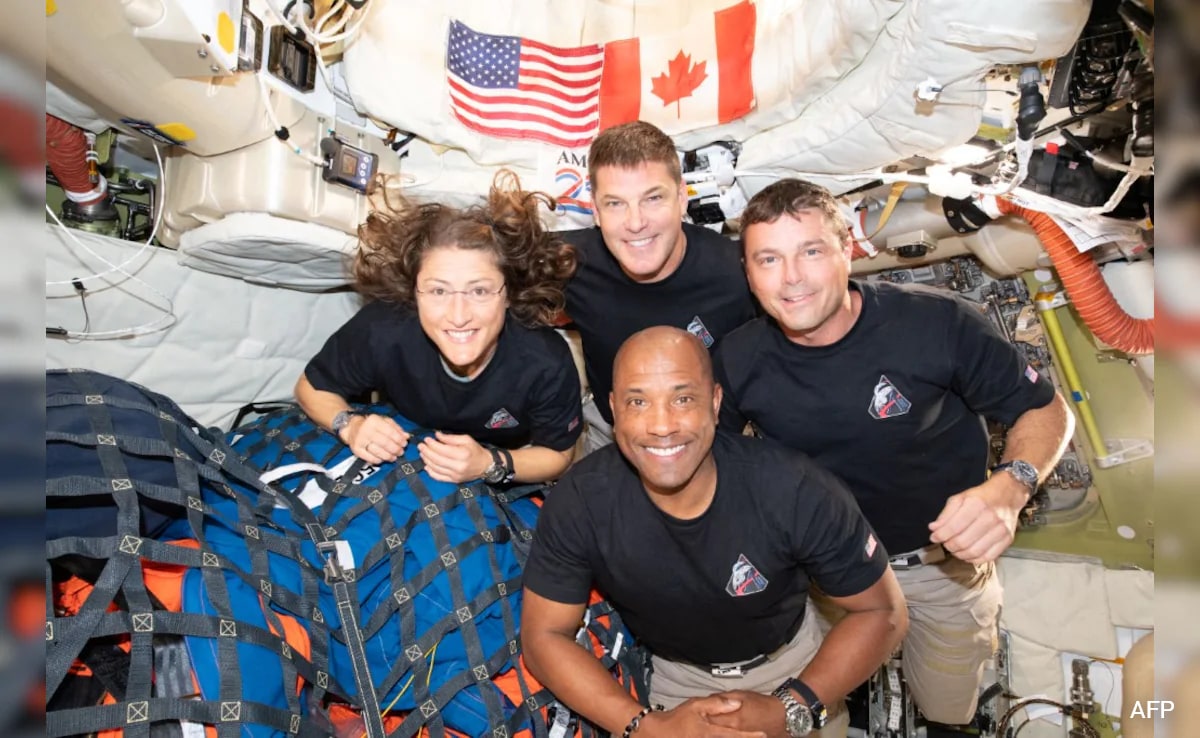
We talk about space in terms of math and thrust. We talk about the Artemis II mission as a series of technical milestones: the first crewed flight of the Space Launch System (SLS), the 10-day high-earth orbit trajectory, the lunar flyby that will take Reid Wiseman, Victor Glover, Christina Koch, and Jeremy Hansen farther from home than any human has ever traveled. We measure the success in kilometers and liquid oxygen consumption. But those are just the numbers. The reality is four people sitting in a pressurized can the size of a small kitchen, hurtling through a vacuum at speeds that defy the human imagination.
And then comes the return. The "grand finale" isn't a celebratory parade. It is a violent, searing, high-stakes gamble against the physics of friction.
The Fire in the Sky
Think about the last time you drove 60 miles per hour. Now, imagine traveling 400 times that fast.
As the Orion spacecraft hits the Earth's atmosphere, it isn't just "landing." It is slamming into a wall of air at 25,000 miles per hour. At those speeds, the air doesn't just move out of the way; it compresses so violently that it turns into plasma. Outside the tiny windows, the world turns a hellish, blinding orange. The heat shield, a complex honeycomb of chemical resin, reaches temperatures of 5,000 degrees Fahrenheit.
Inside, the crew feels the weight of the world. Gravity returns not as a gentle embrace, but as a crushing force. They go from the weightlessness of the lunar void to feeling six or seven times their own body weight pressing them into their seats. It is hard to breathe. It is impossible to speak. They are encased in a man-made meteor, praying that the chemistry of the shield holds and that the math of the engineers was right.
This isn't just a technical achievement. It is a homecoming for a species that has been away from the deep well of space for over fifty years. We have spent decades circling the Earth in the "shallows" of the International Space Station. Artemis II is the moment we step back into the ocean.
The Ghost of Apollo
There is a weight to this splashdown that has nothing to do with gravity. It is the weight of history.
When the last Apollo mission bobbed in the water in 1972, the world was a different place. Computers were the size of refrigerators. The Cold War was the primary engine of discovery. When those capsules hit the water, it felt like the beginning of an endless expansion. Instead, it was the end of a chapter. We stayed home. We watched the moon from afar, a dusty relic of a bolder era.
The engineers working on the recovery teams today—the divers, the crane operators, the navy specialists—many of them weren't even born when Gene Cernan left the last footprint on the lunar surface. For them, this isn't just about retrieving a capsule. It is about proving we can still do the hard things.
Consider the hypothetical perspective of a recovery diver waiting in a rigid-hull inflatable boat. He’s been training for months in the wave tanks, practicing how to approach a scorching hot vessel in high seas. He knows that if the parachutes don’t deploy in the correct sequence, he’s not looking for a capsule; he’s looking for a memory. He knows that if the "Uprighting System"—the series of balloons designed to flip the capsule if it lands nose-down—fails, the crew is trapped upside down in a swaying, nauseating dark.
The stakes are invisible until they are everything.
The Precision of a Falling Leaf
The descent is a choreographed dance of nylon and steel. At about 25,000 feet, the parachutes begin their work. First, the two drogue chutes fire to stabilize the tumble. Then, the three massive main parachutes unfurl like giant, red-and-white flowers blooming against the blue.
This is the moment when the people on the ship finally see them. It starts as a dot. Then a shape. Then a roar. The capsule hits the Pacific at about 20 miles per hour. It sounds like a car crash, but to the recovery team, it’s the sweetest sound in the world. It’s the sound of four heartbeats returning to the cradle.
But the work isn't over when the splash happens. The Pacific is a volatile partner. If the seas are too high, the recovery ship, the USS San Diego or its equivalent, has to maneuver with surgical precision. They don't just "pick up" the capsule. They have to winch it into the "well deck"—a flooded compartment in the back of the ship that allows the capsule to be floated inside before the water is pumped out.
It is a slow, methodical process. For the astronauts inside, these final hours are perhaps the most grueling. They are back in 1G. Their inner ears are screaming. The smell of burnt resin and recycled air fills the cabin. They are bobbing on the ocean waves, likely seasick, waiting for the door to open. They have seen the back side of the moon, a place of eternal silence and ancient craters, and now they are listening to the slap of salt water against aluminum.
Why We Go Back to the Water
There are critics who ask why we are doing this at all. They point to the cost, the risk, and the fact that we have enough problems on the ground. They see a splashdown as an expensive relic of the past.
But they miss the human core of the endeavor.
We aren't just sending "representatives" to the moon. We are extending the reach of human consciousness. When Christina Koch looks out that window at the receding lunar horizon, she isn't just a pilot; she is our eyes. When Victor Glover manages the systems that keep them alive, he is our hands.
The Pacific splashdown is the bridge between the impossible and the tangible. It turns a "mission" back into "people." When the hatch finally opens and the fresh, salty air of Earth rushes in, it marks the end of a 600,000-mile journey. It is the moment the abstract becomes real.
We need these moments of collective breath-holding. In a world fragmented by small disagreements, the sight of a charred capsule bobbing in the vastness of the ocean reminds us that we are a single, fragile species capable of monumental things. We are capable of leaving our home, circling a dead rock in the dark, and finding our way back to a specific coordinate in a massive ocean.
The recovery ship will eventually turn back toward the coast. The astronauts will be whisked away for medical checks and debriefings. The Orion capsule will be scrubbed and studied, every singe mark on its heat shield analyzed for data.
But for a few minutes out there in the middle of the Pacific, it is just about the silence before the cheers. It is about the orange glow of the parachutes against the sun. It is about the relief of knowing that the four people who left the planet are finally, truly, home.
The moon is a cold, magnificent neighbor, but it has no air to breathe and no water to hold us. We go there to see it, but we come back because the obsidian Pacific, with all its salt and its storms, is where we belong.
The mission doesn't end on the moon. It ends with a splash. It ends with a heavy door swinging open to the smell of the sea.