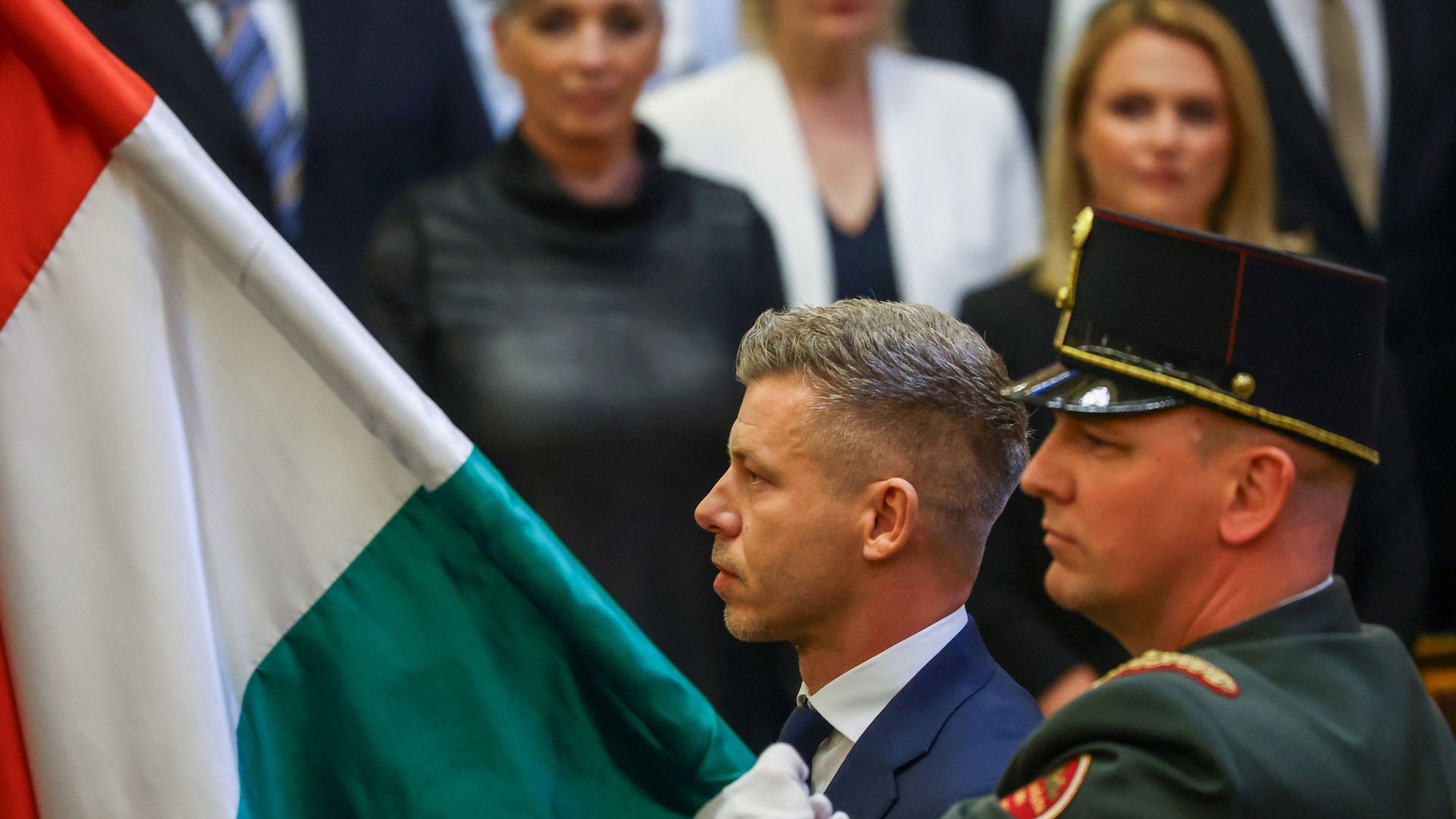
The political gravity in Budapest has shifted with a violent, unexpected shudder. Peter Magyar has been sworn in as Hungary’s prime minister, an event that seemed impossible just months ago when he was merely a disgruntled cog in the machine he eventually dismantled. This is not just a change of leadership. It is the collapse of a fourteen-year political monopoly that many observers believed was permanent. Magyar’s rise to power represents the first successful internal breach of the illiberal state, proving that the most dangerous threat to a fortress often comes from the people who hold the keys.
Magyar secured his mandate by turning the government’s own playbook against it. He understood the mechanics of the Fidesz administration because he helped build them. He knew where the financial levers were hidden and how the media apparatus functioned. When he broke ranks, he didn't just criticize the system from the outside; he exposed its structural rot with the precision of an insider. His inauguration marks the end of the Viktor Orban era, but the transition creates a volatile vacuum that will test whether Hungary can actually return to a functional democracy or if it has simply traded one charismatic strongman for another.
The Architecture of an Inside Job
To understand how Magyar reached the premiership, one must look at the specific failure of the previous administration’s internal loyalty checks. For over a decade, the ruling party relied on a strict hierarchy where dissent was synonymous with professional suicide. Magyar, formerly married to the Justice Minister, was part of the inner sanctum. His defection was triggered by a clemency scandal that touched the very top of the state, but his success was fueled by a deep-seated fatigue within the Hungarian middle class.
The "how" of his victory lies in his mastery of grassroots mobilization in a restricted media environment. While the state controlled the television airwaves and regional newspapers, Magyar utilized unpolished, long-form social media broadcasts to bypass the censors. He spoke to voters in a language they recognized—patriotic, slightly conservative, but fiercely anti-corruption. He didn't campaign as a liberal savior from the West. He campaigned as a man of the right who was disgusted by what the right had become.
Dissecting the Orban Collapse
The fall of the previous government wasn't a slow decline. It was a sudden structural failure. The central pillar of the old regime was the promise of stability and the protection of national interests against foreign interference. However, Magyar’s revelations regarding the scale of private wealth accumulation by a handful of well-connected individuals broke that promise. When the public saw that the "national interest" was often a cover for the enrichment of a shadow elite, the ideological glue dissolved.
Economic factors played a silent but deadly role. Hungary had been battling some of the highest inflation rates in the European Union. While the government blamed external sanctions and the war in Ukraine, Magyar pointed toward the inefficiency of a state-led economy where contracts were awarded based on fealty rather than merit. He argued that the "Hungarian model" was essentially a high-interest loan taken out against the country's future. By the time the election arrived, the working class, once the bedrock of the old regime, found the cost of living unbearable.
The Brussels Connection
One of the most complex challenges Magyar faces as he takes office is the frozen billions in European Union funds. The previous administration was locked in a perennial stalemate with the European Commission over rule-of-law concerns. This standoff starved the Hungarian economy of vital investment. Magyar’s first move as prime minister involves a delicate dance. He must demonstrate enough reform to satisfy Brussels and unlock the cash, without appearing as a puppet of foreign powers to his own voters.
He has already signaled a willingness to join the European Public Prosecutor’s Office. This is a massive shift. It effectively invites external auditors to look at how European money is spent in Hungary. For his supporters, this is a necessary cleaning of the house. For his detractors, it is a surrender of sovereignty. The success of his first hundred days depends almost entirely on whether he can get the euros flowing back into the national treasury while maintaining his "Hungary First" credentials.
The Fragility of the New Coalition
Magyar did not win this alone. His party, Tisza, acted as a magnet for a disparate group of voters ranging from disillusioned conservatives to desperate liberals who had given up on the traditional opposition. This coalition is held together by a shared enemy rather than a shared philosophy. Now that the enemy has been defeated, the internal friction is becoming visible.
Managing this group requires a level of political skill that few first-time prime ministers possess. On one side, he has voters demanding a total purge of the old bureaucracy. On the other, he has a civil service and a judiciary still packed with appointees from the previous decade. If he moves too fast, he risks a total administrative breakdown. If he moves too slowly, his base will accuse him of being a "Fidesz-lite" placeholder.
Magyar’s cabinet reflects this tension. It is a mixture of technocrats, former diplomats, and a few high-profile defectors from the previous regime. This isn't a government of activists. It is a government of managers tasked with an impossible job: dismantling a system while keeping the lights on.
The Economic Reality Check
The celebratory mood in Kossuth Square will likely be short-lived once the reality of the balance sheet sets in. Hungary’s debt-to-GDP ratio remains a concern, and the energy dependence on Russia cannot be uncoupled overnight. Magyar has inherited a series of long-term contracts that tie the country's energy security to the very forces he criticized during the campaign.
There is also the matter of the "national champions"—large corporations created under the previous government to dominate sectors like telecommunications, banking, and construction. These entities are often owned by individuals loyal to the former prime minister. Magyar cannot simply nationalize these assets without spooking international investors and violating EU property laws. Instead, he must find a way to introduce genuine competition into markets that have been rigged for years.
Redefining Foreign Policy
Under the previous leadership, Hungary positioned itself as a bridge between the West and the East, often leaning toward Moscow and Beijing to gain leverage in Brussels. Magyar has indicated a "return to the fold" of the Atlanticist alliance. He has reaffirmed Hungary’s commitments to NATO and moved to repair the fractured relationship with neighboring Ukraine.
However, this isn't a simple pivot. The Hungarian public has been fed a steady diet of skepticism toward "Western liberal interference" for nearly fifteen years. Magyar has to re-educate the electorate on the benefits of a pro-Western stance without sounding like he is reading from a script written in Washington or Berlin. He is attempting to build a "Third Way" that is staunchly European but culturally distinct, avoiding the culture war traps that his predecessor used so effectively to divide the population.
The Shadow of the Former Regime
Viktor Orban has not disappeared. While he no longer holds the title of prime minister, his influence remains embedded in the country’s institutions. The former ruling party still controls a vast network of foundations, media outlets, and local municipalities. They are currently regrouping, waiting for Magyar to make his first significant mistake.
The strategy of the new opposition is clear: obstructionism. They will use their remaining positions in the constitutional court and the fiscal council to block Magyar’s legislative agenda. This is the "deep state" that Magyar warned about, and he now has to govern despite it. He is in a race against time to produce tangible results—lower prices, better healthcare, and a sense of justice—before the old guard can successfully frame his government as incompetent.
The Problem with High Expectations
The greatest threat to Peter Magyar isn't the old regime, but the impossible hopes of his supporters. Many people believe that with a change at the top, the systemic issues of the last decade will evaporate. They won't. Corruption is not just about the people in power; it is about the incentives built into the laws and the culture of the bureaucracy.
Magyar has promised a "new era," but "new eras" are usually messy and disappointing. The legal battles to reclaim stolen assets will take years. The reform of the education system will take a generation. If the public expects an immediate transformation, they will inevitably be let down, and that disappointment is the fertile ground where populism grows back.
He must also contend with the "messiah complex" that often follows successful political disruptors. Because he rose so quickly and so dramatically, there is a tendency to view him as a singular figure who can fix everything by sheer force of will. This is a dangerous delusion. A democracy is only as strong as its institutions, and Magyar’s primary task is to make himself less important by rebuilding those institutions so they can function without a strongman.
A Precarious Balance of Power
The swearing-in ceremony was a moment of high drama, but the real work is happening in the dull, gray corridors of the ministries. Magyar is currently reviewing thousands of government contracts and personnel files. He is looking for the "trapdoors" left behind by the outgoing administration—poison pill clauses in contracts that could bankrupt the state if certain allies are fired.
He is also under intense scrutiny from his regional neighbors. The "Visegrad Four" group—Poland, Czechia, Slovakia, and Hungary—has been dysfunctional for years due to Hungary’s previous stance on the war in Ukraine. A Magyar-led Hungary could revitalize this bloc, creating a powerful Central European voice that is pro-EU but wary of over-centralization in Brussels. This would change the power dynamics of the entire continent, shifting the center of gravity away from the traditional Franco-German axis.
The next few months will reveal if Magyar is a true reformer or merely a more polished version of the system he replaced. He has the mandate, he has the insider knowledge, and for now, he has the momentum. But the history of Central Europe is littered with "reformers" who eventually succumbed to the same temptations of power they once decried.
Magyar must now prove he can govern as effectively as he can campaign. He needs to move beyond the rhetoric of the "betrayal" and start building a state that functions for those who didn't vote for him as well as those who did. The eyes of Europe are on Budapest, not just because a leader has fallen, but because a new, untested model of post-populist governance is being born. It is a fragile experiment conducted in a very dangerous neighborhood.
The transition of power in Hungary serves as a warning to entrenched leaders everywhere. No system is truly airtight, and no amount of media control can forever suppress the reality of a struggling economy and a perceived lack of justice. Peter Magyar didn't create the fire that burned down the old regime; he simply provided the spark for a forest that was already bone-dry. Now he has to figure out how to build something on the ashes before the wind changes direction.
He stands at the podium, the oath of office still ringing in the air, facing a country that is both exhilarated and deeply cynical. The honeymoon will be measured in weeks, the challenges in decades. The man who broke the machine now owns it, and the machine has a history of breaking its owners.
Every policy decision he makes from this moment forward will be a choice between the easy path of the past and the grueling work of a genuine democratic rebuild. There are no shortcuts to a healthy state. He will either be the architect of a new Hungary or the final chapter of the old one. Either way, the era of predictability in Hungarian politics is over.



