The seizure of a stateless dhow in the Arabian Sea by the 15th Marine Expeditionary Unit (MEU) functions as a live-fire demonstration of the United States’ ability to disrupt illicit logistical networks without escalating to localized state-on-state conflict. While media reports often focus on the tactical drama of boarding actions, the strategic value lies in the Maritime Interdiction Operation (MIO) Framework. This framework quantifies the intersection of legal authority, specialized kinetic capability, and the intelligence-driven targeting of non-state actors in contested waterways.
The Triad of Maritime Interdiction Operations
Effective MIO is not a singular event but a sequence of three interdependent phases that must align to achieve a successful seizure. Failure in any single phase results in a mission abort or a legal liability for the sovereign state conducting the operation.
- Legal Domain Identification: The dhow in question was categorized as "stateless." Under the United Nations Convention on the Law of the Sea (UNCLOS), vessels without a clear flag state or those displaying fraudulent indicators lose their sovereign immunity. This status grants warships the "right of visit" to verify the vessel’s nationality.
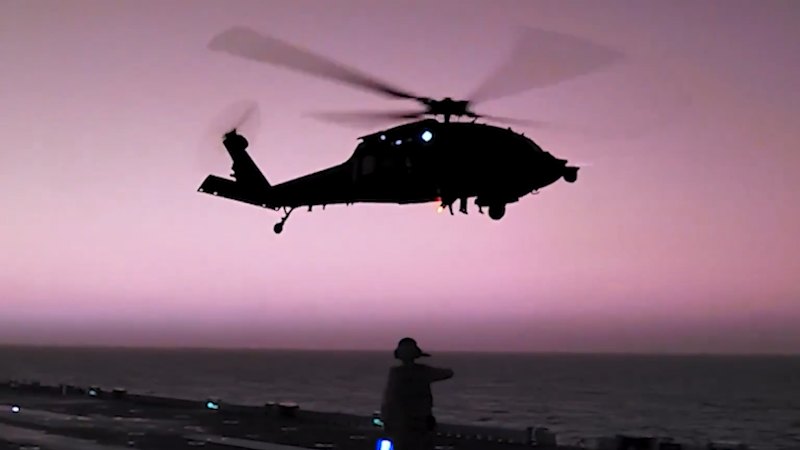
- Tactical Insertion and Control: Executed by the Maritime Special Purpose Force (MSPF), this phase utilizes the OODA Loop (Observe, Orient, Decide, Act) at a compressed scale. The speed of the boarding team—often arriving via fast-roping from MH-60S Seahawk helicopters or high-speed rigid-hull inflatable boats (RHIBs)—is designed to overwhelm the ship’s crew before they can scuttle the vessel or destroy evidence.
- Exploitation and Denial: The final phase involves the systematic search of the vessel and the cataloging of illicit materials. In the Arabian Sea, this typically targets advanced conventional weapons (ACW) or narcotics, which serve as the primary financing mechanisms for regional proxies.
The Cost Function of Stateless Vessel Interdiction
The deployment of a MEU for a boarding operation represents a significant allocation of high-end assets to a low-intensity target. To understand why this trade-off is made, we must analyze the Cost of Inaction (CoI). If a single dhow carries components for medium-range ballistic missiles or unmanned aerial vehicles (UAVs), the arrival of those components at their destination significantly increases the cost of regional defense for U.S. and allied forces.
The utility of the 15th MEU in this context is driven by its organic modularity. Unlike a standard infantry battalion, a MEU carries its own air wing, logistics element, and command structure. This allows for:
- Self-Sustaining Intelligence: Real-time signal intelligence (SIGINT) gathered by the MEU’s assets allows for the identification of anomalies in regional shipping patterns.
- Scalable Kinetic Force: The ability to escalate from a "compliant boarding" (where the crew cooperates) to an "opposed boarding" (where the crew resists) without needing external reinforcements.
- Rapid Evidence Chain of Custody: Immediate biometric scanning and forensic documentation of seized cargo to link illicit networks to specific state sponsors.
Geometric Constraints in the Arabian Sea
The Arabian Sea is a vast maritime theater, yet its traffic flows are bottlenecked by geographical "chokepoints" such as the Strait of Hormuz and the Bab el-Mandeb. This creates a Concentration of Risk. Smugglers utilize dhows because their small radar cross-sections and lack of Automatic Identification System (AIS) transponders allow them to blend into the "white shipping" (legitimate commercial traffic) that saturates the region.
The 15th MEU utilizes a Search-and-Detect Probability Model to filter this noise. The probability of detection $P_d$ is a function of sensor range, platform speed, and the density of the search area. By deploying persistent aerial surveillance (UAVs or piloted aircraft) in tandem with surface vessels, the MEU creates a "permeable net." It does not attempt to stop all traffic but instead creates a psychological and physical barrier that forces smugglers into riskier, more detectable behaviors.
Kinetic Friction and the Mechanics of Boarding
The physical act of boarding a moving vessel at sea involves extreme variables. The Kinetic Friction of the Arabian Sea—characterized by high sea states and heat—degrades both equipment and human performance.
The boarding teams, often drawn from the MEU’s Reconnaissance Company, must manage:
- Vessel Stability: Dhows are notoriously unstable and lack standardized ladders or access points.
- Internal Ballistics: Fighting or searching inside the cramped, metal-heavy environment of a ship creates unique risks regarding ricochets and over-penetration.
- Biometric Verification: Operators use handheld devices to compare the fingerprints and iris scans of the crew against global watchlists in near real-time, even in the middle of the ocean.
This is where the competitor's reporting fails: they treat the boarding as an isolated incident of "policing." In reality, it is a Signal of Credibility. By successfully executing a boarding in a high-stakes environment, the U.S. signals to regional adversaries that their logistics lines are transparent and vulnerable.
Strategic recommendation for maritime security stakeholders
The current reliance on high-cost MEUs for individual dhow interdictions is an unsustainable long-term strategy for maritime domain awareness. The operational tempo (OPTEMPO) required to monitor the Arabian Sea effectively will eventually exhaust the current carrier strike group (CSG) and amphibious ready group (ARG) rotations.
The shift must move toward Distributed Maritime Operations (DMO). This involves:
- Mass-Producing Low-Cost Unmanned Surface Vessels (USVs): Equipping small, autonomous boats with optical and acoustic sensors to act as "tripwires" across known smuggling routes.
- Partner Nation Integration: Rather than the U.S. Navy and Marines performing every boarding, the focus must shift to a "hub-and-spoke" model where U.S. assets provide the intelligence (the hub) and local partner coast guards perform the physical interdictions (the spokes).
- Algorithmic Profiling of AIS Deviations: Using machine learning to identify vessels that deviate even slightly from their historical speed and heading patterns, which often precedes a ship-to-ship transfer of illicit goods.
The seizure by the 15th MEU is a tactical win, but it highlights the need for a structural evolution in how the Arabian Sea is policed. The objective should not be more boardings, but a higher density of automated surveillance that makes the cost of smuggling exceed the potential reward for the financier.