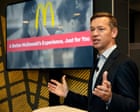
Chris Kempczinski probably thought he was doing something relatable. The McDonald’s CEO sat down to film a taste test of the brand’s new Big Arch burger, likely hoping for a viral moment of corporate "authenticity." Instead, he gave the internet a masterclass in why high-level executives struggle to look like regular humans eating fast food. The video didn't just fall flat. It became a meme-fueled reminder that there's a massive gulf between the people who run the Golden Arches and the people who actually stand in line for a McDouble at 11:00 PM.
Social media users weren't just skeptical. They were brutal. The common consensus? His "aura screams kale salad." Watching a man worth millions of dollars gingerly approach a massive, calorie-dense burger with the caution of a scientist handling biohazardous material is inherently funny. It highlights a recurring problem in modern branding where the C-suite tries to play "everyman" but forgets that the "everyman" doesn't hold a burger like it’s an ancient artifact.
The Problem with Corporate Authenticity
When you’re the CEO of a global fast-food giant, your job is to sell the dream of a consistent, satisfying meal. But there’s a specific kind of performance involved in these promotional clips. Kempczinski’s stiff posture and calculated bites felt more like a boardroom presentation than a lunch break. People can smell a lack of genuine enthusiasm from a mile away.
The "kale salad" comment from observers hits on a deeper truth about perception. We don't actually believe these guys eat the food they sell. When Warren Buffett talks about drinking five Cokes a day, it feels like a quirky, grandfatherly trait because he’s leaned into it for decades. When a polished, fitness-conscious CEO tries to convince us he’s obsessed with a double-patty burger loaded with "tangy sauce," it feels like a scripted lie.
It’s not just about the food. It’s about the energy. If you look like you spend your weekends at a high-end cycling studio and your mornings drinking green juice, don't try to tell us you’re a "burger guy." We know better.
What the Big Arch Launch Tells Us About McDonalds Strategy
Beyond the awkward chewing, the Big Arch represents a major pivot for McDonald’s. They’re trying to compete in the "heavy hitter" category—the space currently occupied by Wendy’s Dave’s Triple or Burger King’s Whopper. The Big Arch is a beast. Two beef patties, crispy onions, pickles, cheese, and a specific "Big Arch" sauce.
It’s an aggressive play for the value-conscious but hungry consumer. However, the marketing needs to match the product. You don't sell a "massive, satiating burger" with a guy who looks like he’s counting the calories in his head while the camera rolls. You sell it by showing the grease, the mess, and the genuine satisfaction of a meal that hits the spot.
The Disconnect in Modern Food Marketing
The industry calls this "food theater." Usually, it’s done by professional hand models and food stylists who make a burger look like a work of art. When you swap the stylist for a CEO, you lose the art and keep the artifice.
- The Grip: Regular people grab a burger. CEOs hold it with the tips of their fingers to avoid getting sauce on their cuffs.
- The Bite: A real taste test involves a mouthful. A corporate taste test involves a nibble that barely clears the bun.
- The Reaction: "It’s great" said with the same tone used for quarterly earnings reports doesn't move the needle.
This isn't the first time a CEO has struggled with this. Remember when Howard Schultz tried to talk about race relations over lattes? Or when tech founders try to wear hoodies to look "down with the kids"? It almost always backfires because it ignores the inherent power dynamic. You aren't one of us, and that's okay—just don't pretend you are while trying to sell us a $9 burger.
Why Social Media is the Ultimate BS Detector
You can’t hide in 2026. The comments section is the new focus group, and it’s a lot more honest than the one you paid $50,000 for in a glass-walled room in Chicago. The "kale salad" joke is more than just a jab at his diet. It’s a critique of the "suit" trying to speak the language of the "customer."
Twitter and TikTok users have spent years deconstructing every frame of corporate content. They see the lighting, the forced smiles, and the way the background is blurred to make the executive pop. When the content feels "produced," the message is lost. The most successful brand moments today are the ones that look a little bit crappy. A grainy video of a line cook showing how they actually make the onions crispy will always outperform a 4K video of a CEO sitting in a sterile office pretending to enjoy a meal.
How Brands Can Fix the Aura Gap
If McDonald’s wants to win the "vibe check," they need to stop putting executives in front of the camera for product launches. Use the people who actually eat the food. Find the super-fans. Use the workers who have been behind the counter for twenty years and actually know what a "good" Big Arch looks like.
Authenticity isn't something you can write into a script. It’s a byproduct of being real. If Kempczinski had walked into a random franchise at midnight and shared a burger with a group of college kids, the "aura" would have been entirely different. Instead, we got a sterile, awkward moment that served as a reminder of how far removed the top floor is from the drive-thru window.
If you’re a business owner or a marketer, take a long look at your own "aura." Are you trying to sell a product you clearly don't use? Are you using language that feels foreign to your actual customers? If you look like you’d rather be eating a kale salad, don't be surprised when people don't buy your burger.
Stop trying to be relatable. Start being useful. If the burger is good, tell us why. Show us the ingredients. Show us the process. But for the love of everything holy, keep the CEO out of the taste test.
Check your recent marketing materials. If your team is telling you a video looks "polished" and "professional," that might be your first sign that it's going to fail the vibe check. Go for the raw, the messy, and the honest instead. That's what actually builds a brand in a world that's tired of being sold to by people in expensive suits.