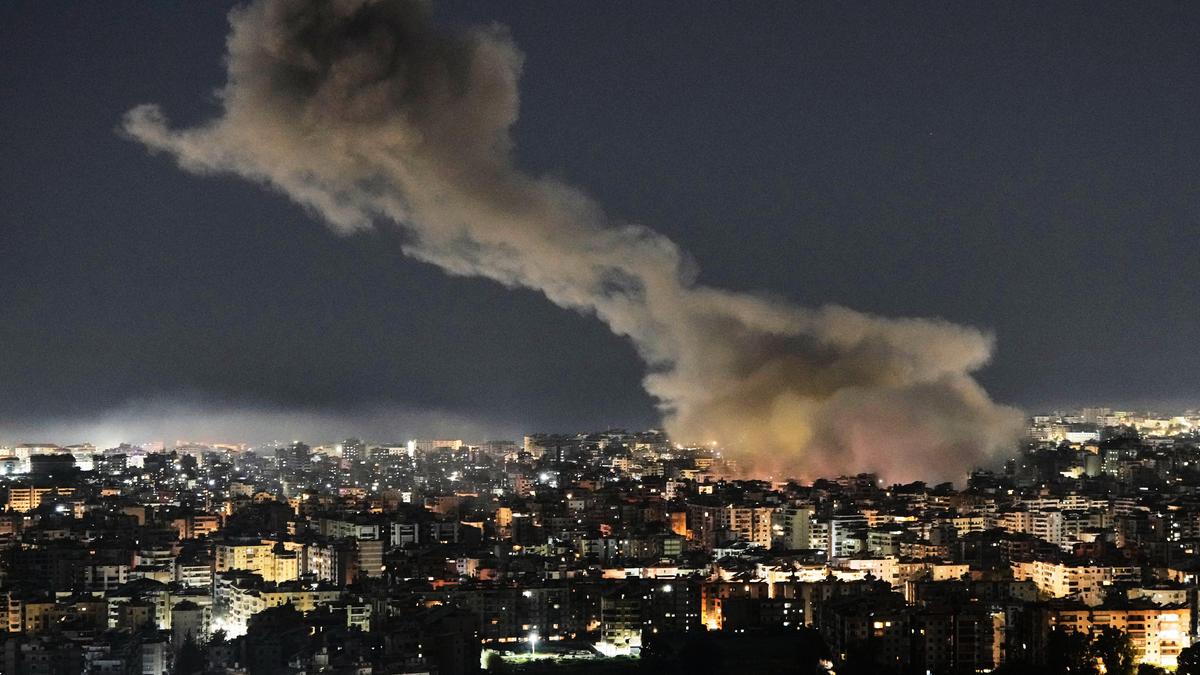
The issuance of evacuation orders by the Israel Defense Forces (IDF) in Southern Lebanon is not merely a humanitarian advisory but a sophisticated component of kinetic operations designed to reshape the physical and cognitive battlespace. These directives function as a precursor to high-intensity conflict, serving three distinct operational goals: the exhaustion of enemy logistics, the creation of a "kill box" through the systematic removal of non-combatants, and the imposition of a psychological cost on the supporting population of an insurgency. Understanding these orders requires moving beyond the surface-level reportage of displacement to analyze the underlying military logic of territorial shaping.
The Tri-Pillar Framework of Modern Evacuation Directives
Military forces operating in dense, asymmetric environments utilize evacuation orders to solve the problem of "target identification in clutter." When an insurgent force like Hezbollah integrates its infrastructure—launchers, tunnels, and command nodes—within civilian centers, the conventional military faces a high-friction environment. The IDF uses evacuation as a tool to clear this friction through three primary mechanisms.
1. Spatial Deconfliction
By designating specific geographic coordinates for evacuation, the military attempts to transform a complex civilian environment into a simplified combat zone. Once a "mandatory" evacuation notice is issued, any remaining movement within the designated sector is categorized as hostile or suspicious. This reduces the cognitive load on drone operators and ground commanders, allowing for a higher tempo of strikes with a lower risk of unintentional collateral damage according to the strictures of International Humanitarian Law (IHL), specifically the principle of distinction.
2. Logistic Interdiction
An evacuated city is a city that ceases to function as a support system for an insurgency. Insurgent groups often rely on local markets, electricity grids, and water supplies. Forced displacement severs the parasitic link between the combatant and the local economy. The tactical objective here is to force the adversary to carry their own supplies, thereby increasing their physical footprint and making them more visible to thermal and multispectral surveillance.
3. Intelligence Signaling
The timing and location of evacuation orders provide a roadmap of intended kinetic action. However, this is frequently used as a "feint" or a method of "channelization." By ordering evacuations in Sector A, the military may be intending to push the population toward Sector B, effectively blocking the adversary’s lines of retreat or reinforcement.
The Cost Function of Rapid Displacement
The effectiveness of an evacuation order is measured by the "Displacement Velocity"—the rate at which a civilian population can vacate a high-risk zone. Several variables dictate this velocity, and when these variables fail, the military objective of a "clean" battlespace is compromised.
- Infrastructure Throughput: The physical capacity of roads leading North. In Southern Lebanon, the Litani River crossings create natural bottlenecks. If the volume of fleeing civilians exceeds the road capacity, the resulting gridlock creates a static target for both sides and prevents military maneuver.
- Information Penetration: The percentage of the target population that receives and trusts the message. The IDF utilizes Arabic-language social media accounts, SMS broadcasts, and physical leaflets. The failure of any one channel leads to "pockets of persistence," where civilians remain in a strike zone, necessitating a pause in operations or a higher risk of civilian casualties.
- Asset Liquidity: The ability of civilians to move. Lower-income demographics or those without private transport move slower. This creates a stratified evacuation where the most vulnerable remain in the highest danger zones, complicating the "Proportionality Calculus" that military lawyers must perform before every strike.
Defining the "Red Line" of Humanitarian Law
The legality of these orders rests on the concept of "Effective Advance Warning." Under Article 57 of Protocol I of the Geneva Conventions, a party to a conflict must give effective advance warning of attacks which may affect the civilian population. However, the term "effective" is a point of significant legal friction.
The military argues that providing specific village names and escape routes fulfills this obligation. Critics argue that if the time window is too short or the "safe zones" are themselves subject to strikes, the warning is technically ineffective. From a strategic consulting perspective, the IDF’s reliance on these orders serves as a legal defensive layer, shifting the burden of safety onto the civilian to vacate rather than the military to refrain from striking a populated area.
The Kinetic-Psychological Feedback Loop
Evacuation orders are a form of Psychological Operations (PSYOPS). They are designed to demonstrate the inevitability of the military advance. By forcing a population to move, the state demonstrates total control over the adversary’s home soil. This creates a "Crisis of Governance" for the insurgent group. If Hezbollah cannot protect its constituents or provide for them during their flight, its political legitimacy is eroded.
This feedback loop is calculated as follows:
$$C = (D \times T) / S$$
Where:
- $C$ = Cognitive impact on the adversary.
- $D$ = Duration of displacement.
- $T$ = Total geographic area cleared.
- $S$ = Perceived stability of the "Safe Zone."
If the safe zone is perceived as unstable, the cognitive impact shifts from "despair" to "radicalization," which can be counterproductive to the long-term stabilization goals of the campaign.
Asymmetric Countermeasures to Displacement
Hezbollah and similar non-state actors do not remain passive during evacuation phases. They employ specific countermeasures to negate the IDF's spatial deconfliction.
- Administrative Friction: Discouraging civilians from leaving to maintain a "human shield" presence that complicates the IDF’s Rules of Engagement (ROE).
- Infrastructure Sabotage: Blocking roads to prevent rapid egress, thereby trapping civilians and preventing the IDF from gaining a clear line of fire.
- Visual Obfuscation: Using the movement of civilian convoys to mask the movement of high-value personnel or weapons systems.
This creates a "Stalemate of Egress," where the civilian becomes the primary currency of the conflict. The military must then decide whether to proceed with strikes despite the presence of non-combatants—accepting the political and legal fallout—or to stall the offensive, giving the adversary time to regroup.
Strategic Forecast: The Expansion of the Buffer Zone
The current trajectory of evacuation orders in Lebanon suggests the intent to establish a "depopulated buffer zone" extending from the Blue Line to the Litani River. This is not a temporary measure but a structural change to the border geography. By systematically emptying these villages, the IDF is preparing for a " scorched earth" tactical approach where any structure remaining can be treated as a military fortification.
The strategic play for any regional observer is to monitor the Duration of Exclusion. If the IDF prevents the return of civilians after a kinetic phase, it signals a shift from a "raid" posture to a "territorial occupation" or "security zone" posture. Stakeholders should anticipate a prolonged displacement cycle, as the re-entry of civilians into these zones would require a total dismantling of Hezbollah’s short-range rocket infrastructure—a task that historically requires months, if not years, of ground presence.
The immediate operational priority for humanitarian and international actors will be the management of the "Northward Surge." As the IDF pushes the evacuation line further North, the density of displaced persons in central Lebanon will reach a breaking point, potentially triggering internal sectarian tensions that Hezbollah will struggle to manage while simultaneously fighting a front-line war. This internal pressure is a deliberate, albeit unstated, goal of the evacuation strategy.
Would you like me to analyze the specific geographic coordinates of the most recent orders to identify the likely next axis of the IDF's ground advance?