The coffee in the border town of Rēzekne hasn't changed its price in three years. It is thick, bitter, and usually the only thing keeping the early morning fog from settling into the bones of the locals. But lately, the fog feels different. It carries a metallic tang, a whisper of something that doesn't belong to the Baltic marshes or the pine forests of Estonia. It is the scent of a war that was supposed to be a thousand miles away, now arriving on the wind in the form of carbon fiber and high explosives.
When a drone falls out of a clear sky, there is no siren. There is no panicked radio broadcast. There is only the sudden, jarring realization that the invisible lines on a map—the ones we call sovereign borders—are remarkably porous to a piece of plastic powered by a lawnmower engine.
Estonia and Latvia are finding themselves in a strange, liminal space. They are the spectators who suddenly found a stray bullet lodged in their living room wall. They aren't the targets. Not yet. But the "stray" nature of these Ukrainian and Russian drones is precisely what makes them so terrifying. It is the randomness of the debris.
The Weight of a Falling Star
Consider a hypothetical resident named Elina. She lives near the Latvian border, in a house her grandfather built during a time when the world was much louder. For Elina, the war in Ukraine was a series of flickering images on a television screen and a rise in the price of heating oil. It was distant. It was "over there."
Then came the sound.
A drone is not a jet. It doesn't roar. It buzzes—a persistent, angry whine that mimics a swarm of hornets. When it malfunctions, that whine cuts out. The silence that follows is the heaviest thing a human being can experience. In that silence, gravity takes over. The drone, a Shahed or a locally made Ukrainian variant, becomes a dead weight of several hundred pounds, packed with electronics and, often, a lethal payload.
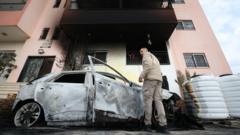
When one crashed in a Latvian field recently, it wasn't a deliberate strike. It was a failure of navigation, a victim of electronic warfare, or perhaps just a machine that ran out of will. But to Elina, standing on her porch and looking at the charred furrow in the earth, the technical reason didn't matter. The war had touched her soil. The "dry" facts reported by international agencies mention "unintentional incursions." The reality on the ground is a shattered sense of sanctuary.
The Physics of an Accident
The math of modern warfare is brutal and indifferent. To understand why Estonia and Latvia are suddenly catching these stray birds, we have to look at the geography of the corridor. Russia launches from the north; Ukraine defends and counters. The air above the Baltics is thick with "invisible noise"—GPS jamming, signal spoofing, and frequency hopping that turns the sky into a hall of mirrors.
A drone guided by satellite coordinates can be "tricked." A jammer tells the drone it is ten miles to the west of its actual position. The drone's onboard computer, trying to correct this perceived error, veers off course. It keeps flying until its fuel blinks out.
$F = ma$
Force equals mass times acceleration. When a 200kg object hits the soft earth of a Latvian farm at 150 kilometers per hour, the energy released is enough to vaporize a shed or level a small house. It doesn't matter if the drone was intended for a power plant in Russia or a command post in Ukraine. Gravity does not take sides. Gravity does not respect NATO’s Article 5.
The Invisible Stakes
Why does this keep happening? The problem isn't just a lack of skill or a technical glitch. We are witnessing the first truly "automated" attrition war. Thousands of these craft are in the air at any given moment. Statistically, a percentage will always fail. A percentage will always drift.
But for Estonia and Latvia, the stakes aren't statistical. They are existential. These are nations that carry the deep, rhythmic pulse of history in their DNA. They know what it means to be a buffer zone. Every piece of charred wing-tip found in an Estonian forest is a reminder of the 20th century, a ghost of the occupations and the iron curtains that they fought so hard to tear down.
The governments in Tallinn and Riga find themselves in an impossible rhetorical position. If they react too strongly to a stray drone, they risk escalating a conflict they are trying to contain. If they say nothing, they tell their citizens that their safety is a secondary concern to the "big picture" of the war.
It creates a psychological wear and tear. People start looking at the sky differently. The drone isn't just a weapon; it is a symptom of a world where the rules are being rewritten in real-time. We used to believe that borders were solid. Now, we know they are only as thick as our ability to jam a radio frequency.
The Alchemy of Fear
There is a specific kind of dread that comes from technological unpredictability. If an artillery shell lands in your yard, you know there is a gun pointed in your direction. If a drone falls through your roof because its GPS chip got confused by a cloud or a jammer, there is no one to blame but the chaos of the age.
This is the hidden cost of the conflict. It is the erosion of the "peace of the periphery." The Baltic states have spent decades building themselves into digital powerhouses, bastions of stability and tech-forward thinking. They are the success stories of the post-Soviet era. Now, that progress is being shadowed by low-tech, high-impact accidents.
The authorities speak in measured tones about "airspace monitoring" and "bilateral communications." They use words like contingency and mitigation. But talk to a farmer in eastern Latvia, and he won't use those words. He will point to the spot where the earth turned black and ask what happens when the next one doesn't land in an empty field.
The Glitch in the System
We are living in the era of the "unintentional participant." By virtue of being next door to a fire, you are going to get scorched. The drones hitting Estonia and Latvia are the sparks jumping from a massive bonfire.
The irony is that these machines are supposed to be "smart." We are told they are the pinnacle of cost-effective, precision engineering. Yet, here they are, falling into forests and fields like drunken birds. It turns out that when you saturate the sky with thousands of cheap robots, the "precision" part of the equation starts to degrade. The sky becomes crowded. The signals get crossed. The machines get tired.
The real danger isn't a planned invasion. The danger is a mistake that looks like a provocation. A drone hits a school instead of a field. A misinterpreted signal leads to a defensive launch. The chain of events that follows is a slide down a mountain that no one intended to climb.
The Sound of the Forest
If you walk into the Estonian woods today, the silence is different. You listen for the wind in the pines, but you also listen for the hum. You look at the horizon and wonder if that speck is a hawk or a piece of the war coming to find you.
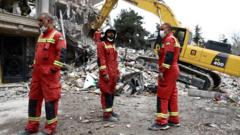
The people of the Baltics are resilient. They have survived worse than falling debris. They will repair the craters and they will continue to brew their bitter coffee. But the innocence of the border is gone. They are no longer just neighbors to a war; they are the involuntary hosts of its malfunctions.
The metal rain doesn't care about your treaties. It doesn't care about your history. It only cares about the terminal velocity of a falling object and the cold, hard ground of a country that just wanted to be left in peace.
The next time a drone enters the airspace over the Baltics, it might be spotted by radar. It might be intercepted. Or it might simply tumble, unheralded and unstopped, until it finds a place to rest in the quiet, Baltic soil. The world will call it a "stray." The people on the ground will call it a warning.
A single, charred propeller sits on a desk in a regional police station, its edges melted into an abstract shape that looks like a broken wing. It is cold to the touch now. It is heavy. It smells of burnt circuitry and lost directions. Outside, the fog continues to roll in from the east, thick and grey, hiding everything that is yet to fall.