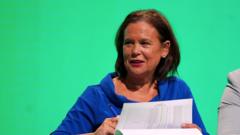
Sinn Féin president Mary Lou McDonald didn't just suggest a second term for Michelle O'Neill; she framed it as an inevitability. Speaking at a recent party gathering, the message was clear: the Republican movement is no longer playing the "newcomer" role in Stormont. They're the incumbents now. And they like how it feels.
The call for O'Neill’s re-election as First Minister is a calculated opening salvo for the 2027 Assembly elections. It’s a move designed to project stability in a political system that’s historically been anything but stable. McDonald is betting that voters prefer the current "quiet" to the years of collapse and stalemate that defined previous administrations.
The strategy behind the early endorsement
Politics in the North usually runs on a cycle of crisis. We’ve seen enough "will they, won't they" drama with the Executive to last a lifetime. By planting the flag for O’Neill early, McDonald is trying to flip the script. She’s positioning Sinn Féin as the party of the status quo—but in a good way.
There are three main reasons why this push is happening now:
- Normalizing Republican Leadership: For decades, the idea of a Sinn Féin First Minister was used by unionist parties as a "bogeyman" to scare voters. Two years into O'Neill's tenure, the sky hasn't fallen. McDonald wants to cement the idea that an Irish Republican leading the North is just... normal.
- The DUP Dilemma: The DUP is still soul-searching after the post-Brexit chaos. By rallying behind O'Neill, Sinn Féin forces the DUP to either focus on their own internal mess or spend their energy attacking a First Minister who currently holds a solid approval rating among her base.
- A "Two-Island" Strategy: McDonald is looking at two elections. One in the North and a looming General Election in the Republic. Success in Belfast is the ultimate proof of concept for Sinn Féin's ability to govern in Dublin.
Is O'Neill's re-election a safe bet
If you look at the polls, Sinn Féin is sitting pretty. While they’ve seen a slight dip from their 2022 highs, they remain the dominant force. The real battle for 2027 isn't actually for the top spot. It's for third place. With the Alliance Party, the SDLP, and smaller unionist parties fighting over the middle ground, Sinn Féin's path to being the largest party again looks fairly clear.
But being the largest party is only half the battle. You’ve got to actually form an Executive. O'Neill's "First Minister for All" branding has been her shield against accusations of narrow sectarianism. She's attended royal events and stood alongside DUP leaders, a move that would've been unthinkable for her predecessors. McDonald knows this "soft power" is what wins over the middle-ground voters who decide elections.
The issues that could trip them up
It’s not all smooth sailing. McDonald can talk about re-election all she wants, but the "bread and butter" issues are starting to bite. You can't run an election solely on the "historic" nature of your office twice. Eventually, people want to know why the waiting lists at the Royal Victoria Hospital are still miles long.
The Executive is facing a massive financial squeeze. The new British government hasn't exactly been throwing money at Stormont. We're seeing cuts to winter fuel payments and a lack of funding for massive infrastructure projects like Casement Park. If O'Neill can't deliver tangible wins—new social housing, shorter GP wait times, or better schools—the "change" she promised in 2022 will start to look like more of the same.
What this means for the Union
Let's be real: every time Mary Lou McDonald talks about Michelle O'Neill, she’s also talking about a United Ireland. She’s been very direct about this being the "decade of opportunity."
"We have secured the peace. It's now time to write the next chapter of our national story—the reunification of Ireland." — Mary Lou McDonald, April 2026.
💡 You might also like: The Diplomatic Delusion Why Pakistan and Irans Dialogue is a Geopolitical Dead End
This is the tightrope O'Neill has to walk. She has to be the pragmatic administrator of a British-funded devolved government while her party president talks about dismantling that very state. So far, she’s managed it. But as the 2027 election approaches, the pressure to "deliver" on the border poll conversation will increase from the Republican grassroots.
What you should watch for next
The next 12 months will be the "delivery phase." If you're watching this play out, don't look at the big speeches. Look at the small stuff.
- Budget Allocations: Watch where the money goes. If Sinn Féin pushes hard for social housing in West Belfast or Derry, they're shoring up their base.
- The "Third Party" Surge: If the Alliance Party continues to grow, Sinn Féin will have to pivot further toward the center to keep their lead.
- London-Belfast Relations: If the relationship with Westminster sours over funding, expect O'Neill to use it as a campaign tool, blaming "British austerity" for any local failures.
McDonald’s call isn't just about a job title for her colleague. It's an assertion of power. She's telling the world that the "Sinn Féin era" in Northern politics isn't a fluke—it’s the new reality. Whether the voters agree in 2027 will depend less on the history books and more on the state of their bank accounts and hospitals.


