The air in the room was heavy with the scent of old paper and the hum of an air conditioner that had seen better decades. I was sitting across from a man named Elias, a retired shopkeeper whose hands were mapped with the blue veins of a life spent lifting crates. He wasn't talking about the stock market or the Federal Reserve. He was looking at a photograph of his grandson, Leo.
"I keep hearing they're building things for him," Elias said, his voice a dry rasp. "Roads, bridges, a future. But nobody mentioned he’s already been sent the bill. He’s six. He can’t even tie his shoes, and he’s already in the red."
Elias isn't an economist, but he felt the weight of a mathematical truth that most of Washington spent four years trying to ignore. We often treat the national debt like a weather report—something distant, slightly threatening, but ultimately out of our hands. During the Trump administration, this abstraction became a runaway train. The promise was simple: growth would cure all. If we cut taxes and pumped the engine, the resulting prosperity would make the mounting trillions look like pocket change.
It was a beautiful story. It just wasn't true.
The reality of those four years wasn't a sudden explosion, but a steady, quiet erosion of the floorboards. When Donald Trump entered office, the national debt stood at roughly $19.9 trillion. By the time he left, it had ballooned to nearly $27.8 trillion. You can blame the pandemic for the final, frantic spike, but the structural damage was done long before the first mask was ever donned.
The Architect and the Avalanche
To understand how we got here, you have to look at the tools. In 2017, the Tax Cuts and Jobs Act was positioned as a lightning bolt for the American heartland. The theory suggested that by lowering the corporate rate, money would "trickle down" like mountain snowmelt into the parched valleys of the working class.
But money has a funny way of staying at the summit.
Instead of a broad reinvestment in wages and infrastructure, much of that capital flowed into stock buybacks. The Treasury’s coffers, meanwhile, began to leak. We were living in a house where we decided to stop paying the mortgage because we bought a faster car. It felt great on the highway. The wind was in our hair. But the bank was still keeping track of every mile.
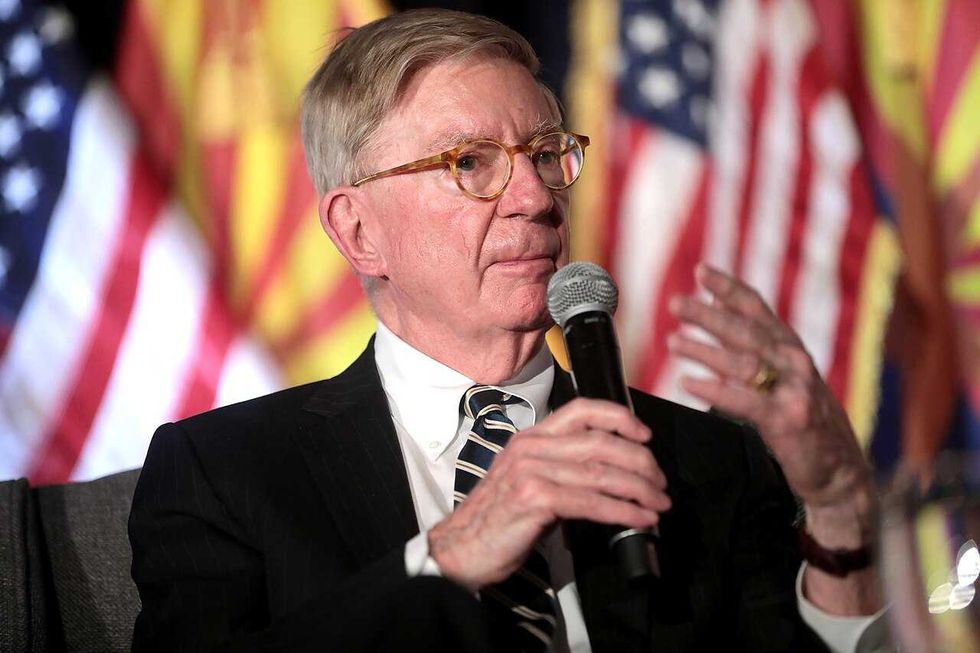
George Will, a man who has spent more time contemplating the soul of American conservatism than perhaps anyone alive, watched this with a kind of resigned horror. He saw a party that once defined itself by fiscal restraint—the "adults in the room"—suddenly succumb to the allure of the credit card. It was a betrayal of a fundamental conservative principle: that you do not steal from your children to pay for your today.
The Invisible Stakes of a Trillion Dollars
What does a trillion dollars actually look like? If you spent one dollar every single second, it would take you 31,709 years to reach a trillion. We added nearly eight of those in a single term.
When a government spends more than it takes in, it issues IOUs in the form of Treasury bonds. To attract buyers, it eventually has to raise interest rates. Think of it like a crowded restaurant. When everyone wants a table, the price goes up.
Consider the "crowding out" effect. This isn't just a term in a textbook. It’s the reason a young couple in Ohio can't get a small business loan to open a bakery, or why a tech startup in Austin finds their VC funding drying up. When the government is vacuuming up all the available credit to pay off its own old dinner tabs, there is less left for the rest of us.
The stakes aren't just numbers on a screen. They are the missed opportunities. The bridge that doesn't get built because the interest on the debt now costs more than the entire Department of Transportation. The cancer research that loses its grant because we are too busy servicing the ghost of 2018's tax policy.
The Pandemic as an Alibi
Then came 2020. The world stopped.
Suddenly, the profligacy of the previous three years mattered deeply. When you enter a crisis with your pockets already turned inside out, you have no margin for error. The CARES Act and subsequent relief packages were necessary—nobody denies that a house on fire needs water—but the water was being drawn from a well that was already running dry.
The tragedy of the Trump era wasn't just the spending during the pandemic; it was the refusal to save during the "good times." In an expansionary economy, a responsible leader trims the sails. They prepare for the storm. Instead, the administration kept the pedal to the floor, cutting revenue while increasing spending on everything from the military to domestic subsidies.
It was an abdication of the most basic duty of leadership: stewardship.
The Quiet Theft
We talk a lot about "freedom" in our political discourse. We debate the freedom of speech, the freedom of religion, the freedom to carry a weapon. But we rarely talk about the freedom of the next generation to not be born into indentured servitude to the past.
Every time a politician promises a benefit without a corresponding sacrifice, they are lying. They are telling you that the meal is free while sliding the check into your daughter’s backpack.
Elias, the man with the grandson, understood this instinctively. He knew that Leo would grow up in a world where a massive chunk of his tax dollars would go toward paying the interest on money spent before he was even born. Leo will have less money for his own healthcare. Less for his own children’s education. Less for a world that will undoubtedly face its own version of a pandemic or a Great Depression.
The Myth of the Easy Fix
There is a temptation to look for a villain. We want to point at a single policy or a single person and say, "That was the moment." But it’s more like a slow-motion car crash. It’s the result of a thousand small decisions to prioritize the next election cycle over the next decade.
The Trump administration didn't invent the national debt. They inherited a problem that had been growing for forty years. But they were the ones who looked at a simmering pot and decided to turn the heat to high. They proved that "fiscal conservatism" had become a slogan rather than a belief system.
The "growing economic crisis" Will wrote about isn't a crash that happens all at once. It’s a rot. It’s the slow weakening of the American dollar. It’s the gradual loss of our ability to respond to global threats. It’s the feeling of being trapped in a cycle where we borrow to pay interest on what we borrowed.
A Debt of Honor
At its core, debt is a moral issue. It represents a promise. When we borrow, we are promising that the future will be productive enough to pay us back. We are betting on the labor of people who haven't yet entered the workforce.
During those four years, that bet became a reckless gamble. We treated the American economy like a strip mine—extracting as much immediate value as possible without a thought for the landscape we were leaving behind.
I think back to Elias and his grandson. He told me a story about his own father, who came over from Greece with nothing but a suitcase and a sense of obligation. His father used to say that the goal of every generation was to leave the woodpile higher than they found it.
"We’re burning the woodpile to stay warm for one night," Elias said. "And it’s going to be a long, cold winter for Leo."
The tragedy isn't that we spent the money. The tragedy is that we spent it on ourselves, at the expense of someone who wasn't even at the table to protest. We traded a sustainable future for a temporary high, and the hangover is going to last for decades.
Somewhere in a suburban classroom, a child is learning about the Founding Fathers and the "blessings of liberty." They don't yet know that they are also the inheritors of a $34 trillion legacy of debt. They don't know that their choices have been narrowed, their paths restricted, and their earnings pre-allocated.
The debt isn't just a number. It's a shadow. It’s the ghost in the nursery, waiting for the child to grow up so it can finally collect.