The air in the depot usually smells of diesel, sterile latex, and the faint, lingering scent of industrial-strength floor cleaner. It is a scent of readiness. To an EMT ending a grueling twelve-hour shift, that smell is the signal that the world is, for a moment, held at bay. But at three in the morning, under a sky the color of a bruised plum, the air changed. It turned thick. Acrid. It carried the roar of something that didn't belong in a place of healing.
When the first window shattered, it wasn't just glass that broke. It was a silent contract.
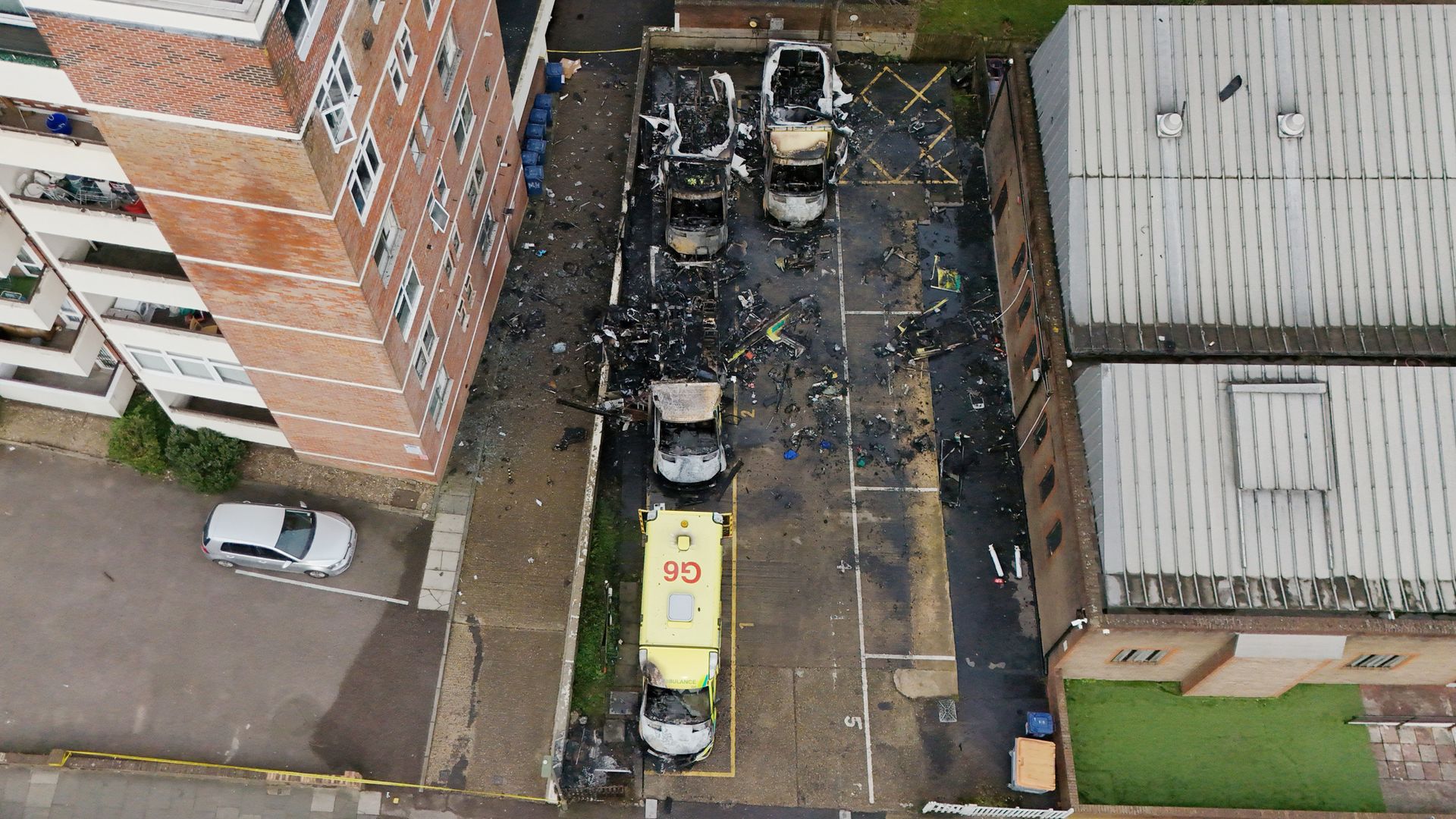
We think of ambulances as invincible yellow and green boxes, shouting their way through gridlock to cheat death. We don't think of them as fragile shells of aluminum and oxygen tanks. But when the heat hit the magnesium frames of the fleet parked in the yard, they didn't just burn. They screamed. Blue lights, melted into grotesque plastic tears, dripped onto the asphalt while the sirens, short-circuited by the creeping flame, gave one last, dying wail.
By dawn, six vehicles were skeletal remains. Six crews had no tools. Six neighborhoods lost their lifeline.
The Claim in the Dark
While the smoke was still curling off the blackened husks, a message appeared in the digital undergrowth of the internet. It wasn't a cry for help or a political manifesto with a name attached. It was a cold, calculated claim of responsibility. An Islamist group, previously a footnote in regional intelligence briefings, stepped into the light of the fire. They didn't just want the ambulances gone; they wanted the credit for the vacuum left behind.
Police investigators moved in before the metal was cool enough to touch. They weren't just looking for accelerants or DNA on a discarded petrol cap. They were looking for the "why." In the dry language of a standard news brief, this is called an "arson probe." In the reality of the streets, it is a hunt for the soul of a community.
When a group claims an attack on an ambulance, they aren't targeting the government. They are targeting the grandmother with chest pains at 4:00 AM. They are targeting the toddler who stopped breathing after a fall. By turning a tool of mercy into a pillar of fire, the arsonist sends a message: Even your helpers are not safe. Even the neutral ground is a battlefield.
The Invisible Stakes of a Vanishing Fleet
To understand the weight of this, you have to look past the charred metal and into the dispatch room. Imagine a dispatcher named Sarah. She has a headset pressed to her ear, and on her screen, six glowing icons have turned gray. "Out of Service."
A call comes in. It’s a high-speed collision on the outskirts of town. Normally, the depot that just burned would have a crew on the road in ninety seconds. Now, Sarah has to look further afield. She has to pull a truck from two towns over.
Minutes matter.
In the world of emergency medicine, there is a concept known as the Golden Hour. It is the window of time where medical intervention has the highest likelihood of preventing death. Every sixty seconds that pass without a paramedic’s hands on a patient, the odds of survival drop by nearly 10%. By burning those six ambulances, the attackers didn't just destroy property. They stole time. They reached into the future and decided that someone, somewhere, would not make it to the hospital because the closest help was a pile of ash.
The statistics of the "probe" will eventually list the dollar amount of the damage. They will talk about the cost of a modern Mercedes Sprinter converted for frontline duty—upwards of $200,000 before you even put a defibrillator inside. But the real cost is measured in the silence where a siren should be.
The Psychology of the Target
Why an ambulance?
Terrorism, at its most basic and brutal level, is the theater of the unexpected. Attacking a military base is a statement of strength. Attacking an ambulance is a statement of nihilism. It exploits our most basic human vulnerability: the need to be cared for when we are at our weakest.
Consider the perspective of the investigators currently sifting through the wreckage. They are dealing with a "claim" from an Islamist cell, which adds a layer of ideological complexity to a simple act of destruction. Radicalization often feeds on the destruction of civil society. If the state cannot protect its own ambulances, the logic goes, then the state is weak. If the state is weak, the radical group is strong.
But this logic ignores the humans under the uniforms. Paramedics are a strange breed. They work for low pay, high stress, and the occasional "thank you" from someone who was too hypoxic to remember their face. When they saw their rigs burned, the reaction wasn't fear. It was a quiet, vibrating fury.
"That was my office," one medic muttered, staring at a melted stethoscope through a cracked side window. "I saved a kid in the back of that rig last Tuesday."
Mapping the Investigation
The police aren't just looking for the people who lit the match. They are tracing the digital breadcrumbs of the claim itself. Was the group actually there, or are they "clout-chasing"—using a local act of vandalism to boost their global profile? This is the modern face of the investigation: part forensic chemistry, part digital archaeology.
Detectives are currently pulling CCTV from every shop within a three-mile radius. They are checking cell towers for pings that don't belong in an industrial estate at 3:00 AM. They are looking for the intersection of radical ideology and local opportunity.
The arsonist's greatest mistake is usually their need to be seen. Fire is a loud medium. It demands an audience. And in that demand for attention, they leave behind the very threads that the authorities will use to hang them. Forensic teams use a technique called "fire pattern analysis" to determine exactly where the first flame licked the tire. From there, they can deduce the height of the person, the way they move, and the level of sophistication in their "cocktail."
The Ripple Effect
The attack ripples outward, affecting people who will never even hear the name of the group that claimed it.
Insurance premiums for municipal services spike. Taxpayer money that could have gone to new cardiac monitors is instead diverted to basic security fences and night-vision cameras for the depot. The "holistic" cost of the fire isn't just the vehicles; it's the hardening of our world. It's the moment we decide that a place of healing needs to look like a fortress.
We live in a time where the "truth" is often obscured by the loudest voice. The group claiming the attack wants you to believe they are a powerful shadow army. The reality is likely far more pathetic: a few desperate individuals with a can of gas and a sense of inadequacy, trying to feel important by breaking things they could never build.
The investigation continues. The charred shells have been towed away, leaving black scars on the concrete that will take years of rain to scrub clean. The police will follow the leads, the lawyers will file the paperwork, and the news cycle will eventually find a newer, brighter fire to stare at.
But tonight, Sarah will sit in the dispatch room. She will look at her screen, seeing the gaps where the icons used to be. She will pray that the phone doesn't ring for a call three miles away from the depot.
Outside, in the bays that didn't burn, the remaining crews are checking their bags. They are restocking bandages. They are testing their oxygen tanks. They are moving with a deliberate, defiant speed. They know that the best response to those who worship fire is to continue the quiet, exhausting work of keeping people cool, hydrated, and alive.
The arsonists wanted a tombstone. Instead, they gave a city a reason to remember why the guardians matter.
The smell of smoke is almost gone now, replaced by the sharp, clean scent of fresh bleach.