The sun was just beginning to dip behind the Pacific, casting a bruised purple hue over the Redondo Beach coastline. It is that specific hour when the joggers thin out and the shadows begin to stretch, claiming the nooks and crannies of the suburban sprawl. Most people were heading inside to start dinner. They weren't looking at the rooftops.
But he was.
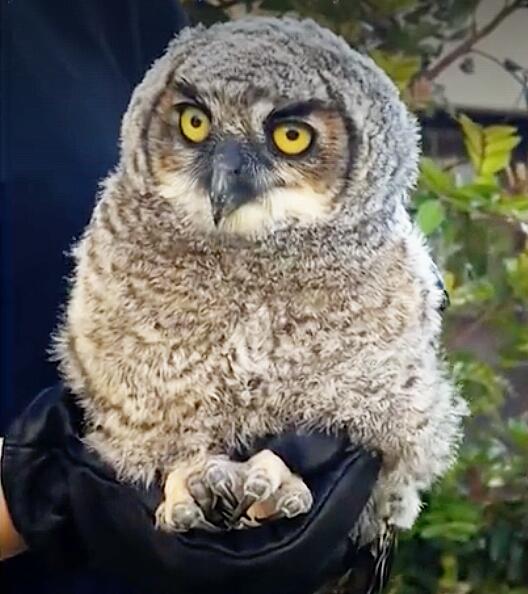
A Great Horned Owl sat perched on the corner of a chimney, motionless as a gargoyle. To a casual observer, the bird is a symbol of wisdom, a silent predator of the night, a majestic piece of the California ecosystem. To the city officials and wildlife experts watching the data, that owl is a canary in a coal mine. It is a living, breathing creature currently navigating a minefield we built for it with our own hands.
The owl didn't move as a small field mouse scurried across the leaf litter in the yard below. It waited. It watched with eyes that can see in what we call total darkness. Then, with a silent beat of wings that defy the laws of acoustics, it dropped.
This is where the story usually ends in a nature documentary. The circle of life. The predator wins. But in Redondo Beach, and in suburban pockets across the country, the predator is unknowingly eating a slow-acting poison.
The Invisible Chain
Consider a hypothetical resident named Sarah. Sarah lives in a beautiful home near the Esplanade. She keeps a tidy garden. When she noticed a few droppings near her trash cans and the tell-tale sign of a rodent making a home in her crawlspace, she did what any responsible homeowner would do. She went to the hardware store.
She bought a sleek, black plastic box. It looked professional. It looked safe. Inside was a bait block, a bright, artificial blue or green that looks like candy but carries a chemical payload designed to thin the blood until it no longer clots. Sarah placed the box, forgot about it, and went back to her life.
She thought she was solving a problem. She was actually setting a trap for the very bird she loves to hear hooting at three in the morning.
The mouse eats the bait. It doesn't die instantly. It becomes sluggish. It wanders out into the open, dazed and thirsty, making it an easy target for the Great Horned Owl on the chimney. The owl eats the mouse. Then it eats another. And another. The poison doesn't vanish; it accumulates.
Wildlife rehabilitators call it "Secondary Poisoning." I call it a heartbreak we can prevent.
A Public Service of the Heart
The City of Redondo Beach recently issued a public service announcement regarding these sightings. On the surface, it sounded like a standard municipal update. "We have owls. Please be careful." But if you read between the lines, it was a plea for a shift in how we inhabit our shared space.
When a fledgling owl—a "brancher"—is learning to fly, it is at its most vulnerable. These teenagers of the avian world often end up on the ground, looking awkward and helpless. Our first human instinct is to "save" them. We want to pick them up, put them in a box, and drive them to a vet.
Stop.
Unless the bird is visibly bleeding or has a wing hanging at an impossible angle, it is exactly where it needs to be. Its parents are likely ten feet away, hidden in the pines, watching you with more intensity than you can imagine. They are teaching their young how to navigate the vertical world. By "rescuing" them, we are often kidnapping them.
The real danger isn't the ground. It’s the chemistry.
The Cost of Convenience
We live in a culture of "out of sight, out of mind." We want the pests gone, and we want it done without having to see the process. Anticoagulant rodenticides are the ultimate expression of this desire. They are easy. They are effective. They are also devastatingly indiscriminate.
Research shows that an overwhelming majority of raptors tested in urban environments—up to 90 percent in some studies—show traces of these poisons in their systems. It doesn’t always kill them outright. Instead, it weakens them. It makes them susceptible to mange, to infections, and to the slow-motion reflexes that lead to being hit by a car on Pacific Coast Highway.
We are inadvertently creating a world where the very animals that provide free, organic pest control are being wiped out by the chemicals we use to do their job poorly. A single owl family can consume thousands of rodents in a breeding season. They are the most efficient "exterminators" on the planet.
Yet, we keep buying the black boxes.
Choosing a Different Path
There is a visceral fear that comes with a rodent infestation. I understand it. The scratching in the walls at night can make your skin crawl. It feels like a violation of the sanctuary we call home. But the solution doesn't have to be a death sentence for the neighborhood’s biodiversity.
There are alternatives that require a bit more effort but offer a lot more peace of mind.
- Exclusion: This is the unglamorous work. It’s crawling around your foundation with a roll of steel wool and a caulk gun. If they can’t get in, they aren't a problem.
- Sanitation: Rodents are there for a reason. Usually, it's the birdseed spilled on the deck or the bag of dog food left open in the garage. Remove the buffet, and the guests leave.
- Snap Traps: If you must kill, do it quickly. Mechanical traps inside the home prevent the "walking poison" scenario. It’s more gruesome for the homeowner to deal with, perhaps, but it's more honest.
It's about taking responsibility for the full arc of our actions.
The Silence of the Pines
Walking through the neighborhoods of Redondo Beach, you can smell the salt air and the jasmine. It feels permanent. It feels like a place where nature and suburbia have reached a truce. But that truce is fragile.
The owls are here because we have tall trees and plenty of prey. They are a gift. They are a reminder that even in a city of nearly 70,000 people, we are still part of a wilder, older rhythm. When we lose that, we lose the soul of the place.
Imagine a night where you step outside and the silence is absolute. Not because it’s peaceful, but because the predators are gone. The mice roam unchecked, the pines stand empty, and the "hoo-hoo-hoo" that used to anchor your nights has faded into a memory.
That is the hidden stake.
The owl on the chimney isn't just a bird. It is a sentinel. It is watching to see if we are capable of sharing this sliver of coast with something that doesn't pay rent, doesn't vote, but makes our lives infinitely richer just by existing.
The next time you see a rodent, think of the yellow eyes in the dark. Think of the silent wings. Think of the blue plastic bait and the way it travels through the blood.
We have the power to keep the night alive. It starts with one less box in the crawlspace and one more look at the stars.
The owl is waiting. It’s time we started looking up.