.jpg?width=1200&auto=webp&crop=3%3A2)
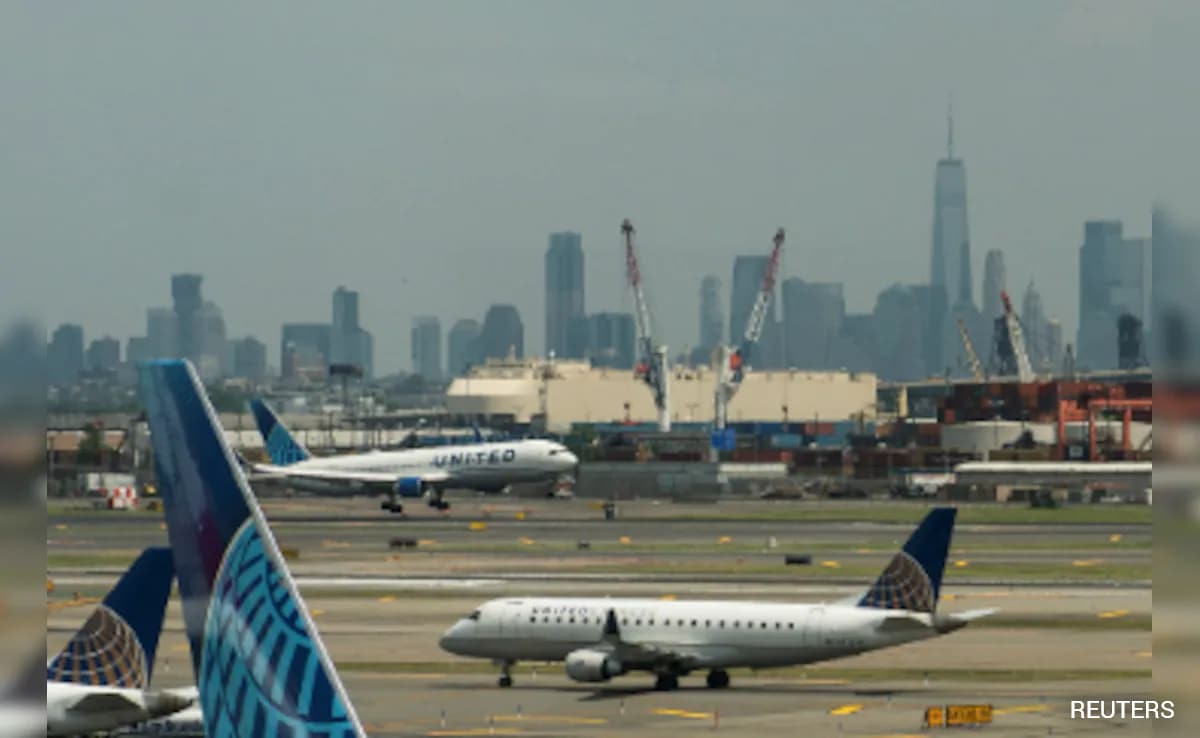
Ground-to-air collision events represent a breakdown in the sterile corridor required for safe terminal arrivals. When United Airlines Flight 2148, a Boeing 737-900ER originating from San Francisco, struck a light pole and a stationary vehicle upon approach to Newark Liberty International Airport, it exposed a failure in the spatial management protocols that govern the transition from active flight to taxiway integration. This incident is not merely a pilot error or a mechanical fluke; it is a manifestation of an interface conflict between fixed ground assets and dynamic aeronautical movements.
The Vector Conflict Framework
To understand why a 79,000-kilogram aircraft makes contact with a light pole, one must analyze the Lateral Clearance Envelope. This envelope is the defined three-dimensional space required for an aircraft to maneuver without risk of collision. The breach at Newark suggests a deviation in one of three primary operational vectors.
- Navigational Deviation (The Pilot Vector): The flight crew may have misjudged the centerline during a visual or instrument-aided approach, placing the wingtip or engine cowling outside the designated safety margin.
- Infrastructure Encroachment (The Port Authority Vector): Permanent or semi-permanent fixtures, such as light poles, must adhere to strict Federal Aviation Administration (FAA) Part 77 standards regarding "Objects Affecting Navigable Airspace." If the pole was positioned or repaired outside of these tolerances, the infrastructure itself becomes the hazard.
- Ground Asset Mismanagement (The Operational Vector): The presence of a truck in the proximity of an active runway or taxiway suggests a breach in ground control communication. Airport Surface Detection Equipment (ASDE-X) is designed to prevent these specific incursions by tracking all vehicle and aircraft movements on the field.
The physics of a Boeing 737-900ER wing strike are unforgiving. With a wingspan of roughly 117 feet, even a marginal deviation of three to five feet can result in a catastrophic structural compromise. In the Newark incident, the contact occurred before the aircraft had completed its transition to taxi speed, meaning the kinetic energy involved was sufficient to shear metal and destabilize the airframe's center of gravity.
Structural Integrity and Damage Assessment Mechanics
The aftermath of a wing-to-pole strike involves a specific hierarchy of engineering concerns. Aircraft skin is designed to handle aerodynamic loads (tension and compression) but is highly vulnerable to point-load impacts (piercing or shearing).
- Leading Edge Slat Compromise: The slats are movable components on the front of the wing used for lift at low speeds. A strike here disrupts the laminar flow and can jam the hydraulic actuators, rendering the wing aerodynamically asymmetrical.
- Fuel Cell Penetration: On the 737-900ER, much of the wing structure serves as an integral fuel tank. Impact with a light pole creates a high risk of ignition or environmental contamination, although modern "survivable" fuel systems include spark-suppression technology.
- Spar Stress Transfer: The most critical concern is whether the impact force transferred through the wing skin into the main spar. If the spar—the "backbone" of the wing—is warped or cracked, the aircraft may face a hull loss, as the cost of spar replacement often exceeds the residual value of the airframe.
The Failure of Surface Movement Radar and Ground Control
Newark (EWR) is one of the most congested airspaces in the global transit network. The safety of the operation relies on a "Swiss Cheese Model" of layers.
The first layer is Visual Separation. Pilots must maintain situational awareness of ground obstacles. However, the cockpit of a 737 offers limited visibility of the wingtips, which are over 50 feet behind the pilot’s seat. This creates a reliance on ground markings and external guidance.
The second layer is ATC Ground Control. Controllers use ASDE-X to monitor the position of every transponder-equipped vehicle on the tarmac. A truck being struck indicates a failure in this digital surveillance layer. If the truck was "non-cooperative" (lacking an active transponder) or if the controller failed to issue a hold short instruction, the systemic safety net failed.
The third layer is Airfield Geometry. Taxiways are designed with specific "Object Free Zones" (OFZ). For a Group III aircraft like the 737, the OFZ is wide enough to provide a generous buffer. Striking a light pole suggests the aircraft was either significantly off-taxiway or the taxiway was being used for a category of aircraft it was not rated to handle.
Quantitative Risk of High-Density Hub Operations
Newark Liberty International functions as a high-utilization hub for United Airlines. In such environments, the "Pressure of the Push" creates a latent risk environment.
- Turnaround Latency: Every minute an aircraft is delayed on the taxiway affects the downstream schedule of dozens of other flights. This pressure can lead to "taxi-in" speeds that exceed the optimal safety threshold for tight maneuvers.
- Construction Hazards: Newark has undergone significant infrastructure upgrades. Construction zones often involve temporary lighting rigs and service vehicles that may not be updated in the daily NOTAMs (Notice to Air Missions) with the precision required for low-visibility operations.
Logical Reconstruction of the Incident Sequence
Based on the available evidence of the impact, we can hypothesize the sequence of failure. The aircraft was in the "landing roll-out" or the initial "turn-off" phase. At this juncture, the pilot’s focus shifts from vertical speed management to directional ground control.
If the aircraft exited the runway via a high-speed turn-off (HST), the centrifugal force requires precise steering to stay centered. A slight oversteer or a skid on a damp surface would swing the outboard wingtip into the "sterile" zone where the light pole and truck were located.
The presence of the truck is the most damning variable. In a controlled airfield environment, no vehicle should be within the wing-clearance radius of an active taxiway unless it is a follow-me car or a tug explicitly cleared by the tower. The truck represents a "runway incursion" (or more accurately, a taxiway incursion) that necessitates an immediate NTSB (National Transportation Safety Board) investigation into the communication logs between the vehicle operator and the ground controller.
Operational Recommendations for United Airlines and the Port Authority
The resolution of this incident requires more than a repair bill; it demands a recalibration of the Newark ground operations interface.
- Implementation of Wingtip Sensors: While common in the automotive industry, wide-body and narrow-body aircraft lack proximity sensors on winglets. Retrofitting fleet assets with ultrasonic or LiDAR sensors for ground movement would eliminate the "blind spot" inherent in 737 cockpit geometry.
- Dynamic Geofencing for Ground Vehicles: The Port Authority should mandate that all ground service equipment (GSE) be outfitted with GPS-linked geofencing. If a vehicle enters a "red zone" (an active taxiway clearance envelope), the vehicle’s engine should automatically govern down or alert the driver and the tower simultaneously.
- Taxiway Lighting Recess: Fixed-pole lighting in high-traffic transition zones represents a legacy design flaw. Transitioning to recessed, in-pavement LED lighting for all turn-off areas removes the physical obstacle entirely, replacing a "hard" hazard with a "soft" navigational aid.
The investigation must prioritize the synchronization of the Flight Data Recorder (FDR) with the ground-based ASDE-X logs. Only by overlaying the exact GPS coordinates of the aircraft’s wingtip against the known coordinates of the light pole and the truck can the industry determine if this was a failure of pilot navigation or a failure of airport spatial design.
The immediate strategic pivot for United Airlines is a fleet-wide review of "Arrival Gate Procedures" at congested hubs. Increasing the "Safety Buffer Zone" by an additional 10% during peak-hour arrivals may decrease throughput by 2-3%, but it eliminates the multi-million dollar capital loss and reputational damage associated with ground-strike incidents. Operational efficiency is worthless if it compromises structural integrity.