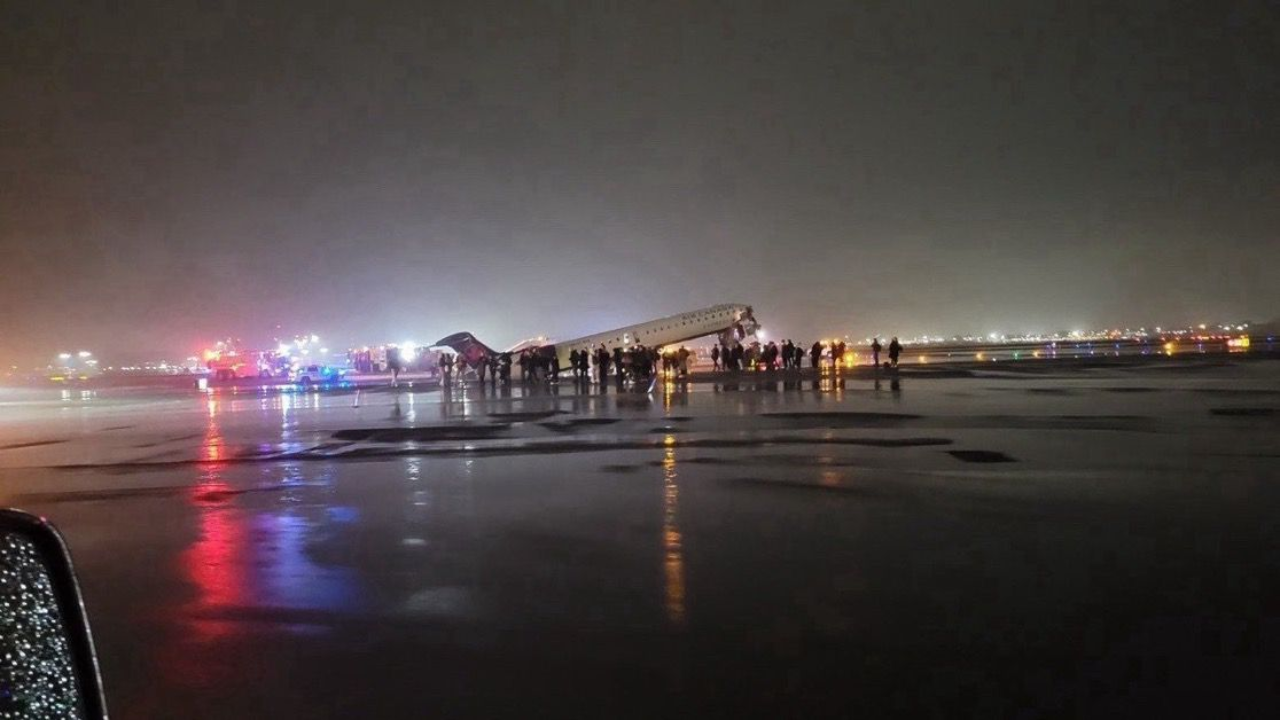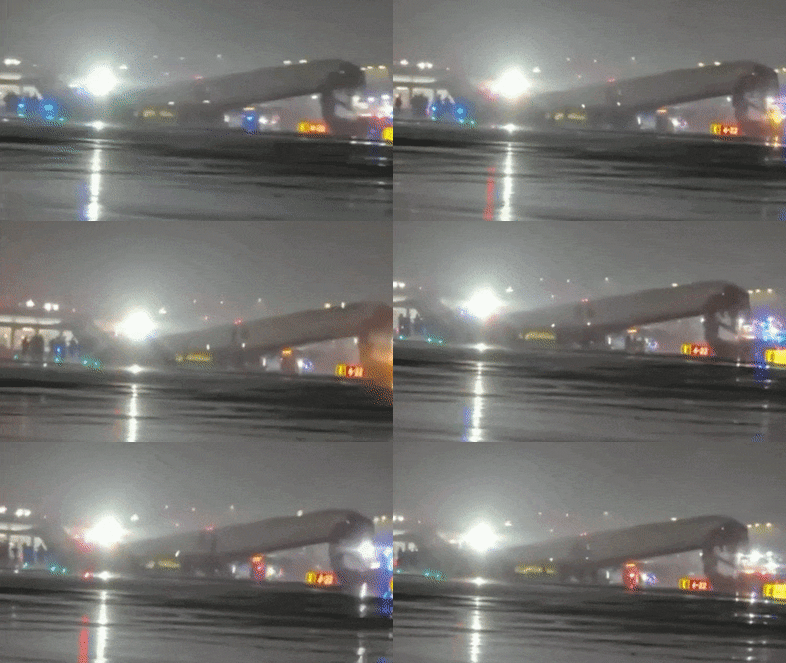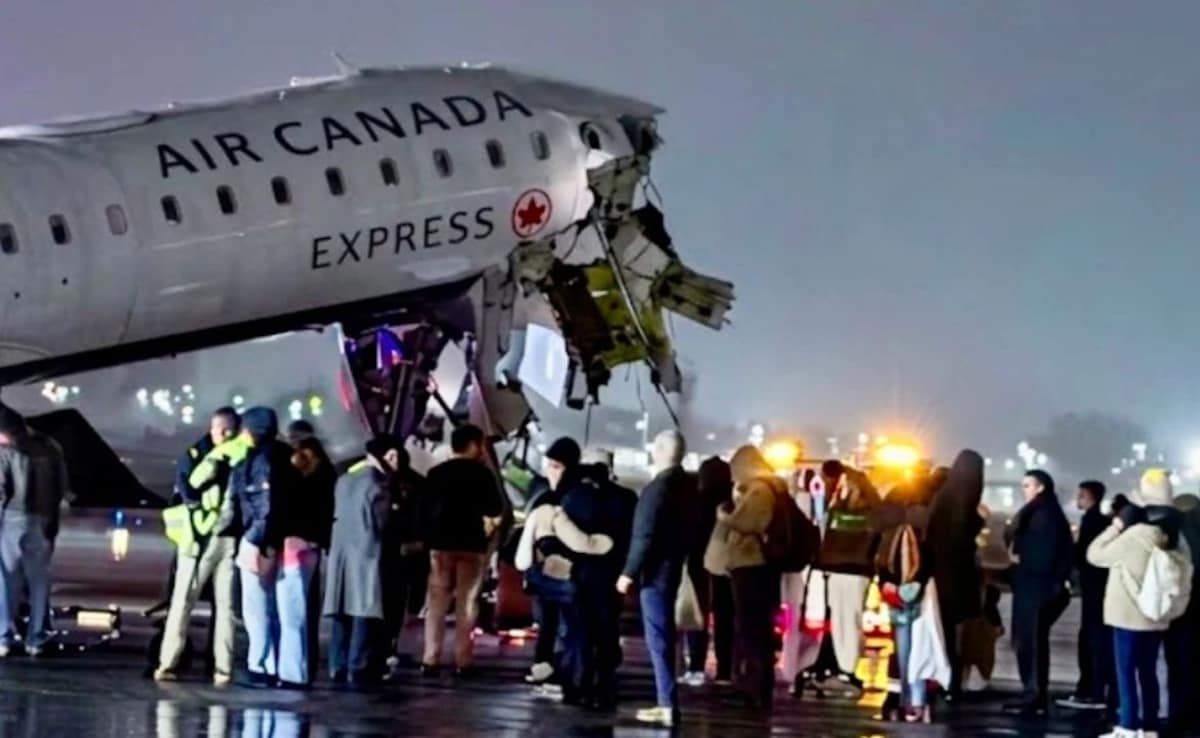
The collision between an Air Canada Express CRJ-900 and a ground service vehicle at New York’s LaGuardia Airport (LGA) represents more than a logistical delay; it is a breakdown in the Spatial-Temporal Deconfliction protocols required for high-density airport operations. In aviation safety, ground movements are governed by a rigid hierarchy of right-of-way and radio communication. When a multi-ton aircraft and a support truck occupy the same coordinate at the same timestamp, the failure is rarely the result of a single mechanical flaw. It is a systematic collapse of the Three Pillars of Ramp Integrity: visual acquisition, air traffic control (ATC) handoff, and ground vehicle adherence to movement area boundaries.
Understanding this event requires moving past the headline of "many injured" to analyze the specific physics and regulatory frameworks that failed during the pushback or taxi phase.
The Mechanics of Impact and Energy Transfer
In a collision involving a regional jet, such as the Bombardier CRJ-900 operated by Jazz Aviation for Air Canada Express, the structural disparity between the vehicles dictates the injury profile. A CRJ-900 has a maximum takeoff weight (MTOW) of approximately 84,500 pounds. Even at low taxi speeds—typically between 10 and 20 knots—the momentum ($p = mv$) is immense.
Ground service trucks, while smaller, are dense. When a truck impacts the fuselage or the wing root, the deceleration forces are transferred directly to the passengers through the airframe. Unlike automotive collisions, aircraft lack crumple zones designed for side-impact protection. The "many injured" reports typically stem from:
- Secondary Impact Injuries: Passengers thrown against tray tables or armrests due to the lack of three-point harnesses.
- Whiplash and Axial Loading: Sudden lateral acceleration causing cervical spine strain.
- Galley Projectiles: Unsecured service carts or cabin luggage becoming unmoored during the sudden change in velocity.
Spatial Constraints and the LaGuardia Bottleneck
LaGuardia is historically one of the most congested geographic footprints in the National Airspace System (NAS). The airport's design, constrained by Flushing Bay and the Bowery Bay, creates a high-pressure environment for ground operations. The Cost Function of Congestion at LGA manifests in reduced margins for error.
The movement area—the runways and taxiways controlled by the tower—is separated from the non-movement area (the ramps and gates) by a "shilo" or boundary line. Collisions often occur at this interface. We can categorize the failure points into three distinct zones:
1. The Visual Blind Spot Quadrant
Pilots seated in the cockpit of a CRJ-900 have limited visibility of objects directly below the nose or near the wingtips. They rely on "wing walkers" and ground marshals during pushback. If a vehicle crosses the path of a taxiing aircraft, the pilot may not see the hazard until the moment of impact. This is a failure of Ground Situational Awareness (GSA).
2. Frequency Congestion and Communication Lag
At LGA, the ground frequency is often saturated with instructions. A "read-back" error—where a driver or pilot mishears a clearance—can lead to an unauthorized entry into a taxiway. If the vehicle involved was not equipped with a transponder or was not in direct communication with the ramp tower, the aircraft is essentially operating in a "dark" environment regarding ground obstacles.
3. The Tug-to-Taxi Transition
The most vulnerable moment for an Air Canada Express flight at LGA is the transition from pushback to under-power taxi. During this phase, the aircraft is transitioning between two different sets of physics (towed vs. propelled) and two different sets of observers (ground crew vs. flight crew).
Quantifying the Regulatory Breakdown
The Federal Aviation Administration (FAA) Part 139 certification governs airport safety. It mandates specific training for "Vehicle Pedestrian Deviations" (VPDs). When a truck collides with a plane on a runway or taxiway, it is classified as a Runway Incursion or a Surface Incident.
The investigation will focus on the Logic of the Deviation:
- Was the vehicle authorized? Non-movement area vehicles (tugs, catering trucks, fuelers) must follow designated service roads.
- Was there a "Lost Link" in communication? In many ground collisions, the driver was distracted or operating under a "conformation bias," assuming the aircraft would stop or that they had been cleared to cross.
- Environmental Factors: Glare from the terminal lights, rain-slicked pavement reducing braking coefficients, or construction-related detours often serve as the "latent conditions" described in James Reason’s Swiss Cheese Model of accident causation.
The Economic and Operational Ripple Effects
The impact of an Air Canada Express collision at a hub like LaGuardia is not contained to the two vehicles. It triggers a Cascade of Disruption that can be modeled as follows:
- Asset Depletion: The aircraft is removed from service for structural NDT (Non-Destructive Testing). For a regional carrier, the loss of one hull can result in 4–6 canceled segments per day.
- Investigatory Stasis: The specific taxiway or runway segment becomes a crime scene/investigation site, forcing the airport into a "Single Runway Operation" or "Ground Delay Program."
- Liability and Tort: The "many injured" aspect introduces significant legal liability. Under the Montreal Convention, the carrier is liable for proven damages up to a certain threshold regardless of fault, though they may later seek subrogation from the ground handling company if the truck was at fault.
Systematic Deficiencies in Ground Radar
A critical question for analysts is why the Airport Surface Detection Equipment, Model X (ASDE-X) or the newer Surface Awareness Initiative (SAI) did not prevent the collision. These systems are designed to alert controllers to potential conflicts on the ground.
Failures in these systems usually fall into two categories:
- Target Dropping: The system fails to track a small vehicle (the truck) among the clutter of the terminal gate area.
- Alarm Fatigue: In a high-volume environment like LGA, "nuisance alerts" are common in the ramp area, leading to a slower human response time when a genuine conflict arises.
Strategic Mitigation for Carriers and Infrastructure
To prevent a recurrence, the industry must move toward Automated Ground Conflict Detection. This involves installing proximity sensors on ground vehicles that utilize DSRC (Dedicated Short-Range Communications) or 5G to "talk" to aircraft transponders.
- Geo-Fencing: Ground vehicles should be equipped with GPS-linked speed governors and "kill switches" that activate if the vehicle enters an active runway or taxiway without a valid transponder code.
- Enhanced Wing-Tip Lighting: Increasing the strobe intensity or using laser-line projectors to "paint" the aircraft’s path on the tarmac would provide ground drivers with a visual "no-go" zone.
- Standardized Marshalling Protocols: Eliminating the variance between different ground handling subcontractors (e.g., Swissport, Unifi, Menzies) at LGA to ensure that every pushback follows an identical safety checklist regardless of the airline.
The LaGuardia collision is a symptom of an over-taxed infrastructure where the physical size of modern ground operations has outpaced the legacy spatial layout of the airport. The primary driver of the injury count in this specific incident is the sudden transfer of kinetic energy to unrestrained occupants in a cabin designed for flight, not for terrestrial impact.
Air Canada and the Port Authority must now conduct a "Deep-Dive Audit" of ground vehicle transit routes. The focus should shift from blaming individual operator error to redesigning the Terminal Movement Matrix. This involves re-routing service vehicles away from active taxiway intersections, even if it increases service time by 15%. Safety margins in high-density hubs are currently too thin to accommodate the "speed-to-gate" pressures that likely contributed to this collision. Operators must prioritize the isolation of aircraft from non-essential ground traffic through physical barriers or digital interlocks.
Would you like me to analyze the specific FAA incident report data for LaGuardia over the last 24 months to identify if this collision represents a statistical outlier or a growing trend in ground incursions?