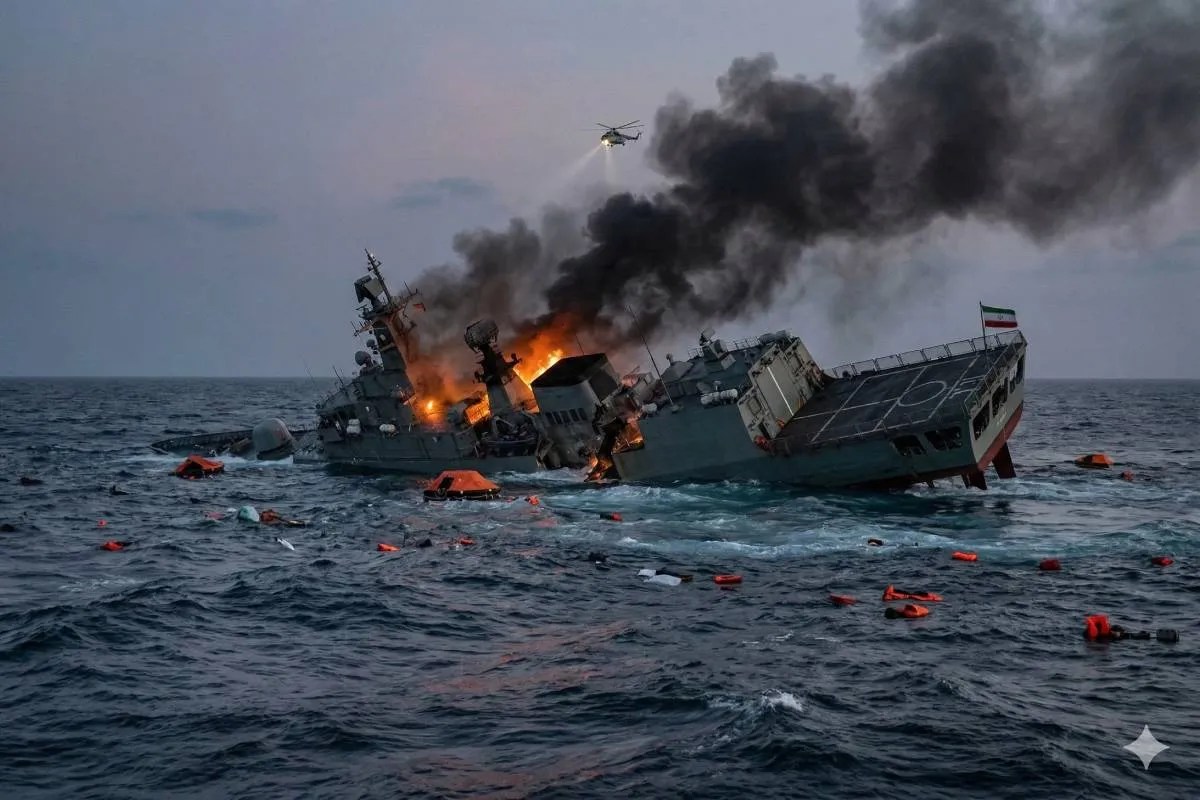
The sinking of the Iranian Moudge-class frigate Sahand (F-74) during a maintenance cycle in Bandar Abbas provides a definitive case study in the intersection of maritime stability physics and operational negligence. While populist narratives focus on the "heroism" of a crew refusing to abandon a sinking vessel, a clinical analysis reveals a breakdown in damage control protocols and naval engineering principles. The loss of a platform that was only commissioned in 2018 suggests that the failure was not an act of God, but a predictable outcome of specific mechanical and procedural variables.
The Stability Equation and Centers of Gravity
To understand why the Sahand capsized while moored, one must evaluate the ship's Metacentric Height ($GM$). Stability in any naval vessel is a function of the distance between the Center of Gravity ($G$) and the Metacenter ($M$). When a ship is undergoing repairs, its $G$ is constantly shifting due to the removal of heavy machinery or the addition of ballast.
The Sahand’s failure likely stems from a Loss of Static Stability caused by:
- Top-heavy loading: If radar systems or upper-deck armaments were being serviced without corresponding weight adjustments in the hull, $G$ rose, narrowing the safety margin of $GM$.
- The Free Surface Effect: This occurs when liquids (water or fuel) move freely in partially filled tanks or flooded compartments. As the ship begins a slight heel, the liquid shifts to the low side, creating a massive upsetting moment that overrides the ship's natural righting energy.
- Compromised Watertight Integrity: For a ship to capsize at a dock, there must be a breach of the hull's "watertight envelope." In a maintenance environment, cables, hoses, and ventilation ducts often run through open hatches, preventing the immediate sealing of compartments during an accidental inflow of water.
The Mechanics of the "No Abandon" Directive
Reports from survivors emphasizing that "no member left the ship" point to a specific command-and-control philosophy that prioritizes asset salvage over personnel safety. In naval doctrine, this is known as Aggressive Damage Control (ADC). However, ADC requires a functional platform. Once a vessel exceeds its Angle of Static Heel, where the righting arm ($GZ$) becomes negative, the capsizing is mathematically inevitable.
The decision to remain on board during a terminal list creates a high-risk environment for "entrapment casualties." When a ship rolls 90 degrees, interior corridors become vertical shafts. Equipment that is not "sea-fastened"—common during repair periods—becomes lethal projectiles. The crew’s refusal to evacuate indicates a rigid adherence to the "Captain remains with the ship" tradition, which, while culturally significant, often hampers professional salvage operations by requiring the diversion of resources toward life-saving rather than stabilization.
Failure Vectors in Portside Maintenance
Maintenance environments are statistically more dangerous for capital ships than open-sea operations due to the suspension of standard "Battle Orders." The Sahand’s incident can be categorized via three primary failure vectors:
Technical Vector: The Ballast Imbalance
During the "balancing" of the ship in the dry dock or at the pier, an error in pumping sequences can lead to an asymmetrical load. If the port-side tanks are emptied while the starboard side remains loaded, or if a valve fails, the ship enters a state of permanent list. If the hull's "reserve buoyancy" is low, even a minor swell or a shifted load can trigger a catastrophic roll.
Environmental Vector: The Bandar Abbas Infrastructure
The port at Bandar Abbas faces specific challenges, including high salinity and temperature, which accelerate the degradation of seals and gaskets. If the Sahand suffered a "sea chest" failure—where the intake valves for engine cooling fail—the engine room would flood at a rate exceeding the capacity of portable bilge pumps.
Human Vector: Procedural Non-Compliance
The presence of a "survivor narrative" often masks the absence of a "preventative narrative." A disciplined damage control team would have identified the list at 5 degrees and initiated counter-flooding or emergency mooring adjustments. That the vessel reached a state of total capsizing suggests a delay in recognition or a lack of functional sensors during the maintenance shutdown.
Comparing the Moudge-Class to Global Standards
The Moudge-class frigates are Iranian-built derivatives of the 1960s-era British Vosper Thornycroft Mark 5. While upgraded with modern electronics, the underlying hull geometry remains a 50-year-old design. Modern naval architecture utilizes Redundant Longitudinal Bulkheads to prevent the rapid lateral shift of water. If the Sahand lacked these modern internal divisions, a single-point failure in the hull would allow water to transit the entire width of the ship, causing an immediate and unrecoverable capsize.
Furthermore, the "stealth" modifications made to the Sahand's superstructure added significant weight above the waterline compared to the original Mark 5 design. This reduces the Righting Lever ($GZ$) at high angles of heel. In simpler terms, the ship is less "forgiving" of weight imbalances than its predecessors.
The Operational Cost of Symbolic Resilience
The insistence that the crew stayed until the end serves a domestic propaganda purpose but signals a weakness in professional naval standards. Strategic depth in a navy is measured by the ability to preserve the "human capital"—the trained technicians and officers—over a replaceable hull. By framing the event as a tale of bravery, the Iranian naval command avoids addressing the systemic technical lapses that led to the sinking of a flagship in a controlled harbor environment.
The tactical reality is that the Sahand is now a "dead asset." Even if salvaged, the immersion of sensitive electronics, propulsion systems, and weapon sensors in seawater causes irreversible galvanic corrosion. The cost of stripping, cleaning, and recertifying every electrical lead often exceeds the cost of new construction.
The loss of the Sahand represents a failure of Systems Engineering. The focus must shift from the survival of the individual to the survival of the platform through rigorous adherence to buoyancy physics and automated monitoring. The primary strategic recommendation for regional naval forces is the implementation of "Cold Iron" monitoring systems—independent sensors that track the $GM$ and heel angle of a vessel even when its primary engines and crews are offline. Failure to respect the math of the sea cannot be compensated for by the courage of the crew.

:strip_icc()/pic2513216.jpg)