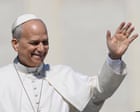
The press is currently hyperventilating because Pope Leo decided to touch down in Monaco, marking the first papal visit in nearly five centuries. They are calling it a "historic reconciliation" and a "spiritual milestone" for the microstate.
They are wrong.
This isn't a spiritual awakening. It is a calculated branding exercise for two of the world’s oldest legacy institutions trying to stay relevant in a century that has largely outgrown them. If you think this visit is about prayer and pastoral care, you haven't been paying attention to the balance sheets of either the Vatican or the House of Grimaldi.
The Myth of the 488 Year Gap
Mainstream outlets love the "488 years" statistic. It sounds weighty. It suggests a long-standing rift or a centuries-old frost that has finally thawed.
The reality is far more mundane. The reason a Pope hasn't set foot in Monaco since the 16th century is because, until recently, they didn't need to. Monaco is two square kilometers of land. The Vatican is 0.44 square kilometers. For most of history, these were two tiny, Catholic-aligned entities that spoke the same language of power and dynastic survival.
They didn't meet because they were already in the same room.
Monaco’s official state religion is Catholicism—a rarity in a secularized Europe. The 1962 Constitution of Monaco explicitly states this. The relationship between the Prince and the Pope has never been broken; it has been institutionalized. This "visit" is a photo-op designed to distract from the fact that both entities are struggling with their 21st-century identities.
One is a tax haven with a PR problem; the other is a spiritual empire with a demographic problem.
The Brand Strategy of the Divine and the Elite
Look at the optics. The Pope, a man who consistently critiques "unbridled capitalism" and the "idolatry of money," is visiting a territory that essentially functions as a private bank for the global 0.1%.
The irony should be deafening.
If this visit were about the "nuance" the media keeps missing, we would be talking about the cognitive dissonance of the Catholic Church endorsing a state built on the proceeds of gambling, luxury real estate speculation, and aggressive tax optimization.
Instead, we get puff pieces about the "historic" nature of the flight path.
The real story is that Monaco needs the Vatican's moral shielding. With the OECD and various European regulators constantly breathing down Prince Albert II’s neck regarding transparency and money laundering, there is no better "laundry" than the spiritual kind.
A papal visit provides a veneer of traditionalist, high-moral-ground legitimacy that no amount of green-initiative PR can buy.
The Fallacy of the Spiritual Hunger in Monte Carlo
"People Also Ask" columns are already filling up with queries like: "Is Monaco becoming more religious?" and "What does the Pope's visit mean for the citizens of Monaco?"
The answer to both is: absolutely nothing.
The residents of Monaco—the ones who actually hold passports—are a tiny minority. The rest are transient wealthy residents who are there for the fiscal climate, not the religious one. The idea that a papal mass in the Saint-Nicholas Cathedral is going to shift the cultural needle of a place that measures success in super-yacht length is a fantasy.
I have seen these high-level state visits before. They are choreographed down to the second. They are designed to produce a specific set of images: the humble Pope in the ornate palace, the blessing of the Grimaldi children, the waving crowds on the Rock.
None of it addresses the structural reality of the Church in Europe.
While the press focuses on this one-day spectacle, they ignore the fact that the Church's influence in its traditional European strongholds is evaporating. In France, Italy, and Spain, church attendance is in a freefall. By visiting Monaco, the Pope isn't reaching out to the "peripheries" he often talks about. He is visiting the ultimate center of established, old-world wealth.
It’s the spiritual equivalent of a vanity project.
The Nuance of the Grimaldi Strategy
Prince Albert II is a shrewd operator. He knows that Monaco’s future depends on it being seen as more than just a playground for the rich. He has pivoted hard toward environmentalism, marine conservation, and now, "historical" religious significance.
The Pope is his latest asset.
By bringing Leo to Monaco, Albert isn't just hosting a world leader. He is asserting Monaco’s place in the "civilizational" hierarchy of Europe. It’s a message to the rest of the EU: "We are one of you. We are the keepers of the old ways. You cannot touch us."
The Pope, meanwhile, gets a platform. He gets to look like a global diplomat capable of bridging the gap between the ultra-rich and the "poor" he champions. It’s a high-stakes game of reputation management.
Why This Matters to You
You might think a papal visit to a tiny principality is irrelevant to your life. You’re wrong because it signals how power will be mediated in the future.
In an era where national borders are becoming increasingly porous for the wealthy and increasingly rigid for everyone else, the alliance between "transnational" entities like the Vatican and "sovereign" enclaves like Monaco is a blueprint for the future.
They are creating a layer of global interaction that exists above the reach of regular democratic processes.
If you want to understand the modern world, stop looking at the G7. Start looking at these small, ancient, and incredibly resilient power players. They have survived 500 years without a face-to-face meeting because they didn't need one. They are meeting now because they are afraid.
They are afraid of a world that is beginning to ask why a religious leader needs a diplomatic passport and why a casino-driven microstate needs a state religion.
The Tactical Error of the "Historical" Narrative
The biggest mistake the competitor article makes—and one most readers fall for—is believing that history is a series of events.
History is a tool.
When a press release mentions "488 years," they are using history to distract you from the present. They want you to think about 1538 instead of 2026. They want you to think about the Reformation instead of the latest offshore tax scandal.
Don't let them.
The fact that it took nearly five centuries for a Pope to visit Monaco isn't a sign of a "thaw." It’s a sign that the necessity of the spectacle has finally outweighed the convenience of the silence.
The Vatican is losing its grip on the masses. Monaco is losing its grip on its status as a "legitimate" sovereign state in the eyes of international regulators.
This isn't a pilgrimage. It's a merger.
Stop looking at the miter. Look at the ledger.