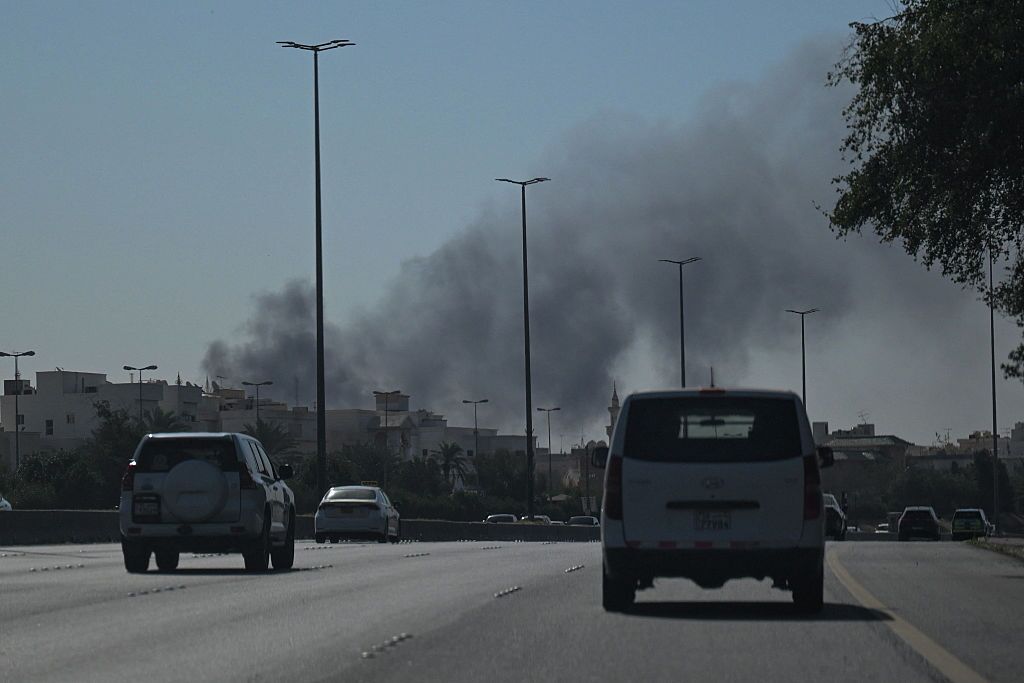
The shadow war between Israel and Iran has stepped out of the darkness and into a brutal, sustained daylight. For decades, the friction between these two powers was managed through proxies, cyberattacks, and deniable assassinations. That era is over. We have entered a period of direct, high-frequency kinetic exchanges where the goal is no longer a decisive victory, but the maintenance of a "manageable" level of violence. This shift isn't a failure of diplomacy—it is a deliberate strategic choice by Tehran, Jerusalem, and Washington to settle into a permanent state of low-to-mid-intensity conflict.
The regional players are no longer looking for an exit ramp. They are building a bigger highway.
The Myth of De-escalation
Every time a missile battery fires or a drone swarm crosses a border, the international community rushes to find a "de-escalation" path. This is a fundamental misunderstanding of the current calculus. Stability is no longer the objective for the ruling elites in either Iran or Israel. For the Islamic Revolutionary Guard Corps (IRGC), a state of constant, controlled friction justifies their grip on the Iranian economy and internal security. For Israel, the old doctrine of "mowing the grass" has evolved into a permanent mobilization that treats war not as an interruption of life, but as its primary backdrop.
Washington, meanwhile, has moved from trying to solve the crisis to merely containing its splash zone. The U.S. presence in the region is now a permanent defensive shield designed to prevent a total collapse while allowing the combatants to trade blows. It is a dangerous equilibrium. It assumes that every player will remain rational and that technical errors won't trigger a total collapse of the system.
The Iron Dome Economy and the Cost of Defense
One of the most overlooked factors in this long conflict is the sheer economic lopsidedness of modern attrition. Iran has mastered the art of cheap, "good enough" technology. A Shahed-136 drone costs roughly $20,000 to produce. It is essentially a flying lawnmower engine strapped to a warhead.
To counter this, Israel and its allies deploy interceptors that cost millions of dollars per shot. The Arrow-3 and David’s Sling systems are engineering marvels, but they represent a massive financial drain. When Iran launches a massive salvo, the cost to defend against it is often ten to twenty times the cost of the attack itself.
Israel’s defense industry is sprinting to close this gap with directed-energy weapons. The Iron Beam laser system is the Great White Hope of the Israeli defense establishment. If it works as advertised, it would reduce the cost per interception to the price of the electricity used to fire the beam—pennies on the dollar. However, laser technology is limited by weather, atmospheric interference, and line-of-sight constraints. Until it is fully operational and scalable, the economic advantage in a war of attrition remains firmly with the side firing the cheap drones.
The Proxy Evolution
The "Axis of Resistance" is no longer a loose collection of militias. It has become a synchronized, multi-front military architecture. We are seeing a level of command-and-control integration between Hezbollah in Lebanon, the Houthis in Yemen, and various groups in Iraq that was previously theoretical.
This isn't just about Iran giving orders. It’s about a shared ecosystem of intelligence and hardware. When the Houthis successfully disrupt Red Sea shipping, they aren't just helping Iran; they are proving that a secondary actor can hold global trade hostage for a fraction of the cost of a traditional navy. This creates a "saturation" effect. Israel cannot focus its entire military weight on one front because the threat is now 360 degrees, 365 days a year.
The Lebanon Trap
Hezbollah remains the most potent non-state military on the planet. Their rocket inventory is estimated at over 150,000 projectiles. The reason a full-scale ground invasion of Southern Lebanon is so terrifying to Israeli planners isn't just the casualties; it’s the depletion of interceptor stockpiles. If Hezbollah fires 3,000 rockets a day, the Iron Dome will eventually run dry. At that point, the conflict shifts from a high-tech defensive success to a visceral, devastating slog that the Israeli domestic population has not experienced since 1948.
The American Buffer Under Pressure
The United States is currently acting as the region’s high-priced janitor. It cleans up the mess, prevents the fires from spreading, but never actually fixes the wiring. The U.S. Central Command (CENTCOM) is now a permanent air-defense coordinator for a coalition that includes unlikely partners.
This creates a paradox. The more successful the U.S. is at intercepting Iranian threats, the less pressure there is on the regional players to actually negotiate. By removing the immediate consequences of Iranian aggression, the U.S. accidentally enables the "long war" to continue.
Furthermore, the American public’s appetite for this involvement is thinning. The U.S. is burning through its own stockpiles of SM-3 and SM-6 interceptors to protect shipping lanes in the Red Sea. These are the same munitions needed to deter a potential conflict in the Pacific. The "long conflict" in the Middle East is actively degrading American readiness for a confrontation with a near-peer competitor like China.
The Nuclear Threshold as a Shield
Iran has realized that they don't need a finished nuclear bomb to reap the benefits of having one. By maintaining "breakout capability"—the ability to produce weapon-grade uranium within weeks—they have created a permanent shield.
Any attempt by Israel or the U.S. to decisively end the Iranian regime's conventional threats is met with the silent threat of a nuclear sprint. This has created a ceiling on how hard Israel can hit back. Both sides are fighting with one hand tied behind their backs, ensuring that neither can win, but both can keep fighting. This is the definition of a "frozen conflict" that is paradoxically boiling hot.
The Failure of Intelligence and the Rise of AI War
We are entering an era where human decision-making is being outpaced by the speed of the battlefield. Israel's use of AI-driven target generation, such as the "Gospel" system, allows for a volume of strikes that was previously impossible. This technology can identify and approve targets at a rate that human intelligence officers cannot match.
While this makes the military more efficient, it also removes the "friction" that usually slows down a war. When targets are generated and struck with clinical, automated precision, the political pressure to stop the fighting diminishes. The war becomes a background process, a series of data points on a screen that can be managed indefinitely.
The Domestic Survival Instinct
Ultimately, the long war persists because it serves the domestic political needs of the leaders involved. In Tehran, the threat of the "Zionist entity" is the glue holding a fractured, economically depressed society together. In Israel, the constant threat of annihilation makes the internal political divisions over the judiciary and the soul of the state feel secondary.
When war becomes the foundation of your political identity, peace is not just difficult—it is a threat to your power.
This conflict will not end with a treaty signed on a lawn. It will not end with a decisive military victory that forces a surrender. It will continue as a series of calibrated pulses, a rhythm of violence that the world will eventually grow used to, much like the background noise of a busy city. The "long conflict" isn't a transition period; it is the new permanent reality.
If you want to understand where this goes, stop looking for the peace plan and start looking at the defense procurement budgets. The money is betting on a war that never ends.
Move your assets out of the line of fire and accept that the map has been redrawn in blood and titanium.