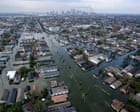
The bureaucrats and ivory-tower academics are at it again. They have a new favorite hobby: drafting blueprints for the slow-motion death of New Orleans. You have seen the headlines. They call it "managed retreat." They wrap it in the sterile language of climate adaptation, citing rising waters and the inexorable sinking of the Mississippi Delta. They suggest that the only rational, scientific choice is to pack up and move.
It is a lie. It is not science; it is bureaucratic surrender disguised as pragmatism.
The argument for abandoning New Orleans ignores the fundamental reality of why cities exist in the first place. You do not build a city for its elevation. You build it for its utility. And New Orleans is perhaps the most essential piece of physical infrastructure in the Western Hemisphere. To suggest "relocation" is to reveal a total ignorance of global trade, economic history, and engineering potential.
The Economic Anchor
Let us start with the math the relocation crowd conveniently ignores. The Port of New Orleans and the associated facilities along the Mississippi River constitute the most vital logistics artery in the United States. We are talking about the gateway for the American heartland. Grain, oil, steel, chemicals—a massive percentage of the country’s export capacity relies on the river flow through this specific point on the map.
Proponents of retreat treat New Orleans like a residential suburb that can simply be rebuilt in a safer zip code. This is an embarrassing misunderstanding of logistics. You cannot move the mouth of the Mississippi River. The geography dictates the commerce. If you abandon New Orleans, you do not just lose a cultural hub; you decapitate the economic potential of the entire mid-continent.
Infrastructure is not a moveable feast. It is an anchor. When you calculate the cost of "retreat," you never see the analysts account for the destruction of trillions in supply chain value. They look at property values and flood insurance premiums. They ignore the foundational reality that moving a port requires an act of God, or at the very least, a complete restructuring of the North American economy. It is not an option. It is a fantasy.
The Engineering Cowardice
The "managed retreat" narrative thrives on a specific kind of defeatism. It assumes that because the water is coming, we are helpless. This is a choice, not a fate.
Look at the Netherlands. A large portion of that nation sits below sea level. They do not hold summits on how to relocate Amsterdam. They build. They engineer. They dominate the water. We have the technology to manage the water in Louisiana. We have the hydrological models. We have the concrete, the steel, and the, expertise to fortify, pump, and divert.
What we lack is the political spine to execute long-term engineering vision. We prefer short-term election cycles to multi-decade infrastructure investments. Every time the water rises, we act surprised. We act as if the concept of a delta is a new discovery. We blame the environment instead of admitting that our maintenance culture is broken.
When you refuse to fund the pumping stations, the levees, and the sediment diversion projects necessary to rebuild the marshes, you are not being "realistic" about the climate. You are actively choosing to let the infrastructure decay so that you can later point at the ruin and say, "See? We have to leave." It is a self-fulfilling prophecy.
The Sunk Cost Fallacy
The loudest voices for retreat love to mention the "sunk cost fallacy." They argue that putting more money into New Orleans is "throwing good money after bad."
This is the opposite of the truth.
In business, when an asset is critical to your core operation, you do not abandon it because the maintenance costs rise. You upgrade the asset. You protect it. You look for efficiency gains.
New Orleans is the ultimate high-value asset. The cost to defend it is high, yes. But the cost to replace the utility it provides is infinite. If you think the public appetite for spending on infrastructure is low now, wait until the supply chains collapse and the cost of grain exports triples because the southern gateway is gone.
Managed Retreat Is A Political Poison
The people who advocate for "managed retreat" are usually not the ones with their lives and livelihoods tied to the city. It is a top-down, condescending approach that ignores the agency of the people actually living there.
When you frame a city as a "sunk cost," you erode the social contract. You stop investing. You let the insurance market dictate the future of a region. You create a cycle of poverty and blight by signaling to investors and residents that the place has an expiration date.
This creates a ghost town effect. People with the means to leave will leave. People with deep roots or a lack of options stay, watching their property value and their municipal services evaporate. By predicting the end of the city, the planners accelerate the collapse. It is a form of social engineering that destroys communities from the inside out.
Stop Trying To Fix The Climate, Start Fixing The Infrastructure
The user intent behind every article about New Orleans relocation is fear. It is a search for a clean, easy solution to a complex, messy reality.
The brutal truth is that there is no clean solution. You are not going to move the city. You are not going to escape the water. The only path forward is to commit to the fight.
This means shifting from a "defensive" posture to an "offensive" one.
Stop the endless, circular studies about "if" we should stay. That money belongs in the ground. It belongs in the levees. It belongs in the sediment diversion projects that actually build land instead of just fighting the inevitable erosion. It belongs in a massive, coordinated effort to turn the Mississippi Delta into an amphibious engine of trade and energy.
Imagine a scenario where we stopped treating New Orleans like a disaster waiting to happen and started treating it like a national security priority, similar to how we treat the power grid or the interstate highway system.
If you want to talk about climate, talk about resilience. Talk about the billions spent on disaster relief that could have been spent on preventative hardening. Talk about the political corruption that allowed vital flood infrastructure to languish for decades.
Do not talk about packing up. It is lazy. It is cowardly. And it is the most expensive mistake this country could ever make.
The Mic Drop Reality
The next time you see a headline about the "inevitability" of New Orleans' decline, ask yourself who benefits from that narrative. It isn't the people of New Orleans. It isn't the American taxpayer. It is the planners who want to avoid the hard work of maintenance.
We are not leaving. We are not relocating. We are going to dig in, engineer our way through the rising tides, and secure the most important trade node on the continent. The debate is over. The only thing left to do is build.