The table was set for six, but the energy in the room felt muted. My friend Sarah pushed a piece of rosemary-crusted chicken around her plate, her movements slow, precise, and entirely devoid of the usual enthusiasm she brought to a dinner party. There was no laughter about how good the sauce was. There were no requests for seconds. She wasn’t just eating less. She was vibrating on a different, thinner frequency.
I watched her, remembering the Sarah of three months ago—a woman who lived for the Sunday brunch, who would curate a cheeseboard with the intensity of a museum curator. Now, she was simply present. Or perhaps, she was mostly absent.
We are living through a profound cultural migration. It is not a movement across borders, but a migration into the body itself. We have found a chemical key that unlocks the door to a leaner existence, a way to hush the relentless noise of hunger that has plagued humanity for as long as we have been walking the earth. The drugs—Ozempic, Wegovy, Zepbound—are everywhere. They are the subject of hushed whispers at gym lockers and the bold, brash headlines of magazines in the grocery aisle.
But as we collectively shed the weight, we are beginning to notice something else leaving the room with it.
The Volume Knob on Desire
To understand what is happening, you have to look past the scale. You have to look at the brain.
Think of your reward system as a crowded nightclub. For most of my life, my hunger was the loudest patron in that club. It danced on the tables, demanded the DJ play its favorite songs, and occasionally started fights with my willpower. It was a constant, driving force—a craving for salt, for fat, for the dopamine hit of a warm cookie after a long day.
These medications act like a very firm, very effective bouncer. They don't just kick the loudest patron out; they turn down the music in the entire club.
The biological mechanism is elegant. These drugs mimic a hormone called glucagon-like peptide-1, or GLP-1. In a healthy body, this hormone signals to the brain that you have had enough. It tells your gut to slow down, to hold onto that food a little longer. But in the modern, ultra-processed environment where our brains are constantly bombarded with food cues, our internal signals have become frantic.
When you inject these drugs, you aren't just curbing appetite. You are dampening the circuitry that seeks out pleasure. And this is where the trouble begins.
If you turn the volume down on the desire for food, does the volume for everything else stay the same?
Sarah sat across from me, and I realized with a jolt that the answer is no. When the chemical hum of hunger vanishes, it takes the background radiation of joy with it. She wasn't just losing weight; she was losing the ability to be interested in the world. She reported feeling "flat." The colors seemed less saturated. The music she used to crank up in her car didn't hit the same way.
The Cost of the Empty Room
We call it the "Ozempic personality." Doctors, of course, have other words for it. They talk about anhedonia, a medical term for the loss of the ability to feel pleasure. It is a known, if rarely discussed, shadow cast by these powerful molecules.
The pharmaceutical companies will tell you that the side effects are primarily gastrointestinal. Nausea. Vomiting. Constipation. The digestive system is a temperamental machine, and when you slam the brakes on it, it tends to sputter. Anyone who has taken these drugs can tell you about the midnight cramps, the sudden, violent rejection of a meal that didn't sit quite right.
But the physical reality is only half the story.
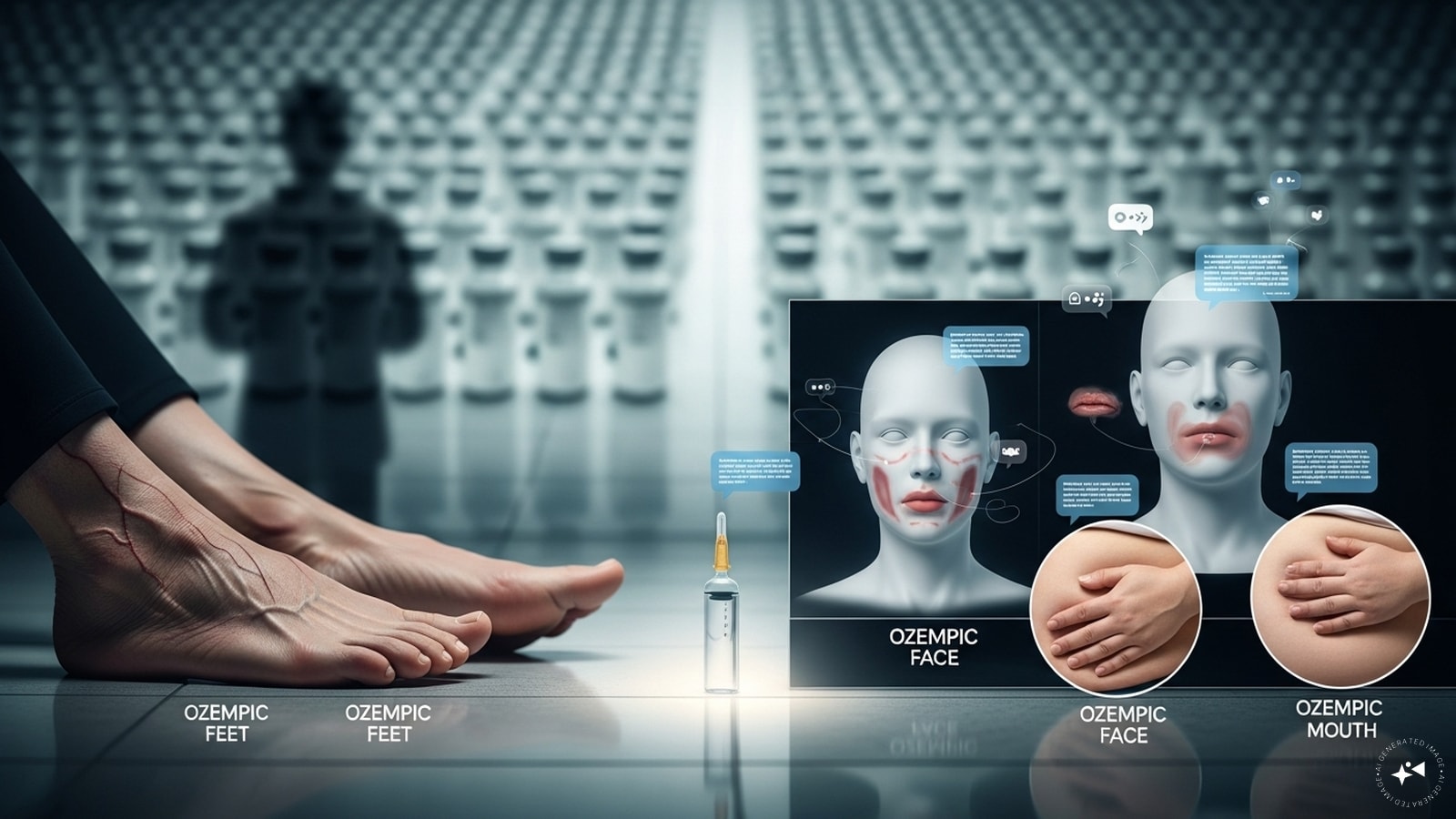
Consider the "Ozempic face." It is a term that sounds like a tabloid invention, but it is a visceral reality for many. When you lose weight with this speed, your body does not have time to adjust its infrastructure. The fat pads that support the cheeks, the jaw, and the skin around the eyes vanish overnight. What remains is a sagging, tired visage—a face that looks like it has aged ten years in ten weeks.
It is a strange irony. We take these drugs to look younger, to feel more vibrant, to fit into a societal standard of beauty that demands a specific, narrow shape. And yet, the cost is often a face that looks hollowed out, a reflection in the mirror that feels like a stranger.
I spoke with a man named Mark, an executive who had dropped forty pounds in three months. He felt, by all medical metrics, healthier. His blood pressure was down. His cholesterol was stellar. But he described his existence as living behind a pane of glass. He was doing everything he used to do—leading meetings, playing with his kids, going to the gym—but he felt like he was watching a movie of his own life rather than living it.
"I don't crave anything," he told me, his voice devoid of inflection. "Not food. Not excitement. Not even the finish line I thought I was running toward. I just exist."
The Mirror and the Molecule
We have to ask ourselves what we are actually chasing.
For decades, we have been told that our weight is a moral failing, a sign of laziness or a lack of discipline. When a drug comes along that removes that weight without the need for the grueling, repetitive struggle of diet and exercise, it feels like a miracle.
It feels like the cheat code we’ve been waiting for.
But biology is not a game you can hack without consequences. We are deeply complex, evolved organisms. Our hunger is not just a nuisance. It is an engine. It is the drive that gets us out of bed in the morning to hunt, to gather, to build, to create. It is linked to our reproductive drive, our social drive, and our creative drive.
When you mute the hunger, you are muting the primal urge to reach out and grab the world.
There is a terrifying vulnerability in admitting this. We want the weight loss to be pure gain. We want the thin body without the hollow spirit. We want the medical miracle to have no strings attached. But the strings are there, tethered to our very biology.
Maybe the "Ozempic personality" is not a side effect at all. Maybe it is the price of admission for a body that is no longer allowed to want.
The Invisible Stakes
If you are considering this path, you must be honest with yourself about what you are willing to trade.
This is not a condemnation of the medication. For many, these drugs are life-saving tools. They stabilize blood sugar, they protect the heart, and they provide a necessary exit ramp from the crushing weight of obesity. There is no moral high ground in denying someone a medical intervention that can improve their health markers.
However, the medical community has been far too slow to address the psychological toll. We need to stop treating the body like a separate, manageable machine. We are not just vessels for organs and adipose tissue. We are minds, emotions, and memories wrapped in skin.
When you change your chemistry, you change your narrative.
I think back to that dinner party. I think about the way Sarah looked at her plate, not with disgust, but with indifference. The indifference was the most chilling part. If we lose the ability to crave a warm meal, a good conversation, or the tactile joy of living, have we actually gained anything? Or have we just optimized our bodies into a state of hollow, efficient silence?
There is no easy answer. There is only the weight of the choice.
As I sat there, the conversation drifted to other things—the weather, a new movie, the mundane rhythms of our lives. Sarah chimed in, perfectly polite, perfectly stable. But the sparkle was missing. The erratic, beautiful, hungry, flawed humanity that made her who she was—it had been dialled down.
She was thin. She was healthy. She was, in every measurable way, doing better.
But as I looked at her, I felt a deep, aching sadness. I realized that in our rush to sculpt our bodies into the ideal, we are risking the erosion of the self. We are becoming lighter, yes. But we are also becoming less dense, less present, and perhaps, in the quietest, most private moments, just a little bit less alive.
The plate was taken away, still half-full. The dinner party ended. And as we walked out into the cool night air, I felt the sharp, sudden hunger of my own existence—a reminder that despite the discomfort, despite the flaws, the wanting is what makes us human.
We must be careful what we choose to silence. Once the volume is turned down, it is very hard to turn it back up.