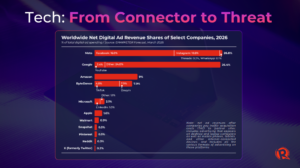
Big tech is breaking the news industry. For a decade, newsrooms played a dangerous game. They traded their soul for reach on Facebook and X. Now, the bill's come due. Algorithms have changed, traffic has dried up, and AI is scraping every bit of value left in the carcass of the open web.
Maria Ressa and her team at Rappler have seen enough. They're pivoting. They aren't just tweaking their strategy; they’re building an entirely new infrastructure to survive. If you’re a publisher or a creator, you should pay attention. This isn't just about the Philippines. It’s a blueprint for anyone who doesn't want to be a digital sharecropper on Mark Zuckerberg's farm.
The era of platform dependence is officially dead
Rappler used to get huge numbers from Facebook. Most news sites did. Then Meta decided news was a buzzkill. They throttled links. They prioritized "meaningful social interactions" over facts. Traffic tanked. According to data from the Reuters Institute, referral traffic from Facebook to news sites fell by 48% in 2023 alone. That's a death sentence if you rely on ad impressions.
It’s even worse now with AI. Google’s Search Generative Experience (SGE) and tools like Perplexity don't just find links. They summarize them. Why would a user click on a Rappler investigation when an AI bot gives them the "too long; didn't read" version for free? The bots are taking the juice and leaving the husk.
Rappler's response? Build a walled garden. They’ve launched "Lighthouse," their own community platform. It’s a move back to the old web where you actually owned your audience. No middleman. No algorithm. Just a direct line to the people who give a damn about what you write.
Why community beats reach every single time
Chasing "reach" was a mistake. We all did it. We optimized for the click, the share, and the like. But likes don't pay the bills when the platform keeps the data and the ad revenue.
Lighthouse isn't just a website. It’s a distributed network. Rappler is moving their community away from the toxic sludge of social media comments and into a space they control. They’re using a protocol called Matrix. It’s decentralized. It means they own the relationship. If Facebook disappears tomorrow, Rappler’s core audience is still there.
This isn't just about tech; it's about trust. When you’re on a platform, you’re competing with cat videos and conspiracy theories. In your own space, you set the rules. You define the culture. Rappler is betting that a smaller, deeply engaged audience is worth more than ten million drive-by scrollers who can’t remember your name five seconds after they close the app.
Breaking the cycle of outrage
Algorithms love anger. They feed on it. The more polarized we are, the more money the platforms make. By shifting away from these platforms, Rappler is trying to break that cycle. They want to move from "information operations"—which were used to attack them under the Duterte administration—to "community actions."
They’re focusing on "action clusters." These are groups of people working on specific issues like climate change or human rights. It’s a transition from being a passive news consumer to an active participant. That’s a bold claim. It’s also incredibly hard to pull off. But what’s the alternative? Staying on X and screaming into the void?
The AI threat isn't just about theft
Everyone talks about AI "stealing" content. That’s part of it. But the real threat is the destruction of shared reality. When AI can generate infinite amounts of "pink slime" news—low-quality, AI-generated junk that looks like journalism—the signal-to-noise ratio goes to zero.
Rappler is doubling down on human expertise. They’re using AI internally for things like translation and data analysis. That’s smart. Use the tool to do the grunt work. But the final product has to be human. People want to know a real person stood behind the words. They want to know someone actually went to the scene, talked to the sources, and verified the facts.
Transparency is their new currency. They’re leaning into "Newsbreak," their investigative arm. Deep reporting is expensive. It's slow. It's the exact opposite of what an algorithm wants. And that’s exactly why it’s valuable. You can’t prompt an AI to do a six-month investigation into government corruption. Not yet, anyway.
Rebuilding the revenue model from the ground up
You can't have independence without money. The old model of "give it away for free and hope for ads" is over. Rappler is pushing a membership model. Not a subscription—a membership.
There's a difference. A subscription is a transaction. I give you five bucks, you give me a magazine. A membership is an investment. You’re joining a cause. You’re saying, "I believe this journalism needs to exist, so I’m going to help fund it."
This only works if you have a community. You can’t ask for membership from a stranger who found you through a Google snippet. You have to nurture them. You have to show them the value. Rappler is using their app to do this. They're pushing people to download the app, sign up for newsletters, and join their Matrix rooms. They’re building a funnel that leads away from the open, chaotic web and into a focused, high-value ecosystem.
The danger of the walled garden
There's a risk here. If you move all your best stuff behind a wall or into a private app, you lose your ability to influence the wider world. You become an echo chamber.
Rappler knows this. They still maintain a presence on social media, but they use it as a billboard, not a home. They post snippets. They engage just enough to pull people back to their own turf. It's a "hybrid" approach. It acknowledges that you can't ignore the platforms entirely, but you can't let them hold you hostage either.
What you should do right now
If you’re running a business, a blog, or a news site, you need to audit your traffic sources today. If more than 30% of your visitors come from a single platform, you're in trouble. You're one algorithm update away from bankruptcy.
Start building your own list. Email is still the king of direct communication. It’s old, it’s unsexy, and it works. Get people onto a newsletter. Get them into a Discord or a private community. Give them a reason to visit your site directly.
Stop writing for the bots. Stop stuffing your articles with keywords and "SEO-friendly" filler. Write for the human on the other side of the screen. If you provide enough value, they'll find you. They'll bookmark you. They'll pay for you.
The platforms aren't your friends. They’re your competitors. They want the user's time and data. You want the user's trust. Only one of those things is sustainable in an AI-saturated world.
Rappler's shift is a wake-up call. It's time to stop renting your audience and start owning it. The transition is painful. It requires more work, more tech, and a complete change in mindset. But the alternative is fading into irrelevance as a footnote in a large language model's training data. Don't let that be your story.
Move your community to a platform you own. Invest in deep, human-led content that AI can't replicate. Pivot your revenue to direct support rather than fickle ad networks. These are the steps to survival. Start now.