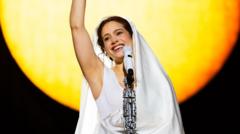
The critics are weeping in London because Rosalía brought a white floor and a few cameras to the stage. They call it a "heavenly" breakthrough. They call it the future of live performance. They are wrong. What they witnessed wasn't a revolution in stagecraft; it was the ultimate surrender to the vertical screen.
We have entered an era where the live experience is being cannibalized by the "content" it produces. When you strip the stage of its physical depth and replace it with a roving cameraman who projects a filtered, high-definition version of the singer onto a giant screen, you aren't watching a concert. You’re watching a live-streamed music video from thirty rows back. Rosalía didn't reach for heaven in London; she reached for the TikTok algorithm and squeezed it until it bled engagement metrics.
The Myth of Minimalist Authenticity
The prevailing narrative suggests that the Motomami tour’s lack of props is an act of artistic bravery. The "lazy consensus" is that by removing the artifice of traditional arena tours—the pyrotechnics, the rising platforms, the backing bands—Rosalía is exposing her raw soul.
Actually, she’s just lowering overhead while maximizing social media "shareability."
I have watched promoters spend decades trying to figure out how to make a 20,000-seat arena feel intimate. Usually, that involves building bridges or B-stages to get closer to the fans. Rosalía’s solution is to ignore the physical space entirely. She performs for the lens, not the room. This isn't "intimacy." It is a highly curated simulation of intimacy. By focusing every movement on how it looks through a 9:16 aspect ratio, the artist treats the physical audience as mere background extras in a digital broadcast.
The Death of the Backing Band
Where are the musicians? In the "heavenly" London show, the music is a sequence of files triggered by a technician. The industry likes to pretend this is a stylistic choice reflecting the digital nature of reggaeton and hyper-pop.
Let's be honest about the mechanics of the industry. Touring is the only way artists make real money in the streaming age. One of the biggest line items in a tour budget is the payroll for a world-class band, their travel, their lodging, and their insurance. By eliminating the band, the profit margin on a tour spikes significantly.
- Traditional Tour Economics: Band (5–8 people), Backline Techs, Sound Engineers for live instruments.
- The Motomami Model: One singer, a group of dancers, and a hard drive.
Calling this "visionary" is a gift to record labels and management firms. It validates the idea that we don't need live instrumentation to justify a triple-digit ticket price. If we accept this as the gold standard, we are telling the industry that we are happy to pay $150 to watch someone sing over a backing track because the lighting is "aesthetic."
The Cinematography Trap
The London show relied heavily on a steady-cam operator who followed Rosalía around like a shadow. The resulting footage, projected on massive screens, is beautiful. It looks like a film. But therein lies the deception.
When you go to a live event, your eyes should be free to roam. You should be able to watch the sweat on the artist's brow, the interaction between dancers in the corner, or the way the light hits the back of the hall. By forcing the audience to watch a "live film" on the screens, Rosalía is dictating your gaze. She is editing the live experience in real-time.
Imagine a scenario where you go to a world-class restaurant, but instead of eating the food, you are required to watch a professionally shot video of the chef eating that same meal on a screen above your table. You can smell the food, sure. You’re in the room with the chef. But the actual sensory experience has been mediated and sanitized.
This "cinematic" approach is a clever way to mask the limitations of the arena. Arenas are sterile, concrete boxes with terrible acoustics. By flooding the visual field with high-end cinematography, the artist distracts you from the fact that you’re sitting in a cold plastic chair in a cavernous barn.
The Flamenco Fallacy
Critics love to cite Rosalía’s flamenco roots as a justification for her minimalism. They argue that the tablao is inherently sparse. This is a fundamental misunderstanding of flamenco.
Traditional flamenco is about duende—a physical, unpredictable manifestation of soul that relies on the tension between the singer, the guitarist, and the dancer. It is an acoustic conversation. It is dangerous because it can fail. Rosalía’s current setup is the opposite of flamenco. It is perfectly programmed. There is no room for the duende to enter because the camera cues are too precise. The dancers are incredible, but they are moving to a grid.
When you remove the variable of live musicians, you remove the soul of the performance. You trade the "danger" of a live show for the "safety" of a polished product.
Why the Fans Don't Care (And Why They Should)
If you ask the average fan at the O2, they’ll tell you it was the best night of their lives. Of course they will. They spent a week’s wages to be there. But they also spent half the night holding their phones up, capturing the exact same footage the professional camera was already projecting.
The "Motomami" tour is designed for the phone. The white stage acts as a giant lightbox, ensuring that every fan’s photo has perfect lighting and zero background clutter. It is a masterpiece of brand consistency.
But what happens to the art when it is designed primarily to be photographed? It becomes static. It becomes a series of poses. We are witnessing the "Instagrammification" of the stage. This isn't just happening to Rosalía; she’s just the one doing it most successfully.
The High Cost of the "New Standard"
The danger of praising this minimalist approach as "heavenly" is that it sets a precedent for the entire industry.
- Ticket Prices Won't Drop: Even as production costs (like bands and physical sets) decrease, ticket prices continue to climb. Fans are paying more for less physical substance.
- Homogenization: If a white floor and a camera are all you need to win a five-star review, why would any artist take the risk of building something complex or hiring live talent?
- The Loss of Shared Reality: When everyone is looking at the screen instead of the stage, the collective energy of the crowd is fractured. We are all just watching the same video in the same room, together but alone.
We should be demanding more. We should be demanding that superstar artists use their massive budgets to push the boundaries of what is physically possible in a space, not just what looks good on a smartphone.
Minimalism in art is supposed to strip away the unnecessary to reveal a deeper truth. In the case of modern pop tours, minimalism is often just a sophisticated way to hide the fact that the industry has figured out how to sell us a broadcast for the price of a performance.
Rosalía is a generational talent. Her voice is a weapon. Her vision is undeniable. But let’s stop pretending that her tour is a gift from the heavens. It’s a highly efficient, corporate-approved, camera-ready product that prioritizes the digital ghost over the living, breathing reality of the room.
If this is the future of live music, the "live" part is already dead. We’re just attending the funeral in very expensive shoes.