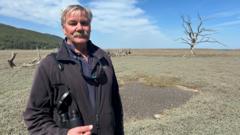
The air in the village of Cley next the Sea carries a particular weight. It is thick with the scent of brine, decaying reeds, and the heavy silence of a landscape that knows it is on loan from the North Sea. For generations, the people here looked at the marshes and saw a predictable, managed beauty. Then came 2013.
The storm surge of that December didn't just break the banks. It shattered a long-held delusion. We thought we were in control of the tide. We were wrong. When the North Sea rose up and poured over the gravel ridges, it swallowed the freshwater grazing marshes that birdwatchers and locals had spent decades "protecting." Meanwhile, you can read related events here: The Esequibo Myth Why Guyana and Venezuela are Both Playing a Losing Game.
At the time, it felt like a funeral. I remember the sight of the seawater retreating, leaving behind a gray, sodden wasteland. The grass died. The freshwater insects vanished. To the human eye, it was a catastrophe—a "precious" habitat destroyed by a single night of violence. But nature doesn't operate on a human calendar. It doesn't share our sentimentality for how things used to be.
While we were mourning the loss of the old, the earth was busy breathing again. What the hurricane-force winds and the surge actually did was perform a violent, necessary surgery. By flooding the land with saltwater, the storm hit a massive reset button. It paved the way for the return of the saltmarsh, a habitat so rare and so efficient at sequestering carbon that it makes a standard forest look like an amateur. To understand the bigger picture, check out the excellent analysis by The Washington Post.
The Engineering of a Miracle
To understand why this "disaster" was actually a gift, you have to look at the chemistry beneath your boots. A freshwater marsh is a delicate, static thing. It requires constant human intervention—pumps, sluices, and endless maintenance—to keep the salt out. It is a garden disguised as wilderness.
A saltmarsh, however, is an engine.
When the tide flows in and out, it brings with it fine silts and organic matter. This sediment settles among the specialized plants like glasswort and sea lavender. These plants are the ultimate survivors. They thrive in conditions that would kill almost any other vegetation. As they trap the silt, the ground literally rises. It builds itself.
This isn't just about pretty purple flowers in the summer. It’s about survival. A saltmarsh acts as a natural shock absorber for the coast. Every square meter of marsh can absorb thousands of liters of water, slowing down the energy of the next big storm before it hits human front doors. While we were busy building concrete sea walls that eventually crack and fail, the marsh was offering us a barrier that heals itself.
Consider a hypothetical local named Elias. Elias grew up fishing these waters. To him, the surge was a thief. It took the grazing land where his neighbor's cattle once stood. But five years later, Elias notices something strange. The water near his boat is clearer. The fish seem more plentiful. This isn't a coincidence. Saltmarshes act as "nurseries" for the ocean. Young bass, herring, and grey mullet hide in the winding tidal creeks, protected from larger predators. The "destruction" of the pasture gave birth to a sanctuary.
The Invisible Stakes
We often talk about climate change as a future threat, something involving melting glaciers in a distant land. But the transformation of the Norfolk coast is climate change in real-time, right in our backyard. It forces us to ask a terrifying question: Do we try to freeze the world as it is, or do we let it become what it needs to be?
The saltmarsh is a powerhouse of "Blue Carbon." Because the soil is waterlogged and anaerobic (lacking oxygen), the organic matter trapped by the plants doesn't decay and release CO2 back into the atmosphere. Instead, it buries it. A saltmarsh can store carbon at a rate up to 50 times faster than a tropical rainforest.
We are standing on a literal carbon sink, created by a storm we once called a tragedy.
This brings us to the emotional friction of conservation. It is easy to love a redwood forest or a coral reef. It is harder to love a muddy, salty bog that smells of sulfur when the tide is out. Yet, our survival might depend more on the bog. We have spent centuries fighting the sea, trying to pin the coastline down like a map on a table. The 2013 surge was the sea’s way of telling us that the map is fluid.
The Return of the Wild
If you walk the paths near Cley or Blakeney today, you won’t see a graveyard. You will see a vibrant, chaotic explosion of life. You’ll see the spoonbill, a bird that looks like a prehistoric fever dream, sweeping its bizarre beak through the shallow pools. You’ll hear the haunting, melodic whistle of the curlew.
These creatures didn't come here despite the salt; they came because of it.
The transition wasn't easy. There were heated meetings in village halls. There were arguments about "managed realignment"—a polite bureaucratic term for letting the sea have its way. People felt abandoned by the government. They felt the land was being "given up." It’s a valid fear. When your family has farmed a patch of earth for two hundred years, being told it’s now a "dynamic intertidal zone" feels like an insult to your ancestors.
But the reality is more nuanced. By allowing the saltmarsh to return, we aren't losing land; we are gaining a future. The freshwater marshes were dying anyway. The cost of pumping them out was becoming unsustainable. The sea was always going to win. The 2013 surge just accelerated the surrender, turning it into a strategic retreat rather than a chaotic rout.
The Wisdom of the Surge
Nature has a memory much longer than ours. The saltmarsh existed here long before we decided to drain it for cows. By breaking the banks, the storm wasn't "creating" something new as much as it was "remembering" what the land used to be. It reclaimed its identity.
We are forced to be humble. We have to admit that our best engineering can't match the elegant complexity of a tidal creek. We have to accept that beauty isn't always a manicured lawn or a calm lake. Sometimes, beauty is a jagged, muddy lung breathing with the pulse of the moon.
The lesson of the 2013 surge is one of radical acceptance. We can spend billions of pounds and endless energy trying to hold back the inevitable, or we can learn to work with the forces that shaped our planet. The saltmarsh is a testament to resilience. It shows us that out of the wreckage of our plans, something more robust, more functional, and more vital can emerge.
Tonight, when the tide comes in, it will flood those creeks again. It will bring in the silt. It will feed the glasswort. It will bury the carbon of a thousand exhaust pipes deep into the mud. The village of Cley will sleep, protected by a barrier of mud and weeds that we didn't build, but finally had the wisdom to allow.
The marsh is not a wound. It is the scar tissue of the earth, and it is stronger than the skin it replaced.