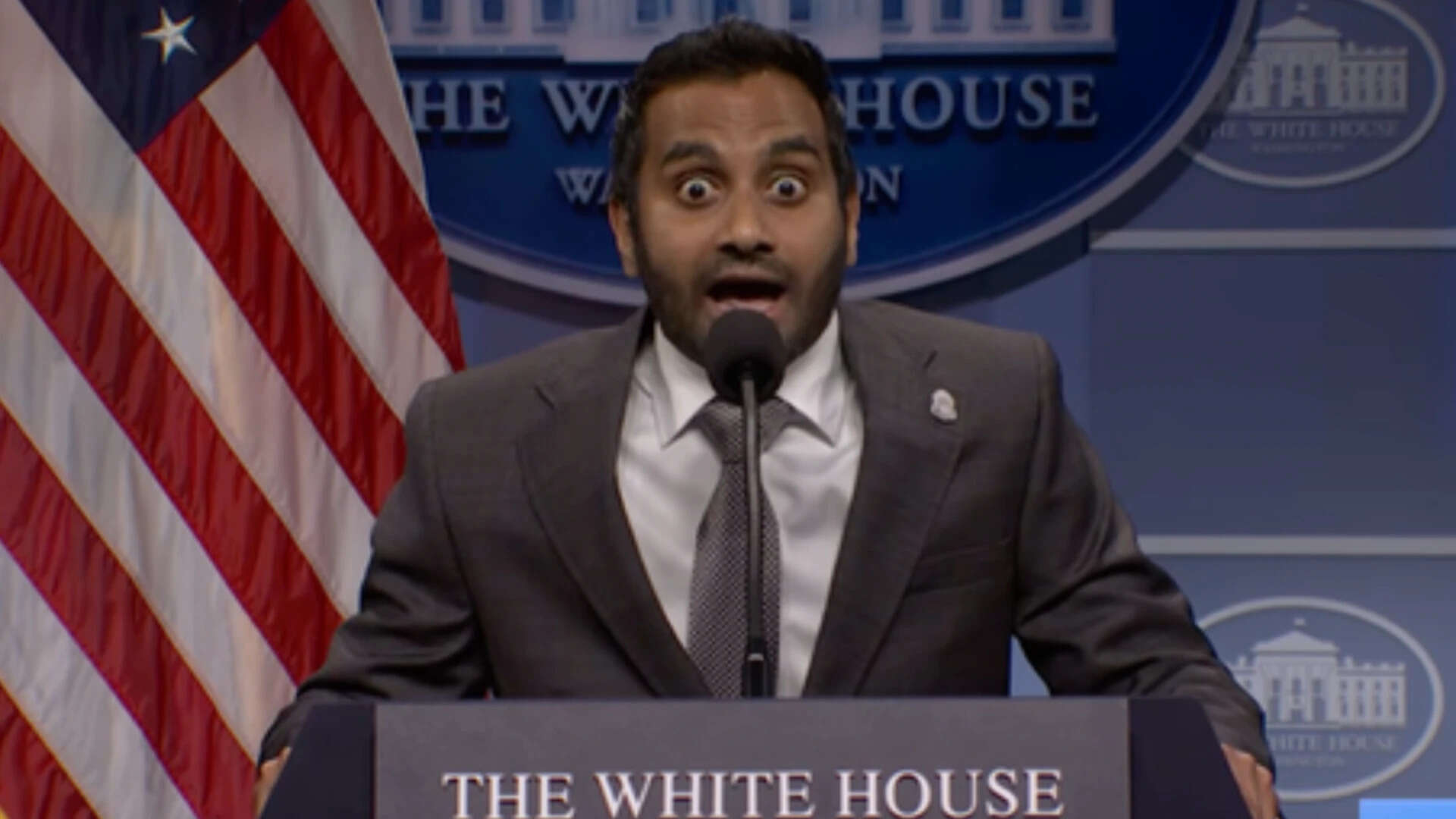
The Saturday Night Live sketch featuring Aziz Ansari as Kash Patel functions as a dual-layered mechanism of political neutralization. On the surface, it operates as a standard caricature of a political appointee; beneath the surface, it utilizes a specific ethnic-identity framework to undermine the subject’s perceived competence. By labeling Patel the "first Indian person to suck at their job," the satire shifts the critique from policy-based opposition to a subversion of the "model minority" archetype. This strategic choice by the writers suggests that the most effective way to diminish a rising political figure’s momentum is not through a debate on their qualifications, but through the weaponization of cultural expectations against them.
The Triad of Satirical Deconstruction
To understand why this specific portrayal resonated, one must analyze the three variables SNL used to frame the narrative:
- Identity Contrast: The casting of Aziz Ansari—an actor synonymous with millennial neurosis and professional relatability—creates an immediate cognitive dissonance when mapped onto a high-stakes intelligence official. This contrast serves to "soften" the subject, making a figure viewed by some as a threat appear instead as an out-of-depth bumbler.
- Competency Inversion: The central thesis of the sketch relies on the inversion of the high-achieving Indian-American trope. By positioning Patel as an outlier to a demographic statistically associated with professional success, the satire attempts to isolate him from his own community's narrative of excellence.
- Performative Absurdism: The use of exaggerated props and costuming—specifically the aviator glasses and aggressive posturing—mimics Patel’s public persona but strips it of its intended gravitas. This turns a deliberate "strongman" aesthetic into a costume-shop parody, reducing political branding to mere theater.
The Logic of Identity Weaponization
The sketch’s most potent line—"the first Indian person to suck at their job"—is a calculated rhetorical device. This is not a random insult; it is an application of the Burden of Representation. In media theory, members of minority groups are often forced to represent their entire demographic. By claiming Patel has failed this collective standard, the satire attempts to revoke his cultural "credentials."
This creates a specific logical trap:
- If Patel ignores the sketch, the "incompetence" narrative gains a foothold in the cultural zeitgeist via repetition.
- If Patel responds, he risks validating the medium of satire, thereby appearing thinned-skinned and confirming the "unserious" label the sketch sought to apply.
The efficacy of this tactic is measured not in policy shifts, but in the degradation of a subject’s Social Capital Index. When a political figure is successfully rebranded as a comedic archetype, their ability to project authority in serious diplomatic or intelligence settings is systematically eroded.
Structural Bottlenecks in Political Satire
SNL’s approach reveals a recurring limitation in modern political commentary: the reliance on "clapter" over insight. The sketch assumes a baseline of hostility toward the subject, which creates an echo chamber effect. While this maximizes engagement within a specific ideological segment, it fails as a persuasive tool for those outside that segment.
The mechanical failure of the sketch lies in its lack of specific policy critique. By focusing entirely on Patel’s demeanor and the "unprecedented" nature of his alleged incompetence, the writers miss the opportunity to engage with the actual structural changes he proposes for the intelligence community. This results in a "Personality vs. Policy" trade-off where the audience is entertained but remains uninformed about the actual stakes of the political appointment.
The reliance on Aziz Ansari’s established comedic persona—the fast-talking, slightly desperate striver—further complicates the analysis. The audience isn't seeing Kash Patel; they are seeing Aziz Ansari doing Aziz Ansari while wearing a Kash Patel name tag. This creates a secondary layer of abstraction that protects the subject by making the parody feel more like a guest appearance than a targeted assassination of character.
The Cost Function of Satirical Misalignment
When satire misses the mark of a subject's actual vulnerabilities, it creates a "Backfire Effect." If the target of the satire demonstrates high-level operational competence in their actual role, the disparity between the SNL caricature and reality becomes a liability for the satirist, not the subject.
There are three primary risks associated with this specific satirical strategy:
- The Credibility Gap: If the "incompetence" narrative is contradicted by future professional output, the satirist loses the trust of the moderate audience.
- The Martyrdom Loop: By attacking a figure on the basis of their identity (even via "inverting" a positive stereotype), the satirist provides the subject with the ammunition to claim they are being unfairly targeted by a "coastal elite" media apparatus.
- The Saturation Point: Over-reliance on the "this person is a joke" framework leads to audience fatigue, where the parody becomes a predictable trope rather than a sharp critique.
The sketch operates under the assumption that the audience shares a uniform definition of "sucking at a job." However, in the current polarized environment, "incompetence" is often in the eye of the beholder. What a critic calls "sucking," a supporter might call "disrupting." SNL’s failure to account for this semantic divide limits the sketch’s impact to a purely performative act for the already-convinced.
The Strategic Shift in Narrative Control
The emergence of Kash Patel as a fixture in political satire marks a transition in how the media handles "anti-establishment" figures. The goal is no longer to argue against the figure's ideas, but to render the figure culturally illiterate.
This leads to a bifurcation of the public image:
- The Digital Reality: A highly disciplined, media-savvy operator building a specific brand across alternative platforms.
- The Satirical Reality: A buffoonish, aesthetically confused character played by a beloved sitcom star.
The struggle for narrative dominance occurs in the space between these two versions. The winner of this conflict is not determined by who is "right," but by which version becomes the default mental image for the average citizen. By using Ansari, SNL is betting that a familiar face can overwrite a less-familiar political reality.
The final move for any strategist observing this interaction is to measure the Durability of the Parody. Does the "incompetent Indian" trope stick to Patel’s public appearances moving forward, or does it evaporate once the Saturday night cycle ends? History suggests that without a corresponding failure in the real world, satirical labels remain shallow. To truly neutralize a figure of Patel’s trajectory, opposition would require a shift from identity-based mocking to a rigorous, data-backed deconstruction of his operational record. Until then, sketches like this serve as high-production-value comfort food for a base that prefers laughter to the more difficult work of structural political engagement.
The tactical recommendation for observers is to discount the "identity-failure" narrative as a temporary emotional signal. Focus instead on the subject's ability to maintain executive function under the weight of this cultural pressure. The real test of professional competence is not whether one can avoid being mocked, but whether one can render the mockery irrelevant through the cold execution of their stated objectives.