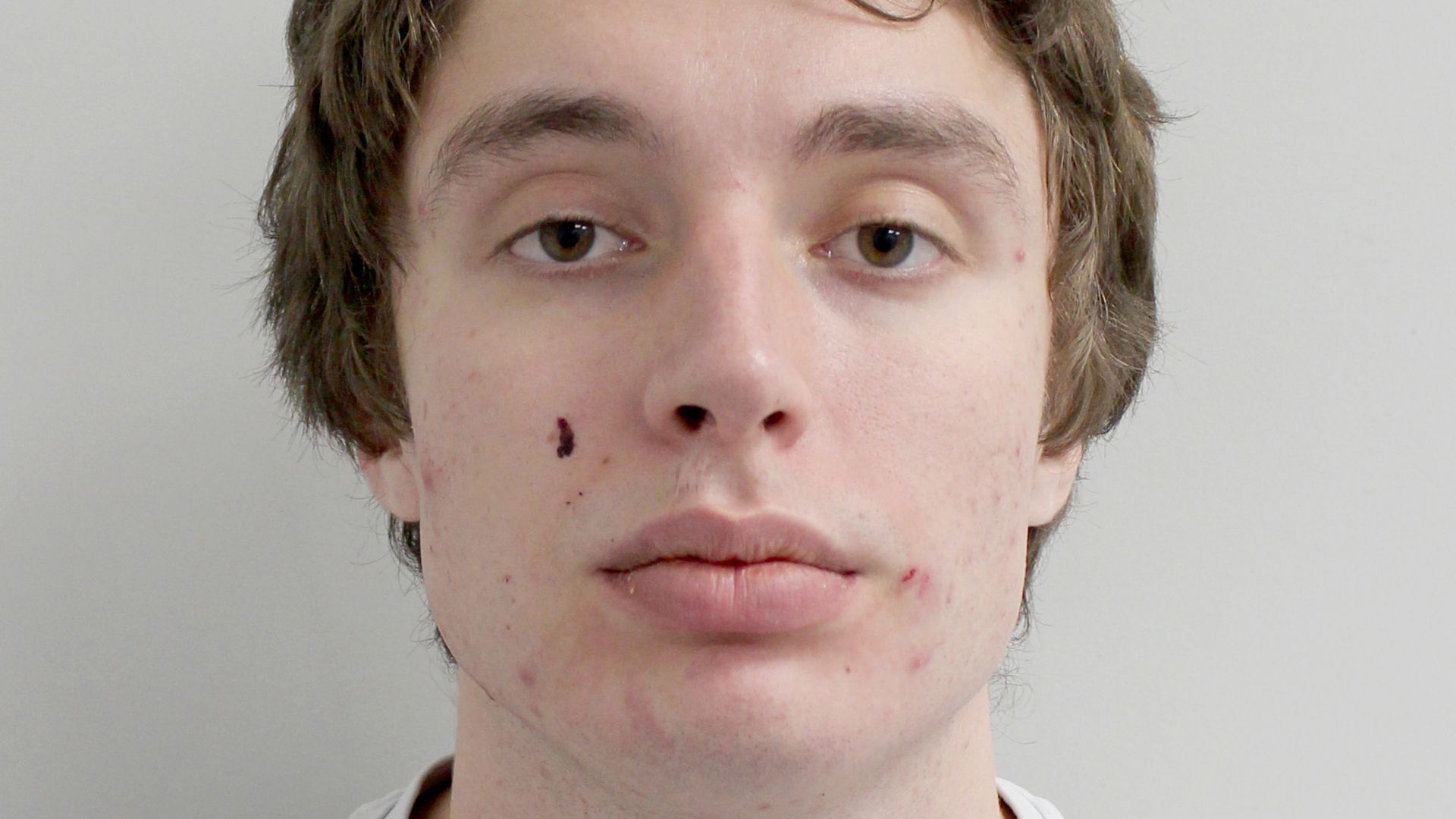
The conviction of Naim Sajid for the assault of a woman in New York City functions as a critical case study in the intersection of urban security vulnerabilities and the high-stakes optics of proximity to protected persons. While media coverage focused heavily on the presence of Barron Trump as a witness, a structural analysis reveals that the event was defined by a specific failure in "perimeter elasticity" and the subsequent rapid-response mechanisms of the Manhattan judicial system. This incident represents more than a localized crime; it illustrates the friction between public accessibility and the specialized security protocols required for individuals under United States Secret Service (USSS) protection.
The Architecture of Proximity and Security Friction
Security in dense urban environments operates on a principle of concentric circles. The primary circle is the "Close Protection" detail, followed by the "Middle Perimeter" (the immediate surroundings), and the "Outer Perimeter" (the public at large). The assault in question occurred within the Middle Perimeter—an area where the public and the protected person occupy shared physical space.
The presence of a USSS protectee usually mandates a "hardened" posture, but in the context of a walking witness, the environment remains "soft." This creates a security paradox: the assets assigned to Barron Trump are legally and tactically restricted to his immediate safety. Their mandate does not inherently include the policing of the general public unless a threat is directed at the protectee. This explains the gap between the commencement of the assault and the intervention by law enforcement. The assailant, Sajid, exploited this gap, not necessarily by design, but through the inherent chaos of high-traffic urban zones.
The Mechanism of the Breach
The failure to prevent the initial contact can be deconstructed into three variables:
- Detection Latency: In a crowd, the delta between a hostile gesture and a security response is measured in milliseconds. If the aggressor’s body language does not trigger "pre-attack indicators" (e.g., target glancing, grooming gestures, or unnatural gait), the security detail remains in a defensive, rather than interceptive, stance.
- Resource Allocation Constraints: Secret Service agents are not beat cops. Their training emphasizes "evacuate and cover" over "detain and process." Diverting an agent to intervene in a third-party assault creates a "security vacuum" around the protectee.
- Environmental Noise: New York City’s baseline sensory input—noise, movement, and density—masks deviant behavior until the moment of physical kinetic impact.
Jurisprudential Processing of High-Profile Assault Cases
The legal trajectory of Naim Sajid, culminating in a 16-month prison sentence, reflects the New York District Attorney’s Office’s strategy of "Aggravated Deterrence." When a crime is committed in the presence of a high-profile figure, the evidentiary threshold often remains the same, but the "prosecutorial vigor" increases due to the public interest and the potential for federal-state jurisdictional overlap.
The charge of second-degree assault under New York Penal Law § 120.05 requires proof of intent to cause serious physical injury. In this instance, the witness testimony—specifically from a member of a former First Family—strengthened the prosecution’s narrative of "unprovoked aggression." The presence of such witnesses minimizes the viability of "mutual combat" or "self-defense" justifications often used by defense counsel in urban altercations.
The Sentencing Calculus
The 16-month sentence is a mid-tier outcome for Class D felonies in New York, suggesting that the court prioritized the "Assaultive History" of the defendant. The judicial system uses a Risk-Need-Responsivity (RNR) model to determine if a defendant is a candidate for rehabilitation or if incapacitation (prison) is necessary. For Sajid, the calculation was influenced by:
- The Gravity of Injury: The physical toll on the victim provides the baseline for the sentence.
- The Public Disturbance Factor: Crimes committed in public thoroughfares are viewed as "affronts to the social contract," necessitating a more visible punitive response.
- Witness Credibility: Having a high-profile, high-security witness ensures that the "Chain of Observation" is impeccable, leaving little room for the defense to challenge the facts of the encounter.
The Cost Function of Urban Protection Details
Protecting a high-profile individual in Manhattan is an exercise in managing the "Cost of Exposure." This cost is not merely financial but involves the expenditure of social and tactical capital. Every time a protected person enters a public space, the "Threat Surface" expands exponentially.
The 2024 incident highlights a critical vulnerability in the "Witness Proximity" protocol. If a protectee witnesses a crime, they become part of the judicial record, which in turn creates a secondary security risk: the necessity of their involvement in legal proceedings. This involves:
- Deposition Exposure: The requirement to provide statements.
- Courtroom Logistics: The massive security footprint required for a simple testimony.
- Media Amplification: The transformation of a standard criminal case into a national news cycle, which can incite "copycat" behavior or targeted harassment of the victim and witnesses.
Operational Realignment for Metropolitan Security
Moving forward, the security apparatus surrounding high-profile witnesses in urban centers must transition from a "Passive Observation" model to an "Active Buffer" model. This involves the integration of "Plainclothes Augmentation." While the primary USSS detail remains focused on the protectee, a secondary, less visible layer of security (often coordinated with local NYPD units) must be tasked with "Pre-Perimeter Sweeping."
This secondary layer functions as a "Kinetic Filter," identifying and neutralizing erratic individuals—like Sajid—before they enter the immediate orbit of the protectee. This does not require additional legislation but rather a shift in the "Standard Operating Procedure" (SOP) for urban movements.
The second necessary realignment involves the "Victim-Witness Interface." The woman assaulted in this case became a footnote in the broader political narrative, yet her safety was the variable that failed. A more robust security posture would treat the immediate "Environment of the Protectee" as a sterile zone where any hostile act is met with immediate, overwhelming tactical suppression, regardless of the intended target.
The 16-month incarceration of Naim Sajid serves as a temporary fix for a systemic issue. The true resolution lies in the professionalization of the "Public-Private Space Interface." Security details must move beyond the "Bodyguard Mentality" and adopt a "Systems Engineering" approach to public safety. This means treating every street corner as a variable in a complex safety equation where the goal is the total elimination of "Uncontrolled Variables."
The strategic priority for security firms and federal agencies must now be the implementation of "Predictive Analytics for Crowd Behavior." By utilizing AI-driven surveillance to monitor deviate patterns in pedestrian flow, details can anticipate potential outbursts like the one witnessed by Barron Trump. The objective is not just to protect the person, but to preserve the integrity of the environment, ensuring that the presence of a high-profile individual does not become a catalyst for, or a witness to, the breakdown of civil order. Failure to adapt this "Buffer Zone" logic will inevitably result in more frequent breaches of the social and physical perimeter, regardless of the judicial outcomes for the perpetrators.