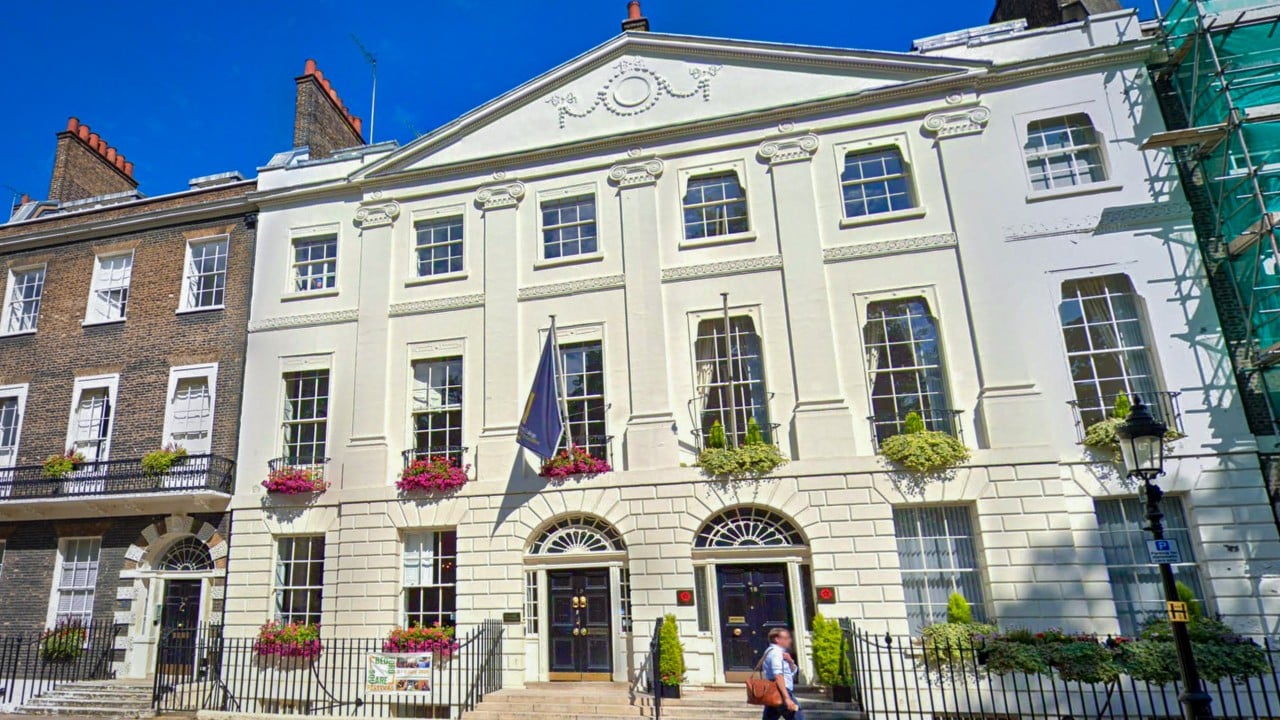
Rain slicked the pavement outside the Old Bailey, a cold, indifferent drizzle that mirrored the gray reality of the proceedings inside. In the wood-paneled quiet of the courtroom, the air felt heavy with a specific kind of modern dread. This wasn't a trial about a physical heist or a violent crime. It was about the slow, silent erosion of safety in a world where your borders are no longer physical, and your enemies might be the people meant to facilitate your business.
Two men, Bill Yuen and Peter Wai, stood at the center of a legal storm that has permanently altered the relationship between London and Hong Kong. They weren't Bond villains. They were middle-aged men in suits, linked to the Hong Kong Economic and Trade Office (HKETO). But a jury saw past the professional veneer. They saw a systematic effort to hunt, harass, and monitor individuals living on British soil—people who thought they had escaped the reach of a surveillance state only to find it had followed them into the leafy suburbs of the UK. You might also find this similar story interesting: Asymmetric Endurance and the Strait of Hormuz Operational Realities of a Sustained Blockade.
The conviction of these men for foreign interference and assisting an overseas intelligence service marks a tipping point. It reveals a chilling truth: the trade offices we once viewed as bridges for commerce have, in some cases, been repurposed into outposts for a global dragnet.
The Anatomy of an Invisible Hunt
Imagine a woman named Maya. She is a hypothetical composite of the activists targeted in this case, living in a small flat in South London. She fled Hong Kong after the 2019 protests, seeking the quiet anonymity of a British winter. She drinks her tea, watches the news, and feels—for the first time in years—safe. As highlighted in latest articles by NPR, the effects are worth noting.
But across the city, in a sleek office building, her name is being typed into a spreadsheet.
The evidence presented in court painted a picture of "hostile activity" that felt more like a thriller than a bureaucratic function. The defendants didn't just watch from afar. They engaged in physical surveillance. they attempted to break into homes. They used the financial resources of a trade office to fund a private security operation aimed at silencing dissent.
This is the "human element" that dry news reports often miss. It is the feeling of a shadow that won't detach. It is the realization that the person standing behind you in the grocery queue might be there because of an order issued thousands of miles away. The court heard how the men tracked activists like Nathan Law and Finn Lau, individuals the Hong Kong government has branded as fugitives.
The stakes aren't just legal; they are psychological. When a foreign power can reach into your new home and touch your front door, the concept of asylum becomes a fragile ghost.
The Weaponization of Bureaucracy
For decades, the Hong Kong Economic and Trade Offices were the darlings of the globalized world. They hosted champagne receptions. They talked about GDP and shipping lanes. They were the diplomatic handshake that kept the money flowing.
But the 2020 National Security Law in Hong Kong changed the DNA of these institutions.
Under the new paradigm, loyalty to the state outweighs the traditional rules of international engagement. The UK court case revealed that the defendants were effectively operating as an extension of the Hong Kong police force. They were the eyes and ears of a crackdown that refuses to stay within its own borders.
Consider the mechanics of the operation. The prosecution detailed how the men were involved in "information gathering" that went far beyond typical diplomatic observation. They were looking for addresses. They were looking for vulnerabilities. They were looking for a way to make the activists feel that nowhere on earth was far enough.
This isn't just a British problem. It is a global one. Across Europe, North America, and Australia, governments are waking up to the reality that transnational repression is the new frontier of espionage. It is cheaper than traditional spying and far more damaging to the social fabric of a democracy. It turns diaspora communities into zones of suspicion. It makes neighbors look at neighbors and wonder who is watching.
The Cost of the Silence
Why does this matter to the average person who has never been to Hong Kong?
Because the integrity of a nation is measured by its ability to protect anyone within its borders. If a foreign intelligence service can operate with impunity in London, the very idea of British sovereignty begins to fray. It suggests that the law is a suggestion, and that enough money or diplomatic pressure can create "black zones" where the rules don't apply.
The conviction of Yuen and Wai wasn't just a victory for the prosecution. It was a message sent to Beijing. It was a statement that the UK will not allow its streets to be used as a playground for foreign authoritarianism.
Yet, the victory feels hollow to those who remain in the crosshairs. The infrastructure of surveillance remains. The trade offices still stand. The digital tools used to track movements and monitor private messages are more sophisticated than ever.
We often think of spying as the theft of nuclear codes or high-level government secrets. But this case proves that the most valuable intelligence today is the location and the spirit of a single person who dares to say "no."
The Friction of Modern Diplomacy
The fallout from this case is already rippling through the corridors of power. The relationship between the UK and China is no longer a "Golden Era" of investment. It is a jagged, high-friction landscape of mutual distrust.
The UK government now faces a grueling dilemma. Do they shut down the trade offices entirely, risking a massive economic backlash? Or do they allow them to remain, knowing that the line between "trade promotion" and "political policing" has been permanently blurred?
There is a deep, unsettling irony here. The very institutions designed to foster connection are now the primary drivers of isolation.
The defendants argued they were merely doing their jobs—that they were caught in a geopolitical misunderstanding. But the evidence told a different story. It told a story of "reconnaissance," of "staged break-ins," and of a relentless pursuit of people whose only crime was wanting to live in a world where their thoughts weren't a matter of state security.
The Mirror on the Wall
When we look at this case, we are looking into a mirror. We are seeing what happens when the digital age meets the old-world ambitions of empire.
The "invisible stakes" are the quiet freedoms we take for granted. The freedom to walk to the park without checking over our shoulder. The freedom to join a protest without fearing for our family back home. These are the things that were being traded in those London offices.
The conviction provides a moment of accountability, but it doesn't provide a cure. The technology used to track these activists is the same technology we use to find our way to a new restaurant or to stay in touch with friends. In the hands of a determined state, the tools of connection become the tools of a cage.
The rain continues to fall in London. The activists remain in their homes, perhaps sleeping a little better tonight, but knowing that the shadow hasn't fully disappeared. The suits have changed, the locations have shifted, but the hunt is far from over.
The quiet of the courtroom has been replaced by the noise of the city, but the echoes of the testimony linger. We are living in an era where the front lines of global conflict are no longer in the trenches. They are in our data, our streets, and the very air we breathe in our cities. The conviction of two men is a period at the end of a sentence, but the book is still being written, and the ending remains dangerously uncertain.


