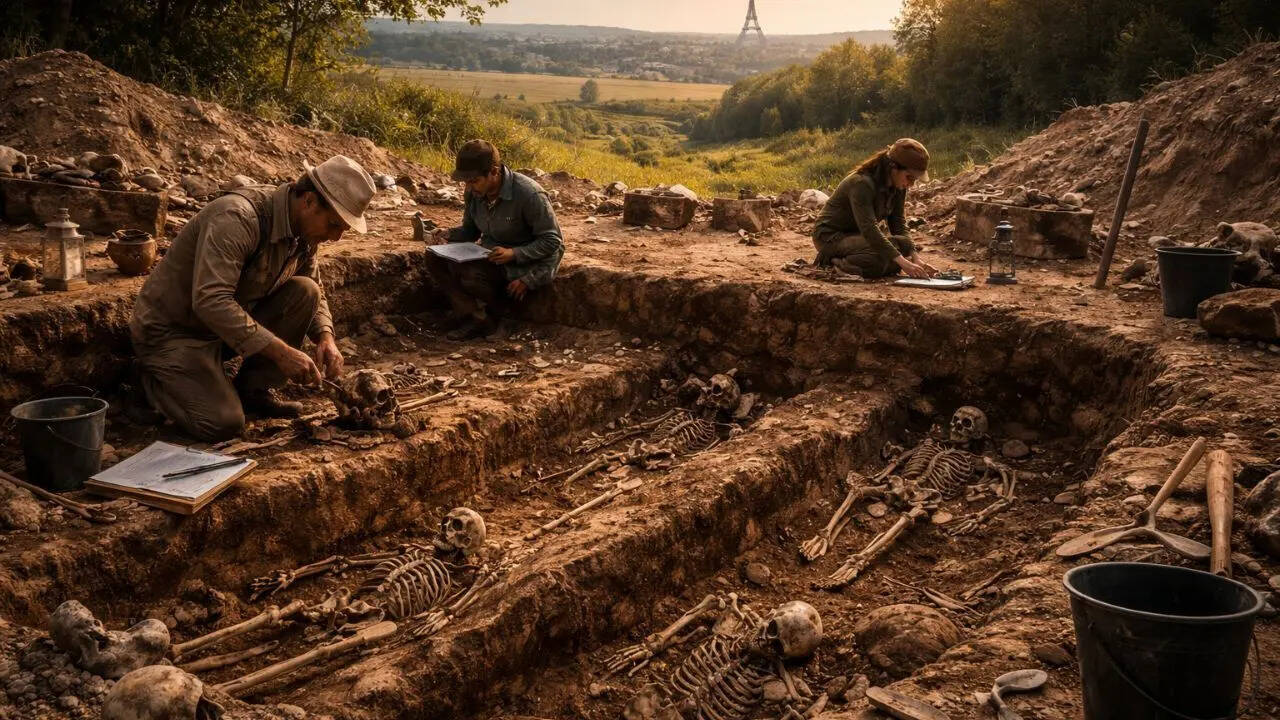
The limestone floor of the tomb at Gurgy, a small village nestled in the Yonne valley just southeast of Paris, felt cold enough to bite through the rubber soles of the archaeologists' boots. For six thousand years, this earth held its breath. When researchers finally peeled back the layers of sediment, they found more than just bones. They found a biological record of a family that had vanished so completely it was as if they had never walked the riverbanks at all.
This was the "Les Noisats" site. It is a mass grave containing 128 individuals, a snapshot of a Neolithic community from 4,700 BCE. But the DNA extracted from these ancient teeth tells a story that upends everything we thought we knew about the people who built the foundations of Europe. It reveals a brutal, invisible erasure.
Imagine a man we will call Adalric. He is a farmer. He spends his days coaxing wheat from the stubborn Parisian silt and his evenings watching the sun dip below the horizon of a world that feels permanent. He buries his father with care. He expects his grandson to bury him in the same soil. But Adalric’s lineage was walking toward a cliff. By 3,000 years ago, the genetic signature of Adalric and every person he ever loved had been wiped from the map of France.
They didn't just die. They were replaced.
The Ghost in the Helix
For decades, the narrative of European history was one of slow, steady blending. We liked to think of it as a melting pot—a gentle folding of new arrivals into the existing population. The reality unearthed at Gurgy is far more jarring.
The genomic study of the 128 bodies showed a remarkably stable community. These were people descended from the first farmers who migrated from the Near East. They were a tight-knit clan. The DNA shows that for centuries, the men stayed put while women from neighboring groups married in, bringing fresh genetic diversity to the village. It was a sophisticated, patriarchal social structure that functioned perfectly for a millennium.
Then, the trail goes cold.
When scientists compared the DNA from the Gurgy site to the DNA of people living in the same region just a few thousand years later, the connection was gone. The farmers who had spent three thousand years taming the French wilderness had no biological heirs left in the land they worked.
We often mistake "ancient" for "simple." We assume these people were transients. But the Gurgy tomb proves they had a deep, multi-generational connection to the land. They were us. They had complex kinship rules. They mourned. They planned for a future that, according to the molecular evidence, simply never happened for them.
The Arrival of the Steppe
The shift didn't happen because of a single war or a localized drought. The culprit was a massive, subterranean shift in the human tide. About 4,500 years ago, a new group of people began to move across the continent: the Yamnaya.
Hailing from the Pontic-Caspian steppe—modern-day Ukraine and Russia—these were horse-riding pastoralists. They brought with them the wheel, a different way of life, and a genetic profile that was ruthlessly efficient at spreading. When the Yamnaya moved into Western Europe, the demographic impact was tectonic.
In a few short centuries, the "Old European" DNA of the Neolithic farmers—the people of the Gurgy tomb—began to plummet. By 3,000 years ago, it had largely vanished from the French gene pool, replaced by the signature of the Steppe.
Why did they disappear?
History is written by the survivors, but the soil tells the truth about the losers. It is tempting to imagine a cinematic invasion, with bronze swords clashing against stone axes. While violence certainly occurred, the erasure was likely more systematic. The newcomers had different social structures, perhaps more aggressive expansionist tendencies, and, crucially, they may have brought diseases to which the settled farmers had no immunity.
Consider the "invisible stakes" of a biological takeover. It isn't just about who wins the battle; it's about whose children get to eat during a famine. It’s about whose daughters marry into the new, wealthier ruling class. Slowly, the lineage of the original Parisian farmers was pushed to the margins, then into the shadows, and finally into extinction.
A City Built on Strangers
Walking through the streets of modern Paris, you see the grand architecture of the Bourbons and the Napoleons. But the deepest history of the city is under your feet, and it belongs to people who are not our ancestors.
The mystery of the Paris tomb is a reminder that "home" is a fleeting concept. The people buried at Gurgy thought they owned the valley. They thought their bones would ground their descendants to that earth forever. Instead, they became a genetic dead end.
The study reveals that the modern French population—and indeed most of Western Europe—is a much more recent "construction" than we care to admit. We are the descendants of the people who replaced the people of Gurgy. We are the inheritors of a land that was taken, not just by force, but by the slow, grinding machinery of population replacement.
The limestone at Gurgy is silent now. The 128 bodies have been cataloged, their genomes sequenced, their secrets laid bare in peer-reviewed journals. But the emotional weight remains. There is a profound loneliness in the realization that an entire culture, with its songs, its gods, and its distinct way of seeing the world, can vanish so completely that only a laboratory can prove they were ever there.
The Weight of the Unseen
We live in an age where we believe everything is archived. We record our lives in digital clouds and stone monuments. We feel permanent.
But the DNA of the Yonne valley serves as a cold warning. The world of 3,000 years ago was a place of radical upheaval, where "stability" was an illusion that could be shattered by a new group of people appearing on the horizon with better tools or harder hearts.
The people of the Gurgy tomb weren't failures. They were masters of their environment for longer than the United States has been a country, longer than the Roman Empire lasted, longer than almost any modern institution. They thrived. They loved. They built a society that lasted three millennia.
And then, the wind changed.
Today, tourists flock to the Louvre and the Eiffel Tower, standing on the same ground where Adalric once looked at the sky and felt secure. They don't know his name. They don't carry his blood. They are walking over a graveyard of a lost version of humanity—a version that did everything right and was still deleted from the code of the future.
The true mystery isn't just why they died. It’s the haunting realization that the same processes of migration, replacement, and disappearance are never truly over. We are all just temporary tenants of the soil, waiting for the next tide to wash the shore.
The bones in the pit at Gurgy aren't just artifacts. They are mirrors. When we look at them, we aren't looking at "them." We are looking at the fragility of "us." The people who lived in the shadow of what would become Paris didn't leave behind a kingdom or a written language. They left behind a gap—a silence in the genome that speaks louder than any monument ever could.
The earth eventually reclaimed Adalric. It reclaimed his children. It reclaimed his entire world. The only thing left is the cold, hard fact of his absence, etched into the very marrow of the bones he left behind in the limestone dark.