The air inside a semiconductor fabrication plant does not move like normal air. It is scrubbed, filtered, and pressurized until it is entirely devoid of dust, moisture, and human debris. It smells of nothing. To enter, you must encase yourself in a white Gore-Tex suit, pull tight a pair of nitrile gloves, and breathe through a mask. You become an anomaly in a temple of absolute precision.
In these cleanrooms, billions of dollars depend on things that cannot be seen by the naked eye. A single speck of dandruff can ruin a silicon wafer worth more than a luxury sports car. The machines hum at a constant, terrifying frequency, etching microscopic pathways onto slivers of silicon that will eventually power the servers, smartphones, and artificial intelligence models of the modern world.
For decades, the undisputed titan of this invisible empire has been Samsung Electronics.
But right now, the greatest threat to this empire is not a speck of dust. It is not a flaw in the photolithography machines, nor is it a supply chain bottleneck in rare earth metals. It is a human heartbeat. Specifically, tens of thousands of them, beating in unison, threatening to do the one thing a semiconductor fab cannot survive.
They are threatening to walk out.
The Price of Perfection
Consider a young engineer we will call Ji-won. He is thirty-two, holds a master’s degree from a top-tier university in Seoul, and hasn't eaten dinner with his family on a weekday in three years.
Ji-won is hypothetical, but his reality is shared by thousands of workers currently wearing those white suits. When Ji-won was hired, his parents wept with pride. In South Korea, joining Samsung is not merely securing a job; it is an induction into national royalty. The company accounts for roughly a fifth of the country’s entire economy. It is a patriotic duty wrapped in a corporate health package.
But patriotism does not pay a mortgage in an inflated economy, nor does it give you back the weekends spent under the harsh glare of cleanroom fluorescent lights.
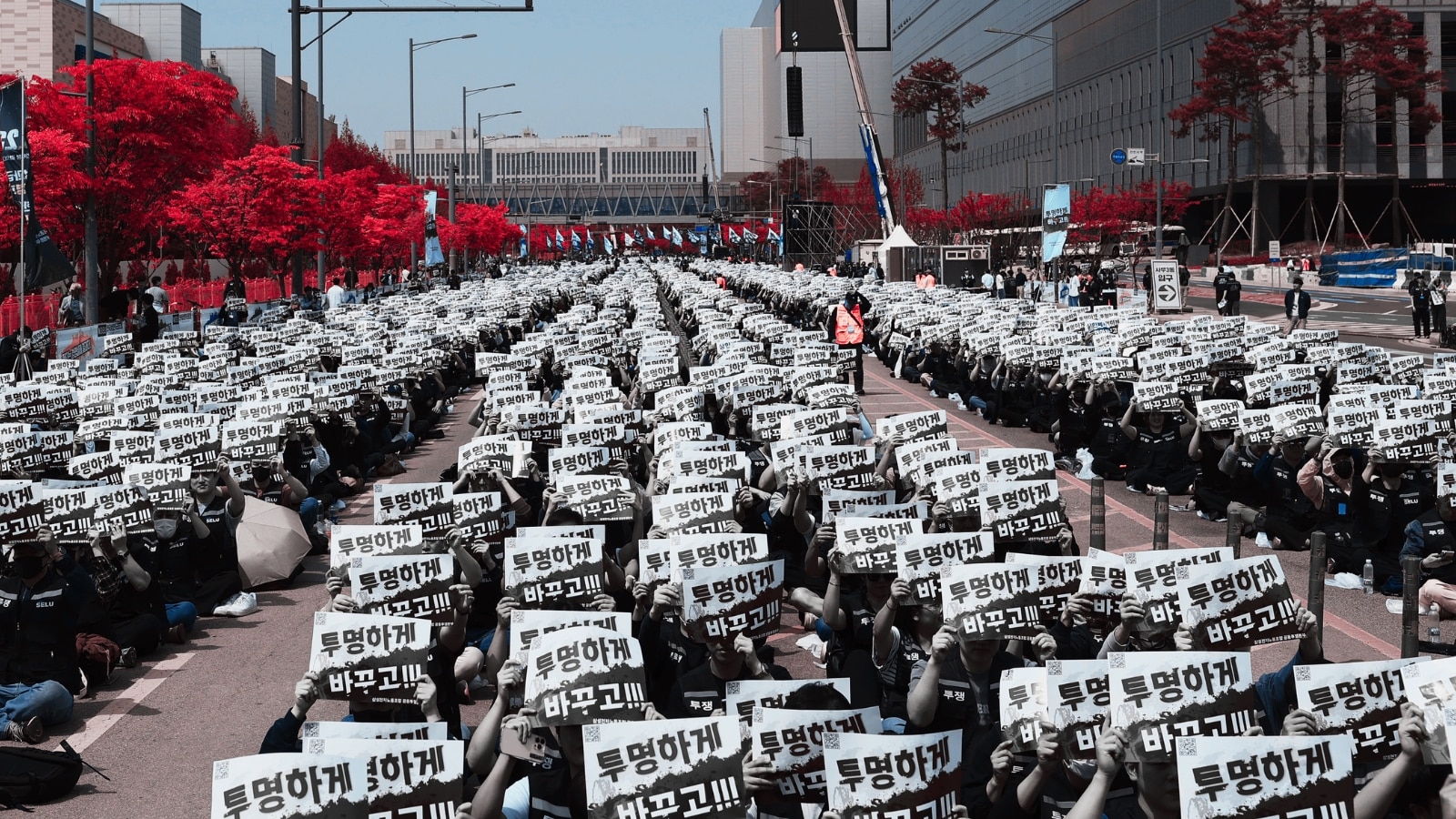
For the past several months, a quiet fury has been building behind the pristine glass walls of Samsung’s facilities. The National Samsung Electronics Union (NSEU), which represents tens of thousands of workers, has been locked in a bitter stalemate with management. The core disputes sound dry on paper: performance-based bonuses, transparent wage structures, and an extra day of annual leave.
To the executives sitting in the glass towers of Seocho-gu, these are line items on a spreadsheet. They look at the global economic slowdown, the fierce competition from rivals like SK Hynix and TSMC, and they preach restraint. They argue that the company must remain lean to survive the brutal cycles of the chip industry.
But to the workers, those line items are a translation of their life force. When Samsung posted record profits during the tech boom years, the bonuses were legendary. When the market dipped, the bonuses vanished, but the twelve-hour shifts remained. The workers watched the company invest billions into new infrastructure while telling the people calibration-testing those very machines to tighten their belts.
The tension has reached a breaking point. A last-ditch effort to negotiate a compromise is underway. If it fails, the union is prepared to initiate the first major strike in the company's five-decade history.
The Fragile Architecture of Tomorrow
To understand why this matters to someone sitting in a coffee shop in Chicago, London, or Tokyo, we have to look at the terrifying fragility of the modern tech ecosystem.
We tend to think of the internet as something ethereal. We talk about "the cloud" as if our data is floating gracefully in the stratosphere. It isn't. The cloud is a sprawling, concrete warehouse in Virginia or Dublin, packed to the rafters with humming servers that consume enough electricity to power small cities.
And at the heart of every single one of those servers is a memory chip.
Samsung is the world’s largest producer of dynamic random-access memory (DRAM). Think of DRAM as the short-term working memory of a computer. Without it, the most advanced AI processors are just expensive paperweights. They cannot process information. They cannot think.
The manufacturing process of these chips is not like building cars or sewing clothes. You cannot simply turn the assembly line off on a Friday night and flip the switch back on Monday morning. A silicon wafer takes up to three months and hundreds of distinct chemical, ultraviolet, and mechanical steps to complete.
If the workers walk out, even for a few days, the machinery doesn't just sit idle. The delicate chemical balances shift. The temperature-controlled environments fluctuate. Wafers mid-production can be ruined entirely. A sudden halt in production could trigger a ripple effect through the global supply chain that would take months to rectify.
Imagine a row of dominoes stretching across the Pacific Ocean. The first domino is a meeting room in Seoul where two sides refuse to blink. The last domino is the price of your next smartphone, the availability of medical imaging equipment in hospitals, or the deployment of critical cybersecurity infrastructure.
The Ghost of New Management
The irony of this standoff is rooted in history. For decades, Samsung operated under a strict, unyielding non-union policy.
It was a philosophy established by the company's founder, Lee Byung-chull, who famously declared that he would never allow unions "until I have earth over my eyes." For generations, management maintained this stance through a mixture of paternalistic benefits and aggressive deterrence. Employees were taken care of, but they were expected to give their unquestioning loyalty in return.
That cultural compact worked as long as the company’s trajectory went in only one direction: up.
But corporations, like the empires of old, eventually outgrow their founders' philosophies. In 2020, amid legal battles and shifting societal expectations, leadership publicly apologized and pledged to end the no-union practice. The genie was let out of the bottle. Workers realized that the collective voice was the only tool powerful enough to challenge an entity that practically co-governs their nation.
What we are seeing today is the painful puberty of a new corporate era. The old guard still expects the absolute deferential sacrifice of the 1980s. The younger generation of workers, influenced by global shifts in labor rights and a deeper desire for work-life balance, is rejecting the idea that their identity must be entirely consumed by their employer’s logo.
It is a classic tragic narrative. Two sides, both believing they are defending the future of the company, looking at the exact same problem and seeing two entirely different realities.
The Gathering Storm
The negotiation room is quiet. On one side of the table sit executives in tailored suits, looking at projections of global market share, worried that a concession here will signal weakness to Wall Street and global investors. They know that the semiconductor industry is cutthroat; if Samsung slips, competitors are waiting like wolves to tear away their market dominance.
On the other side sit union representatives, carrying the exhaustion of thousands of families. They are thinking of the parents who see their children only when they are asleep. They are thinking of the psychological toll of working in an environment where perfection is the minimum requirement and mistakes are treated as heresy.
The clock is ticking toward a deadline that nobody truly wants to hit.
A strike would be catastrophic for Samsung’s reputation. It would signal to the world that the clockwork precision of South Korean manufacturing has a flaw in its gears. For the workers, a strike means risking the stability that they and their families have built their entire lives around. It means stepping out of the protection of the corporate umbrella into the cold wind of public scrutiny.
But sometimes, the pressure builds to a point where the logical consequences no longer matter. When people feel invisible for long enough, they will do whatever it takes to remind the world that they exist, even if it means breaking the very machine they helped build.
The cleanroom continues to hum, oblivious to the drama unfolding outside its pressurized doors. The robotic arms move with flawless, mathematical grace, transferring wafers from one station to the next. But those machines are inanimate. They do not possess creativity, resilience, or the capacity to innovate.
Without the human hands that guide them, the cleanrooms are just incredibly expensive, beautifully designed tombs of silicon. As the sun sets over Seoul, the world waits to see if the people who create our digital future will decide that the cost of building it has finally become too high to bear.


