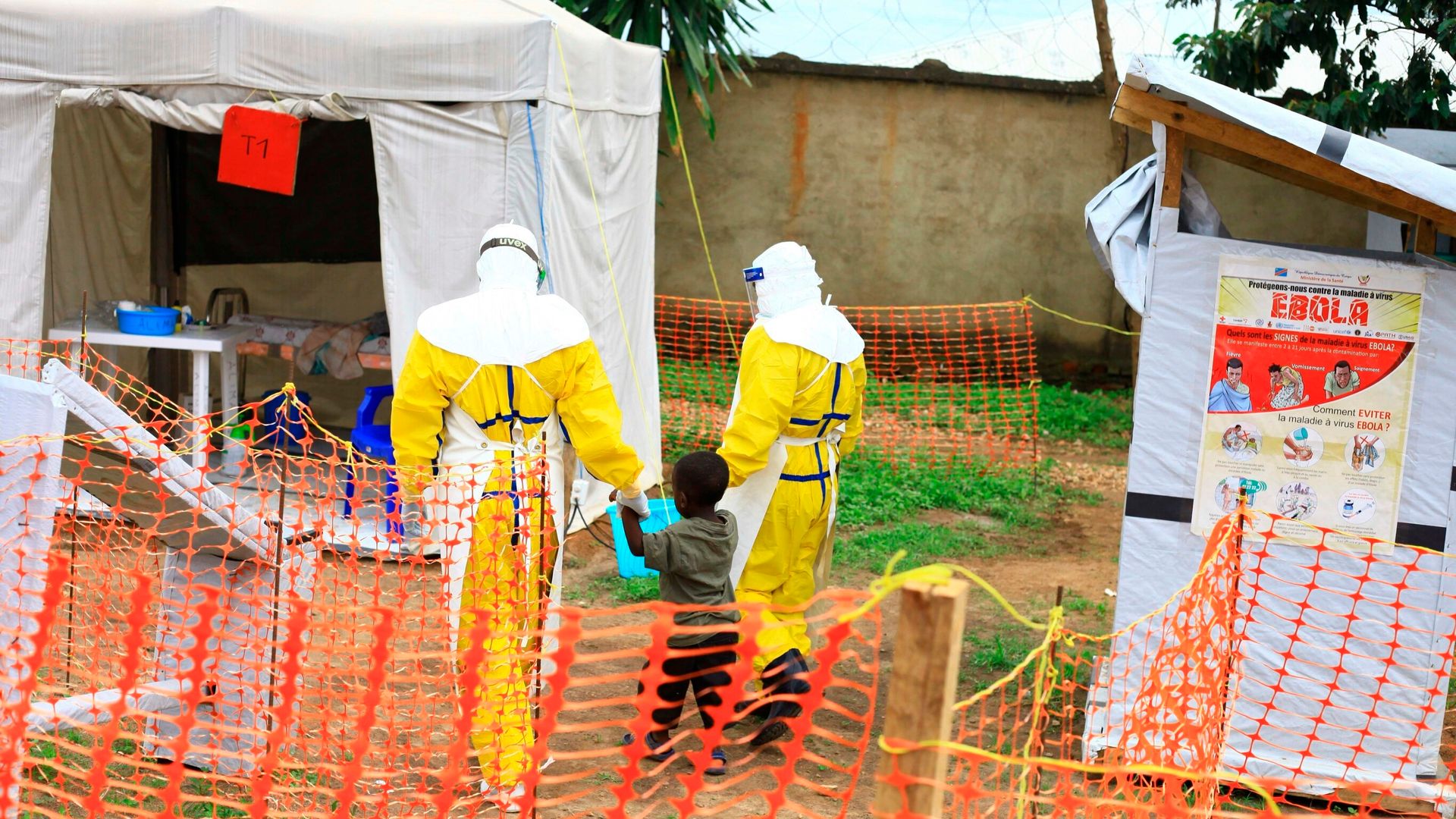
The heat in the Equateur province of the Democratic Republic of Congo does not just sit on you; it presses into your chest. It carries the scent of red earth, woodsmoke, and river water. On an ordinary Tuesday, you would hear the rhythmic thud of cassava being pestled into fufu, the bright, cascading laughter of children chasing a deflated soccer ball, and the low hum of transistors tuned to local radio stations.
Then, the music stops.
Isolation does not always begin with a barricade. It begins with an absence of noise. When an invisible killer slips into a remote community, the silence is heavy. It is the silence of a mother holding her breath, praying the heat radiating from her toddler’s skin is just a passing malaria bout, knowing in the dark, terrifying recesses of her mind that it might be something else. Something unforgiving.
More than 60 people are dead. To a reader scrolling through a news feed in London, New York, or Tokyo, that number is a minor statistic, a brief flicker of tragedy easily swallowed by the next headline. But statistics are just human beings with the tears wiped away. Each unit in that count represents a ruptured universe. It is a grandfather who kept the oral history of his village, a young merchant who had just saved enough to expand her market stall, a newborn who never got the chance to learn the sound of her own name.
To understand how a microscopic strand of RNA can paralyze an entire region, you have to look past the sterile laboratory reports and step onto the dirt roads where the battle is actually fought.
http://googleusercontent.com/image_content/186
The Anatomy of an Ambush
Ebola is not a clever virus. It is a brutal one.
Think of the human body as a highly organized, peaceful city. The roads are clear, the emergency services are alert, and the infrastructure runs smoothly. When a typical virus enters, it behaves like a common thief, trying to hotwire a car or break a window before the police arrive. Ebola operates differently. It enters like an invading army that immediately takes over the communication towers, drafts the police into its own ranks, and tears down the power lines.
It targets the very cells meant to defend us. By co-opting the immune system, the virus tricks the body into turning against itself. The lining of the blood vessels weakens. The system goes into a state of total, chaotic shock. It is a terrifyingly rapid transformation from a slight fever to a catastrophic medical emergency.
But the biological assault is only half the story. The true strength of the virus lies in how it weaponizes human kindness.
We are hardwired to touch. When a child cries, we pull them close. When a spouse shivers with fever, we wipe their brow. When a elder passes away, the customs of grief demand that we wash the body, prepare it with dignity, and send them into the next life with loving hands. Ebola thrives on this intimacy. It transforms our most deeply ingrained cultural virtues—compassion, community, duty—into transmission vectors.
Consider a hypothetical healthcare worker named Jean. He is not a character from a movie; he represents dozens of real men and women currently putting on layers of impermeable plastic in suffocating heat. Jean knows the risks. He has seen the data. But when a neighbor stumbles into the clinic, bleeding and terrified, the abstract protocols in a handbook blur. The instinct to catch a falling human being overrides the memory of a training seminar. In that split second, the virus finds its next home.
The Geography of Exclusion
Why here? Why now?
The Democratic Republic of Congo is a land of staggering vastness and unimaginable complexity. It is a place where dense, primeval rainforests meet bustling urban centers. The Equateur province, sitting squarely on the equator, is a labyrinth of rivers and waterways. Roads are often non-existent or reduced to muddy tracks that swallow trucks whole.
When an outbreak occurs in a place like this, logistics become an epic poem.
Imagine trying to transport a fragile, temperature-sensitive vaccine across hundreds of miles of jungle without a reliable power grid. The vials must be kept at temperatures colder than an Antarctic winter. This requires a rolling chain of specialized freezers, generators, fuel, and absolute precision. A single broken fan belt on a Land Cruiser or a sudden tropical downpour that turns a road into a swamp can ruin a batch of life-saving medicine.
This is the logistical friction that standard news reports omit when they state that an outbreak has occurred. They treat the geography as a backdrop rather than an active adversary. The distance between a central laboratory in Kinshasa and a symptomatic patient in a river village is not just measured in kilometers; it is measured in days, broken axles, and unreliable satellite connections.
Furthermore, this physical isolation breeds deep psychological barriers. If you live in a community that has been largely forgotten by the central government and international agencies for decades, the sudden arrival of outsiders clad in white, ghost-like biohazard suits is profoundly jarring. They come speaking foreign languages or technical jargon, telling you that you cannot bury your dead, that your traditions are dangerous, and that your loved ones must be taken away behind plastic sheets.
Conspiracy theories do not grow from ignorance; they grow from a lack of trust. When the only time the world notices your village is when you are dying of a contagious disease, suspicion is a completely rational response.
The Double-Edged Sword of Progress
We have better tools now than we did a decade ago. This is an undeniable fact. The scientific community has developed highly effective vaccines and advanced monoclonal antibody treatments that can dramatically increase survival rates if administered early.
But a tool is only as good as the system that delivers it.
If a patient hides their symptoms out of fear of being stigmatized or forcibly isolated, the most advanced treatment in the world remains useless inside a shipping container. The real work of stopping an outbreak does not happen in a laboratory in Geneva or Atlanta. It happens under the shade of a mango tree, where a local chief, a trusted pastor, and an international epidemiologist sit down to talk.
It requires humility. The outsiders must listen before they lecture. They must understand that to change burial practices, they must first honor the grief behind them. They must find ways to adapt ancient rituals so they remain sacred without being lethal.
When a community feels respected, the walls of suspicion come down. When the chief is the first to roll up his sleeve for a vaccine, the village follows. The tide turns not through a massive deployment of military force or draconian lockdowns, but through the slow, painstaking restoration of trust.
The Unseen Shockwaves
An outbreak is a stone thrown into a still pond. The splash is the immediate death toll—the 60 plus lives cut short. But the ripples extend far beyond the isolation wards.
While the medical infrastructure is pivoted to fight Ebola, everything else collapses. Maternal health clinics close because the nurses are reassigned or too terrified to report for duty. Routine immunizations for measles, polio, and yellow fever are suspended. Malnutrition spikes because farmers are afraid to go to the fields or transport their produce to regional markets.
Months from now, when this specific outbreak is officially declared over, the true ledger of loss will be tallied. Children who never contracted Ebola will have died of preventable dehydration. Pregnant mothers will have perished from complications that a simple clinic visit could have resolved. The economic scars will linger for years, compounding the vulnerability of a population already living on the edge of survival.
This is the true cost of global health insecurity. A fire in a remote corner of the world eventually scorches the entire forest. We live in an era where an individual can board a plane in a provincial capital and be on the other side of the planet in less than twenty-four hours. Pathogens do not recognize borders, require visas, or respect national sovereignty.
Investing in the health of a rural Congolese community is not an act of charity; it is an act of collective self-preservation.
The Long Road Back
The sun begins to set over the Congo River, painting the water in brilliant streaks of copper and violet. In the temporary treatment center, a nurse carefully doffs her protective gear, her face lined with deep, red creases from the tight seal of her goggles. She is exhausted, dehydrated, and acutely aware that tomorrow will bring more of the same.
But outside, just beyond the perimeter fence, there is a small sign of defiance. A young man is sitting on a wooden bench, strumming an old acoustic guitar. The melody is faint, competing with the evening insects, but it is there.
The village is not entirely silent.
The fight against Ebola is ultimately a story about resilience. It is about the extraordinary capacity of ordinary people to endure the unthinkable, to adapt, and to protect one another in the face of an invisible terror. The headline told you that 60 people died. The real story is about the hundreds of thousands who are fighting with every breath to make sure that number goes no higher, refusing to let the music stop for good.