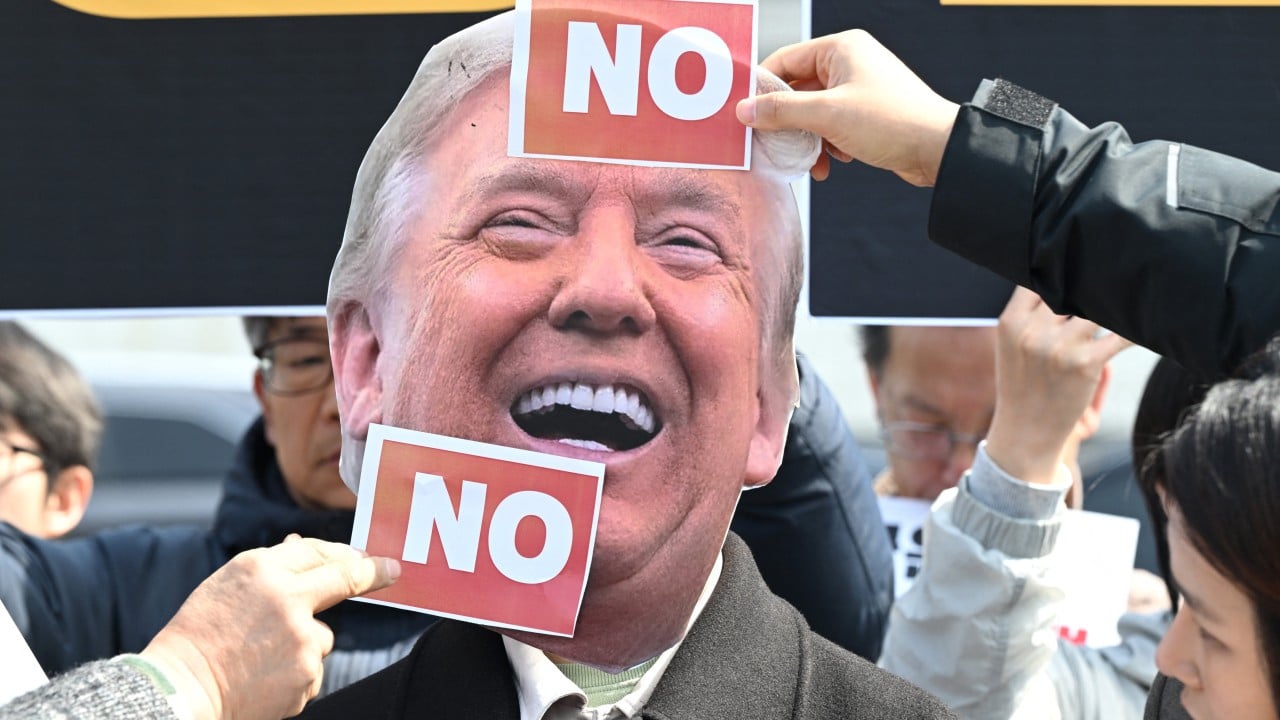
Don't expect South Korea to jump into the fire just because Donald Trump says so. On Monday, the Strait of Hormuz reminded the world why it’s the most dangerous stretch of water on the planet. An explosion ripped through the engine room of the HMM Namu, a cargo ship operated by South Korea’s shipping giant HMM. While the 24 crew members are safe, the political fallout is just beginning to smolder.
Trump immediately pounced on the incident to push his new "Project Freedom" initiative. He’s essentially calling for a maritime "coalition of the willing" to break Iran's grip on the waterway. But Seoul isn't biting. Instead of a gung-ho military response, the South Korean government offered a polite, bureaucratic shoulder shrug. It's a calculated move that shows they understand the stakes much better than the folks in Washington.
The chaos of Project Freedom
Project Freedom isn't some well-oiled military machine. It’s a high-stakes gamble played out on social media. Trump launched the operation on May 4, 2026, claiming the U.S. Navy would guide stranded merchant ships through the blockade. Since the U.S. and Israel started this conflict back in February, the strait has been a graveyard for global trade.
Monday was a bloodbath. While the U.S. claims it destroyed seven Iranian fast boats and successfully escorted two American-flagged ships, Iran is telling a different story. They’ve "redefined" their maritime borders and warned that any ship entering without their permission will be attacked. They aren't kidding. On the same day the HMM Namu caught fire, Iranian drones slammed into a UAE oil terminal and an empty ADNOC tanker.
Trump’s response? He hopped on Truth Social and told South Korea it’s time to "join the mission." It sounds simple. You send some destroyers, you point the guns at the bad guys, and the oil starts flowing again. But for Seoul, it’s a logistical and diplomatic nightmare they’d rather avoid.
Why Seoul is staying on the sidelines
South Korea isn't being cowardly; they're being realistic. They rely on the Strait of Hormuz for a massive chunk of their energy, but they also know that a unilateral move would be suicide.
First, there’s the legal hurdle. A senior official from the presidential office recently noted that sending troops or ships into a foreign combat zone isn't something they can just do on a whim. They need a UN Security Council resolution. They need approval from their own National Assembly. Neither of those is happening tomorrow.
Then there’s the "North Korea factor." Seoul is always looking over its shoulder at the nuclear-armed neighbor to the north. They don't have the "surplus capacity" to go playing world police in the Middle East when things are perpetually tense on the peninsula.
The gap between rhetoric and reality
Experts like Jun Bong-geun, president of the Korea Nuclear Policy Society, have pointed out a massive "asymmetry of interests." The U.S. wants to project power and break the blockade. South Korea just wants its ships to stop exploding.
Trump’s "Project Freedom" lacks the one thing Seoul actually needs: a multinational consensus. If Japan, the European Union, and other major players were all lining up to form an escort fleet, South Korea might consider it. But right now? It’s basically just the U.S. and Israel. Seoul has no interest in being the only other name on that guest list.
There’s also a big question about what "Project Freedom" even is. Is it a real military strategy or just a series of posts? Analysts are skeptical. There are no concrete plans, no clear chain of command, and no exit strategy. For a country like South Korea, joining a "war with no clear end" is a non-starter.
What happens next for global shipping
If you're waiting for the Strait of Hormuz to open up and for oil prices to drop back to normal, don't hold your breath. Brent crude is already swinging wildly above $111 a barrel. Major shipping lines like Hapag-Lloyd have basically said transit is still impossible.
The HMM Namu is currently being towed to Dubai for inspection. We still don't know for sure if it was an Iranian mine, a drone, or an internal malfunction, though the timing is awfully suspicious.
Here is what you should actually watch for:
- The UN response: If the UN Security Council actually moves on a resolution, that’s your signal that South Korea might change its tune.
- Multilateral movement: Keep an eye on Tokyo. If Japan joins "Project Freedom," Seoul will feel a lot more pressure to follow suit.
- The Pakistan channel: Diplomacy is still happening in the background via Pakistan. A lasting truce is the only way these ships are moving safely again.
Seoul’s "managed ambiguity" is the smartest play they have. They aren't saying "never," but they are saying "not like this." In a region currently defined by hot-headed tweets and drone strikes, South Korea’s cautious, boring bureaucracy might actually be the most rational thing on the water.