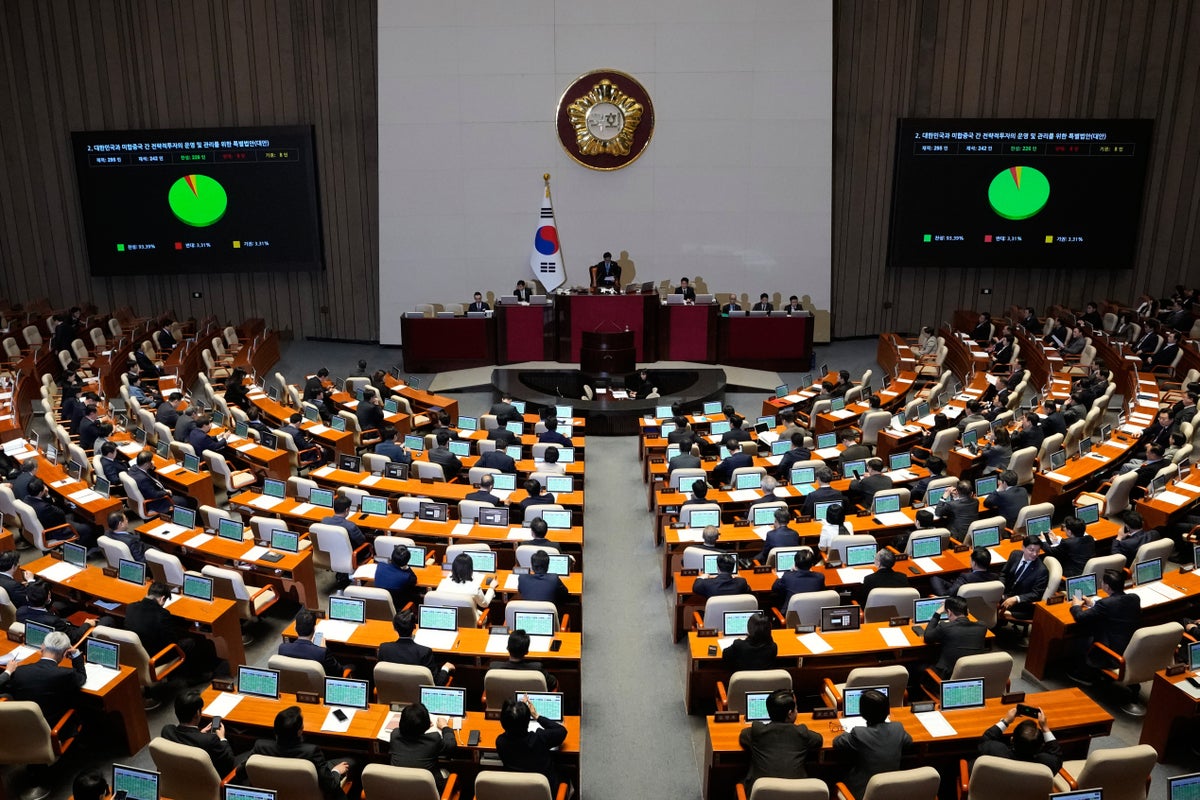
South Korean lawmakers have officially moved to codify oversight of the staggering $350 billion investment pledge made to the United States. This isn't just a routine bureaucratic filing. It is a defensive maneuver. By establishing a formal framework to manage these massive capital outflows, Seoul is attempting to ensure that its domestic industrial base doesn't hollow out while its biggest conglomerates—Samsung, SK, Hyundai, and LG—build the next generation of American infrastructure. The new legislation creates a monitoring mechanism to track the execution of these investments, ensuring that the "Chips Act" handouts and "Inflation Reduction Act" tax credits promised by Washington actually materialize before Korean companies ship their entire supply chains across the Pacific.
The numbers are large enough to reshape global trade maps. Since 2021, the South Korean private sector has committed more than $350 billion to U.S.-based projects, primarily in semiconductors, electric vehicle batteries, and clean energy. It represents the single largest foreign investment push in the history of the ROK-U.S. alliance. But back in Seoul, the mood has shifted from pride to pragmatism. Lawmakers are now asking the hard questions that should have been asked three years ago. What happens to the Korean job market when the most advanced high-tech factories are built in Texas and Georgia instead of Gyeonggi Province?
The Hidden Cost of the American Dream
South Korea is currently trapped in a geopolitical pincer movement. On one side, the U.S. is demanding "friend-shoring" to decouple from China. On the other, China remains Korea's largest trading partner and a massive market for the very chips and batteries being subsidized by the U.S. government. The $350 billion pledge was, in many ways, an entry fee for Korean firms to stay relevant in the American market.
However, the "America First" policies of the U.S. government have proven to be more aggressive than many in Seoul anticipated. The recent legislative move by the National Assembly serves as a reality check. It signals that the South Korean government will no longer give its conglomerates a blank check to move operations abroad without a clear accounting of the domestic impact. The law focuses on "investment reciprocity," a term that is becoming a mantra in the halls of the Blue House. If Samsung is spending $44 billion on a massive logic chip hub in Taylor, Texas, the Korean government wants to see a proportional commitment to R&D and specialized manufacturing back home.
There is a growing fear of "industrial hollowing." We have seen this script before. In the 1980s and 90s, the U.S. watched its manufacturing heartland migrate to Asia. Now, the roles are reversing in the high-tech sector. Korea is effectively exporting its most valuable economic engine. The new oversight law is an attempt to install a governor on that engine, slowing the transition to a pace that the domestic economy can survive.
The Subsidy Trap and the Risk of Overextension
The U.S. CHIPS and Science Act promised billions in grants, but those funds come with heavy strings attached. Provisions that limit expansion in China for a decade are a direct threat to the bottom lines of Samsung and SK Hynix, both of whom have massive "legacy" memory chip plants on the Chinese mainland.
Korean lawmakers are now mandating a more granular level of reporting on these foreign ventures. They want to see the fine print. The concern is that Korean companies might be overextending themselves, taking on massive debt to fund U.S. expansions while the actual subsidies from the U.S. Department of Commerce face delays or political pushback.
Consider the battery sector. LG Energy Solution and SK On have committed tens of billions to joint ventures with American automakers. But as the U.S. EV market experiences a cooling period and political winds shift regarding environmental mandates, these investments look increasingly risky. The new Korean oversight law allows the government to intervene or at least provide "guidance" if the global market conditions make these massive U.S. outlays a threat to the parent companies' financial stability.
Protecting the Crown Jewels
Beyond the money, there is the matter of the "crown jewels"—the proprietary technology that makes South Korea a global powerhouse. When a company builds a state-of-the-art 3nm chip foundry in the U.S., the talent and the "know-how" inevitably follow. The National Assembly is tightening the screws on technology leakage.
The legislation introduces stricter penalties for unauthorized transfers of "national strategic technologies." While this is framed as a general security measure, it is a pointed reminder to Korean executives that their primary loyalty must remain with the domestic economy. You cannot simply export the soul of the company to secure a tax break in Ohio.
The Geopolitical Gamble
This isn't just about economics; it's about survival. South Korea is small, and its leverage on the world stage is almost entirely derived from its technological dominance. If it loses that edge, it loses its seat at the table.
Washington views these investments as a victory for domestic American policy. Seoul, however, is beginning to view them as a strategic vulnerability. The new law is the first step in a broader pivot toward economic nationalism. It suggests that the era of unfettered, globalist capital movement is ending, replaced by a much more transactional and suspicious form of international cooperation.
The Problem of Workforce Attrition
Every billion dollars invested in a U.S. plant is a billion dollars not being used to train the next generation of Korean engineers. South Korea is already facing a demographic crisis with the lowest birth rate in the world. As the talent pool shrinks, the competition for skilled workers becomes a zero-sum game.
If the best and brightest Korean engineers see their career paths leading to Austin or Phoenix rather than Suwon, the long-term outlook for Korean innovation is grim. The legislative push for managing the $350 billion pledge includes provisions for "human capital retention." This is a polite way of saying the government will start incentivizing—or perhaps mandating—that core research and the most advanced manufacturing tiers remain on Korean soil.
Navigating the Two Superpowers
The timing of this law is not accidental. With U.S. elections always on the horizon and trade policy becoming increasingly protectionist on both sides of the American political aisle, South Korea is hedging its bets. They are preparing for a world where "friend-shoring" might just be a euphemism for "America-first."
The $350 billion pledge was a massive show of good faith. But good faith doesn't pay the bills when your domestic factories are sitting idle. The National Assembly is signaling to both Washington and its own corporate titans that the honeymoon period is over. Now comes the hard work of accounting.
Korean conglomerates are now required to submit detailed "Domestic Impact Assessments" before greenlighting the next phase of their U.S. expansions. This creates a new layer of friction, but it also gives the Korean government a seat at the negotiating table when these companies deal with the U.S. government. It provides a level of state-backed cover. A CEO can now tell a U.S. governor, "I'd love to build more here, but my government's new oversight laws are making it difficult." It is a classic tactical maneuver.
The Burden on the Big Four
Samsung, Hyundai, SK, and LG are the pillars of the Korean economy. They account for a disproportionate share of the country's GDP. When they sneeze, the whole country catches a cold.
By passing this law, the government is effectively tethering these companies more closely to the state. It is a return to a more directed economic model, reminiscent of the "Developmental State" era that built modern Korea. The difference now is that the stakes are global. These companies are no longer just national champions; they are global titans that have outgrown their home market. The government is trying to remind them where their home is.
The sheer scale of the $350 billion commitment means that even a 10% shift in how that money is allocated—or the pace at which it is spent—could have massive implications for both the U.S. and Korean economies. This isn't just a law about management; it’s a law about leverage.
For the American side, this should be seen as a warning. South Korea is not a passive partner in the restructuring of the global supply chain. They are a sophisticated actor with their own existential concerns. The "pledge" was never a gift; it was a strategic investment that Seoul now intends to manage with surgical precision.
Watch the next round of earnings calls from the Korean giants. You will likely hear less about the "expansion into the U.S. market" and more about "balancing global footprints with domestic priorities." That shift in language is the direct result of this legislative move. The era of the blank-check investment is over, and the era of the monitored, managed, and highly conditional capital flow has begun.
If you are an investor or a policy analyst, ignore the top-level diplomatic handshakes. Look instead at the reporting requirements and the domestic impact assessments now being codified in Seoul. That is where the real power dynamic is being rewritten. South Korea is moving to reclaim control over its economic destiny, one billion-dollar factory at a time.