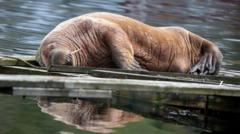
The media is currently swooning over Magnus, the wandering walrus. After a stint lounging on the rugged coasts of Scotland, he has hauled his ton-plus frame across the North Sea to Norway. The headlines read like a travel blog for pinnipeds. They treat Magnus like a quirky backpacker on a gap year, finding himself among the fjords.
This narrative is a collective delusion. It is a dangerous, anthropomorphic fantasy that masks a grim biological reality. We aren't "celebrating" nature when we track Magnus's every move with telephoto lenses and viral tweets. We are witnessing a systemic failure of habitat and a desperate search for calories, all while turning a wild predator into a mascot for our own entertainment.
If you think Magnus "choosing" Norway is a heartwarming tale of animal migration, you have been sold a lie.
The Myth of the Happy Wanderer
Walruses are gregarious, social beasts. They thrive in massive colonies, anchored to stable sea ice. When a lone male like Magnus—or his predecessor, Freya—ends up in the UK or the populated harbors of Oslo, it isn't an adventure. It is an anomaly. Usually, it is a sign of disorientation or habitat displacement.
The "lazy consensus" among travel journalists and casual observers is that Magnus is simply exploring. I’ve spent years analyzing wildlife conservation data and local ecological impacts; animals of this size don't "explore" for fun. They move because they must. They move because the ice they rely on for rest between foraging dives is vanishing.
When Magnus hauls out on a slipway in Scotland or a pier in Norway, he isn't looking for a photo op. He is exhausted. A walrus can weigh over 1,300kg. Dragging that mass out of the water requires immense caloric expenditure. Every time a crowd of tourists gathers to snap a selfie, they trigger a "startle response."
The Caloric Cost of Your Selfie
Let's do the math that the feel-good articles ignore.
- Rest is Survival: For a walrus, hauling out is a metabolic necessity to regulate body temperature and recover from deep-sea foraging.
- The Disturbance Tax: If Magnus is spooked by a drone or a shouting child, he plunges back into the frigid water before his core temperature has stabilized.
- The Deficit: Repeated disturbances lead to a chronic caloric deficit.
I’ve seen this play out with "celebrity" megafauna across the globe. We love them to death. We turn their survival struggle into a spectator sport, and then we act shocked when the authorities eventually have to intervene because the animal has become "habituated" or "aggressive."
Norway is Not a Vacation Home
The competitor pieces suggest Magnus "swapped" Scotland for Norway as if he’s browsing Airbnb. This ignores the predatory and competitive reality of the Norwegian coastline.
While Norway has a native walrus population, it is concentrated far north in the Svalbard archipelago. A walrus appearing in Southern Norway is still out of its element. It is entering waters with heavy boat traffic, industrial runoff, and—most dangerously—people who think a walrus is a giant puppy.
The Freya Precedent
We must talk about Freya. In 2022, a young female walrus captivated the world in the Oslo Fjord. The public refused to keep their distance. They climbed onto boats to see her. They brought their children within meters of her tusks. The Norwegian Directorate of Fisheries warned the public repeatedly. The public ignored them.
The result? Freya was euthanized.
The authorities didn't kill Freya because they were cruel. They killed her because the public's obsession made her a lethal liability. If Magnus follows the same path—moving into high-density human areas—his "heartwarming" journey is just a slow-motion march toward a terminal vet appointment.
The Industry of Ecological Voyeurism
The travel industry and local tourism boards are complicit. They see a wandering walrus as a "unique selling point" for a coastal town. They promote the sighting without enforcing the distance.
True conservation is boring. It looks like an empty beach. It looks like a "No Entry" sign and a $5,000 fine for anyone with a camera within 100 meters. But boring doesn't get clicks.
Why the "People Also Ask" Sections are Wrong
You’ll see queries like: Where can I see Magnus the walrus today?
The answer should be: You shouldn't.
Or: Is Magnus the walrus friendly?
The answer: He is a 2,000-pound carnivore with tusks that can puncture a RIB boat. "Friendly" is a human concept that doesn't exist in the Arctic.
By asking these questions, we reveal our own narcissism. We want nature to be an interactive exhibit. We want the "experience" without the responsibility.
The Cold Truth of Displaced Megafauna
We are seeing more of these "wandering" events because the Arctic is screaming. The benthic invertebrates that Magnus eats—clams, snails, and worms—are sensitive to ocean acidification and warming. If the food moves or the ice retreats, the walrus moves.
Magnus is a climate refugee in a tuxedo of blubber.
When we frame his journey as a "choice" or a "visit," we strip away the urgency of the environmental crisis. We make it a story about a cute animal instead of a story about a collapsing ecosystem. Scotland and Norway are just stops on a map of desperation.
Stop Watching and Start Ignoring
The best thing you can do for Magnus is to hope you never see him.
If you are a coastal resident or a traveler in Norway, and you hear a walrus has arrived, stay home. Don't launch your boat. Don't "check it out" from the pier. If there is no crowd, there is no pressure. If there is no pressure, there is no conflict.
We need to dismantle the idea that wild animals owe us an appearance. We need to stop treating the North Sea like a zoo without cages. Magnus isn't an ambassador for the wild; he is a victim of our curiosity and our carbon footprint.
The obsession with his itinerary is a distraction. While you’re tracking his GPS coordinates, the sea ice that should be supporting ten thousand others is turning to slush.
Put down the binoculars. Close the livestream. Let the animal be a ghost.
If we don't change how we interact with these displaced giants, we aren't "following" Magnus’s journey. We are just spectating his extinction.