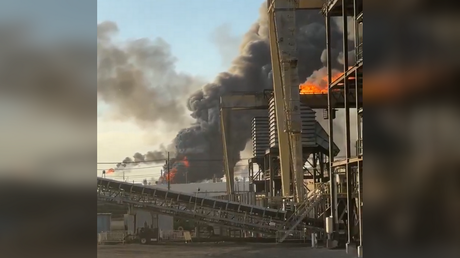
The headlines are predictably frantic. Another fireball over the Texas Gulf Coast, another round of shaky smartphone footage on the evening news, and another wave of "thoughts and prayers" from suits in Houston who haven’t stepped onto a cat cracker in a decade. The media treats these events like acts of God or freak accidents. They aren’t. They are the mathematical certainty of a decaying infrastructure that we’ve decided is too expensive to modernize but too essential to shut down.
Most people look at a refinery explosion and see a tragedy. I see a ledger. Don't forget to check out our recent coverage on this related article.
For twenty years, I’ve watched the energy sector play a high-stakes game of "run to failure." The competitor articles you’re reading right now focus on the smoke and the sirens because they don’t understand the chemistry or the capital expenditure cycles. They want to talk about "emergency response" when the real conversation should be about why we are still using 1970s metallurgy to handle 2026 throughput demands.
The Myth of the Freak Accident
Stop calling these events accidents. An accident is when you trip over a rug. When a high-pressure hydrotreater unit fails because of high-temperature hydrogen attack (HTHA), that’s a predictable outcome of deferred maintenance and metallurgical fatigue. To read more about the background of this, The Motley Fool offers an informative summary.
The industry likes to hide behind the term "Process Safety Management." It sounds technical. It sounds controlled. In reality, it’s often a paper shield used to justify keeping a unit online for "just one more quarter" to hit production targets. When a pipe thins to the point of a pinhole leak, and that leak turns into a vapor cloud, and that cloud finds an ignition source, that is a sequence of events we have mapped out for fifty years.
We know exactly why these plants blow up. We just don't like the price tag of preventing it. Replacing a reactor isn't just about the cost of the steel; it’s about the thirty days of lost revenue while the plant is dark. In a market where margins are squeezed by renewables and global volatility, "dark time" is the ultimate sin. So, we patch. We clamp. We pray.
The Dirty Secret of "Safety Records"
You’ll hear the PR reps brag about their "days since a lost-time incident." Don't fall for it.
That metric is a scam. It tracks how many guys tripped on a ladder or stubbed their toe. It has zero correlation with catastrophic process failure. A refinery can have a world-class record for "slips, trips, and falls" while simultaneously being three seconds away from a BLEVE (Boiling Liquid Expanding Vapor Explosion).
- Occupational Safety: Wearing your safety glasses and holding the handrail.
- Process Safety: Ensuring the 500-degree volatile chemicals stay inside the pipes.
The industry is obsessed with the former because it’s easy to track and makes for great posters in the breakroom. The latter requires deep-tissue engineering, expensive non-destructive testing, and the courage to tell shareholders that the Q3 numbers will be lower because the plant needs a total turnaround.
I’ve sat in rooms where engineers flagged "pitting corrosion" in critical sections, only to be told by a plant manager that the risk was "within acceptable parameters." "Acceptable parameters" is code for "we’re betting the plant that it holds until the next scheduled maintenance." Sometimes you win that bet. Sometimes Texas residents wake up to a shockwave that shatters their windows.
Automation is Not Your Savior
The "lazy consensus" says that more technology—AI sensors, remote monitoring, automated valves—will stop the bleeding. It’s a seductive lie.
Adding digital layers to a physical system that is fundamentally corroded is like putting a Tesla dashboard in a 1988 Yugo. It gives you more data about your impending failure, but it doesn't stop the steel from cracking. In fact, over-automation creates a "black box" effect where operators lose the "feel" for the plant.
When everything is a sensor on a screen, you lose the ability to hear the subtle change in a pump's whine or smell the faint hint of sulfur that tells an old-school operator something is wrong. We are breeding a generation of "glass cockpit" operators who know how to click a mouse but couldn't tell you how a centrifugal pump actually works if their life depended on it. And during a catastrophic event, their life literally does.
Why the Energy Transition Makes Refineries More Dangerous
Here is the counter-intuitive truth: The push for "Green Energy" is making oil refineries more likely to explode.
As the world looks toward 2030 and 2050 targets, the "terminal value" of an oil refinery plummets. If you’re a CEO, why would you invest $500 million in a long-term infrastructure upgrade for a plant that might be regulated out of existence in fifteen years?
We are entering the "harvest phase" of fossil fuels. Companies are extracting every cent of profit they can from these assets while investing the bare minimum to keep them upright. This is the "Sunset Effect." When an industry knows its days are numbered, the incentive to build for the next fifty years vanishes. We are running the most complex, dangerous machines on earth on a "disposable" mindset.
The Cost of the "Cheap Gas" Obsession
Everyone complains when the price at the pump hits $4.00. But that cheap gallon of gas is subsidized by the "risk debt" of the people living in Port Arthur, Deer Park, and Texas City.
We demand low prices, and the market responds by cutting overhead. The biggest overhead in a refinery is maintenance and skilled labor. When you see a blast in Texas, you are seeing the physical manifestation of a supply chain that has been stripped of its margins. We have traded safety margins for consumer convenience, and we pretend to be shocked when the bill comes due in the form of a fireball.
How to Actually Fix It (And Why We Won't)
If we actually wanted to stop these events, the solution isn't "more regulation." We have stacks of regulations. The solution is a fundamental shift in how we value industrial assets.
- Mandatory Metallurgical Transparency: Every refinery should be forced to publish its "corrosion maps" publicly. If people knew how thin the pipes were in the unit next to their neighborhood, the pressure for real change would be internal, not just a fine from OSHA.
- Criminal Liability for "Deferred Maintenance": Until a C-suite executive faces actual jail time for "budgeting" away a known safety risk, nothing changes. Fines are just a line item. They are the "cost of doing business."
- End the "Safety Record" Charade: Stop rewarding managers for low "trips and falls." Start rewarding them for "mechanical integrity" and "zero unplanned shutdowns."
The reality? We won't do any of this. We like our cheap gas too much. We like our quarterly dividends too much. And we’ve become so desensitized to the "Texas Refinery Blast" headline that it has become a background noise of modern life—a recurring tax paid in smoke and steel.
The next time you see a video of a refinery on fire, don't ask "how did this happen?" You know how it happened. We all do. We just agreed to look the other way as long as the lights stayed on and the tank stayed full.
Stop looking at the fire. Look at the balance sheet. That’s where the explosion actually started.
Go look at the 10-K filings of the major players. Look at the "Capital Expenditures" versus "Dividends and Buybacks." There is your smoking gun. There is your "accident."
Shut the plant down or pay the price. There is no third option.