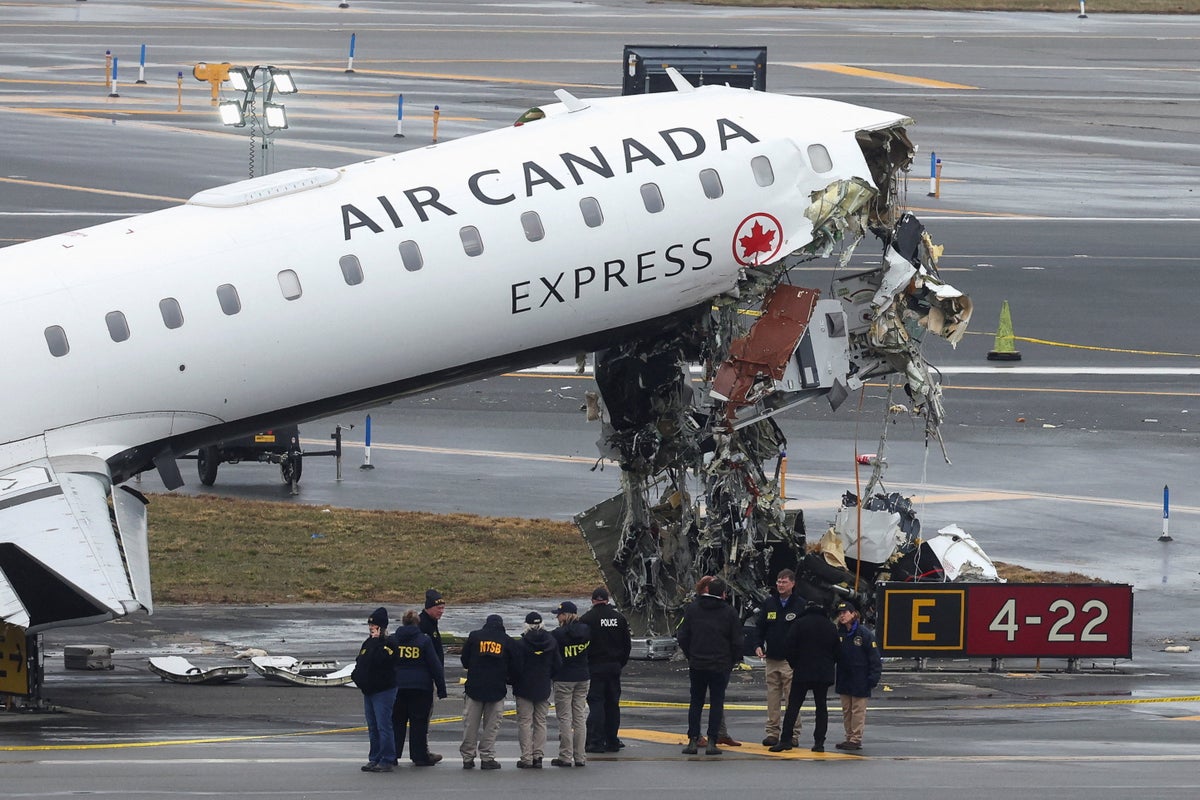
The public has a macabre obsession with the "final three minutes." Whenever a hull loss occurs at LaGuardia or any other high-intensity corridor, the media salivates over the Cockpit Voice Recorder (CVR) transcripts. They treat these audio snippets like a digital seance, hoping to find a "smoking gun" in a pilot’s panicked voice or a mechanical alarm.
It is a distraction. A comfortable lie.
Focusing on the immediate actions of a crew in the final 180 seconds of a flight is like blaming the soot for the fire. By the time those "final three minutes" begin, the accident has usually been in progress for weeks, months, or years. The industry’s fixation on the CVR is a tool for the lazy to assign "Pilot Error" and move on, ignoring the systemic rot that actually downs planes.
The Myth of the Heroic Intervention
Standard narratives suggest that if a pilot just followed the Quick Reference Handbook (QRH) faster, or if they had "better situational awareness," the collision at LaGuardia wouldn't have happened. This assumes the human mind is a linear processor capable of perfect logic under extreme physiological stress.
It isn't.
When things go wrong at low altitudes—specifically during the "deadly transition" from approach to touchdown—the brain undergoes a massive cortisol dump. Cognitive tunneling occurs. You stop seeing the periphery. You stop hearing the co-pilot. This isn't a "failure" of the pilot; it is the biological reality of the human animal.
The contrarian truth? If a catastrophe requires a pilot to be a superhero in the final seconds to avoid a crash, the system has already failed. Safety shouldn't depend on a human being performing a miracle while their lizard brain is screaming "run."
The CRM Fallacy: Why Cooperation Fails
Cockpit Resource Management (CRM) is the industry's golden calf. We are told that better communication prevents accidents. The LaGuardia transcripts usually show "breakdowns in CRM."
I have spent decades analyzing flight data and sitting in simulators where we break the best crews in the world. I can tell you that CRM is a fragile veneer. In high-workload environments like the New York airspace, communication doesn't just "break down"—it evaporates under the weight of archaic Air Traffic Control (ATC) procedures and noise-abatement requirements that prioritize local property values over flight stability.
The "lazy consensus" says pilots need more CRM training. The reality? They need a cockpit that doesn't require constant verbal cross-checking for tasks that should be automated or simplified. We are still flying planes with 1970s interface logic and then acting shocked when a human gets confused by a mode-confusion error.
The Geography of Negligence
LaGuardia is a topographical nightmare masquerading as a world-class airport. Its short runways and proximity to dense water and urban structures leave zero margin for error.
The media focuses on what the pilot said. They should be focusing on why we are still forcing heavy metal into a "postage stamp" airport that was never designed for the volume and weight of modern aviation.
- Runway Safety Areas (RSA): While many airports have expanded their overrun areas, LaGuardia’s geography makes this a logistical headache. We accept "Engineered Materials Arrestor Systems" (EMAS) as a fix, but EMAS is a bandage on a bullet wound.
- The New York Congestion Trap: The pressure to "make the slot" is an invisible hand on the throttle. Pilots don't talk about it on the CVR because it's the air they breathe.
When you hear a pilot’s voice crack on a recording, you aren't hearing a mistake. You are hearing the sound of a human being realizing they can no longer compensate for a flawed infrastructure.
The Problem With "Pilot Error"
The term "Pilot Error" is a legal shield for manufacturers and airlines. It’s convenient. If it’s the pilot's fault, you don't have to redesign the fly-by-wire logic. You don't have to change the training pipeline that values "hours in the air" over "quality of manual handling."
Consider the $1:10:100$ rule in systems engineering. A flaw caught in design costs $1. Caught in testing, it costs $10. Caught in the field—or in the final three minutes of a flight—it costs $100 and a lot of lives.
The industry spends all its time analyzing the "100" stage. We should be looking at why the design allowed a single-point failure to cascade.
What the Transcripts Never Show
- Fatigue Cycles: The CVR doesn't record the four days of "minimum rest" layovers the crew had before the flight.
- Economic Pressure: It doesn't record the subtle memos from management about fuel-saving measures that discourage go-arounds.
- The Software Ghost: It doesn't capture the moment the autopilot logic made a "silent" handoff to the human, leaving them with a stalled wing and a confused flight-envelope protection system.
Stop Asking What They Said
People always ask: "What were their last words?" or "Did they know they were going to hit?"
These are the wrong questions. They are voyeuristic and analytically useless. Instead, we should be asking:
- Why did the flight display allow the airspeed to decay without a tactile (shaker) warning five minutes earlier?
- Why does the ATC handoff in the New York TRACON (Terminal Radar Approach Control) remain one of the most high-stress verbal exchanges in the world instead of a digital data-link?
- Why do we allow airlines to schedule crews on the edge of legal fatigue limits?
The Dangerous Allure of the Narrative
We love stories. We want a hero or a villain. The LaGuardia crash audio provides a narrative arc. It has a beginning, a middle, and a tragic end.
But aviation safety is not a story. It is a cold, hard calculation of probabilities. When you listen to those tapes, you are listening to the output of a broken machine, not the cause of the break.
The contrarian view is uncomfortable because it suggests that we are all complicit. Every time we demand cheaper tickets, every time we refuse to fund airport expansions, every time we demand more flights into LGA, we are narrowing that margin.
Real-World Math: The Probability of the "Final Three"
If we assume a flight is a series of gates, most accidents require 5 to 7 gates to be left open simultaneously.
$$P(Accident) = P(g_1) \times P(g_2) \times P(g_3) \dots \times P(g_n)$$
The CVR only captures $P(g_n)$—the very last gate. By focusing on the audio, you are ignoring the previous six gates. You are ignoring the $P(g_1)$ of poor maintenance and the $P(g_2)$ of inadequate simulator training for high-altitude upsets.
Dismantling the "Safety First" Lie
Airlines love the slogan "Safety is our top priority." This is objectively false. If safety were the top priority, no plane would ever take off. Profit and schedule are the priorities; safety is the constraint.
When the constraint is squeezed, the "final three minutes" become more volatile.
The next time a transcript is "leaked" or released by the NTSB, don't look for the pilot's mistake. Look for the silence. Look for the things the pilot didn't say because they were too busy trying to keep a 160,000-pound piece of aluminum from falling out of the sky.
We need to stop treating pilots like infallible gods and start treating the cockpit like a workspace that is currently designed to fail under pressure.
Burn the "final three minutes" obsession. Start looking at the three years of corporate and regulatory decisions that led to that cockpit.
The black box isn't a mirror. It's an indictment.
Stop listening to the screams and start looking at the blueprints.