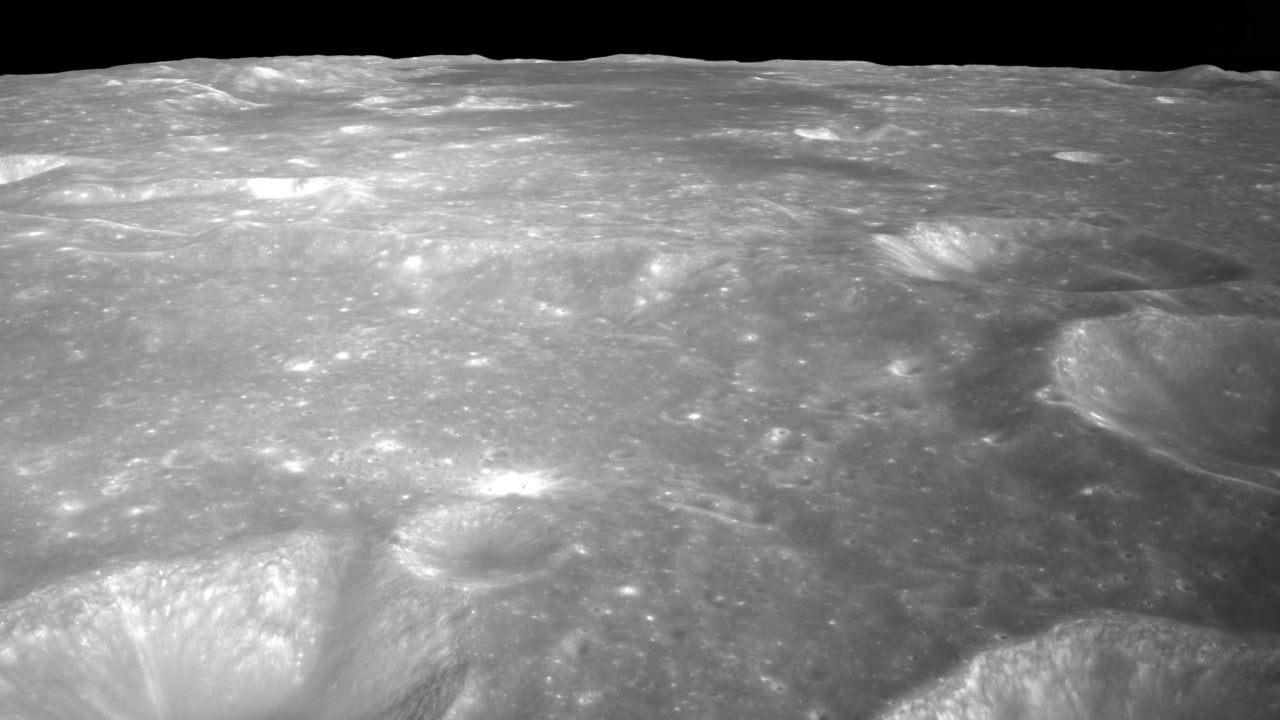
The scientific community is currently patting itself on the back because Chinese researchers used an AI model to "crack the mystery" of why the moon’s far side looks different from its near side. They point to the South Pole-Aitken (SPA) basin. They talk about thermal evolution. They celebrate the machine learning "revelation" that explains the crustal thickness disparity.
They are missing the point.
The obsession with using AI to retroactively validate lunar geology isn't a breakthrough. It’s a sophisticated form of confirmation bias wrapped in a neural network. We are treating AI like a digital oracle that can reveal "truth" about events that happened 4 billion years ago, when in reality, we are just teaching machines to agree with our existing, flawed simulations.
The Data Desert Problem
The loudest cheers for this AI model ignore a fundamental law of information theory: your output is only as good as your ground truth.
We have a massive sample size problem. We have physically touched the moon in a handful of spots. We have a few hundred kilograms of rocks. To claim an AI has "solved" the asymmetry of the lunar crust based on orbital data and a few soil samples is like trying to reconstruct the entire history of Earth by looking at a single parking lot in New Jersey and a satellite photo of the Sahara.
The competitor narrative suggests the AI found a "hidden pattern." I’ve seen Silicon Valley startups burn through $50 million trying to find "hidden patterns" in consumer behavior using the same logic, only to realize the AI was just hyper-tuning to noise. In lunar science, we don't have enough "noise" to even be sure what the baseline is.
The lunar far side isn't a mystery because we lack processing power. It’s a mystery because we lack physical hardware on the ground.
The Asymmetry Obsession
For decades, the "lazy consensus" has been that the Procellarum KREEP Terrane (PKT) on the near side—rich in heat-producing elements like potassium, rare earth elements, and phosphorus—is the sole culprit. The logic goes: the near side stayed hot and volcanic, while the far side froze early.
The recent AI-driven study attempts to bridge the gap by suggesting that the massive impact that created the SPA basin redistributed heat in a very specific way.
Here is the nuance they missed: Impact-induced convection is not a settled science. By feeding an AI model parameters based on "likely" impact scenarios, the researchers aren't discovering a new mechanism. They are automating a specific school of thought. If you tell a model to find the most efficient way a giant rock hit the moon to produce the current crust, it will give you a beautiful, mathematically consistent answer. That doesn't mean it happened.
We are effectively using AI to build a more complex version of "just-so" stories.
The False Idol of Machine Learning in Geophysics
Geophysics is inherently "inverse." You see the result (the moon today) and try to guess the cause (the impact 4 billion years ago).
In standard mathematics, we describe this as:
$$y = f(x)$$
Where $y$ is the moon today, $f$ is the physics of time, and $x$ is the starting condition.
The problem is that for any given $y$, there are an infinite number of $x$ and $f$ combinations that could work. AI is exceptionally good at finding one version of $f(x)$ that looks pretty. It is notoriously bad at telling you if that version is actually the one that occurred in reality.
I’ve watched researchers in seismic imaging use similar "cutting-edge" models to predict oil deposits, only to drill dry holes because the AI found a mathematical correlation that had zero basis in physical geology. The moon is no different. Until we have a dense network of seismometers across the far side, these AI models are just high-end digital paintings.
The Geopolitical Lens
Let’s be brutally honest about why this specific "breakthrough" is being signaled so loudly. This isn't just about science; it’s about establishing intellectual dominance in the new space race.
By claiming AI leadership in lunar evolution, China is signaling that their data processing capabilities match their landing capabilities (which, credit where it’s due, are impressive). But we must separate the engineering feat of landing the Chang'e probes from the speculative science of AI modeling.
The "mystery" isn't cracked. The mystery has just been moved into a black box where it’s harder to argue with the results because "the model said so."
Why Your Questions Are Wrong
People often ask: "When will AI tell us exactly how the moon formed?"
The answer: Never.
AI cannot generate new physical evidence. It can only rearrange what we give it. If our initial assumptions about the lunar mantle's viscosity are off by even $5%$, the AI’s "solution" for the far side's crustal thickness is a hallucination.
Instead of asking if AI can solve the moon, we should be asking: "Why are we using AI as a shortcut to avoid the expensive, difficult work of long-term lunar habitation and deep-core drilling?"
The Risk of Algorithmic Dogma
The danger here is that these AI-generated "solutions" become the new baseline for future missions. If we accept the "Impact-Heat Redistribution" model because an AI validated it, we stop looking for other causes. We stop testing for alternative theories involving tidal locking or early-stage gravitational anomalies.
Trusting a model over physical exploration is a recipe for stagnation.
I've seen this play out in drug discovery. Companies trust the "AI-optimized" molecule, ignore the "weird" results in the wet lab, and wonder why the Phase III trials fail. In space, the stakes are higher. If we build our understanding of lunar resources—like Helium-3 or water ice—based on these types of "cracked mysteries," we are going to find a lot of empty craters when we finally show up with a shovel.
The Actionable Reality
If you want to understand the moon, look at the hardware, not the software.
- Ignore the "Aha!" moments coming from labs that haven't updated their physical data sets in three years.
- Watch the seismology. The only way to "crack" the moon's interior is through long-term vibration monitoring. We need to hear the moon ring to know what it’s made of.
- Follow the samples. The upcoming missions to return far-side samples are worth a thousand AI models.
Stop treating AI as a scientist. It’s a calculator. A very fast, very expensive calculator that is perfectly capable of giving you the wrong answer with absolute confidence.
The moon’s far side remains a cold, silent enigma. No amount of gradient boosting or deep learning is going to change the fact that we are still just guessing in the dark.
Go build a better drill. Leave the "mysteries" to the people who think a GPU is a substitute for a rock hammer.