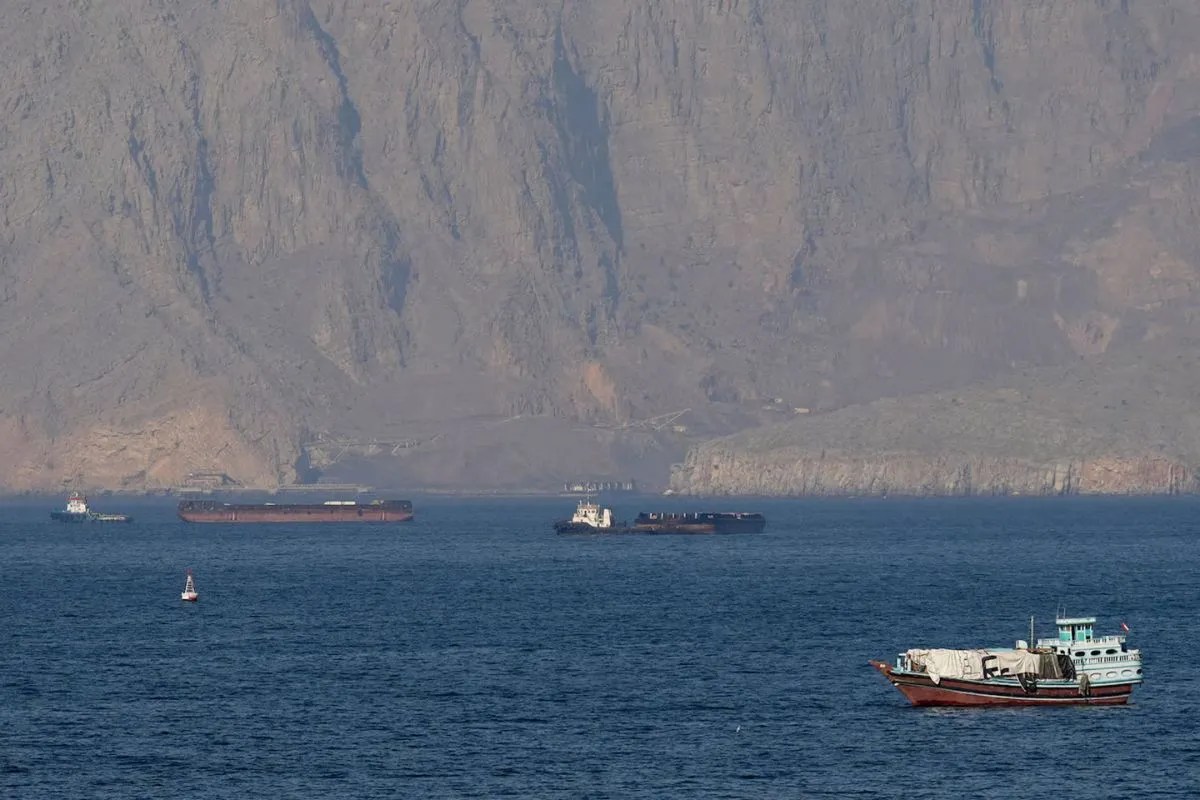
The sudden U-turn of 48 commercial vessels near the Strait of Hormuz marks a breaking point in global maritime logistics. This wasn't a random shift in tide or a routine navigational adjustment. It was a calculated retreat triggered by the realization that traditional naval protection can no longer guarantee safe passage through the world’s most volatile chokepoint. While political rhetoric from Washington suggests a new era of deterrence, the reality on the water tells a different story. Shippers are voting with their rudders. They are choosing the massive overhead of longer routes over the binary risk of seizure or missile strikes.
The Mechanics of the Hormuz Chokepoint
To understand why 48 ships would simultaneously abandon their headings, you have to look at the geography. The Strait of Hormuz is a narrow strip of water—only 21 miles wide at its narrowest point—connecting the Persian Gulf with the Gulf of Oman. It is the jugular vein of the global energy trade. Meanwhile, you can explore similar events here: The Geopolitical Cost-Benefit Analysis of the Eswatini-Taiwan Diplomatic Corridor.
Every day, roughly 20 million barrels of oil pass through this corridor. That represents about 20% of the world's liquid petroleum consumption. When tensions spike between Tehran and the West, the Strait becomes a tactical playground. Iran’s Islamic Revolutionary Guard Corps (IRGC) utilizes a "swarm" doctrine, employing hundreds of fast-attack craft, sea mines, and shore-based anti-ship missiles. This asymmetric setup means even a massive carrier strike group cannot fully insulate a slow-moving tanker from a localized strike.
The Failure of Conventional Deterrence
The recent exodus of vessels occurred despite high-profile declarations of increased maritime patrols. For decades, the presence of the U.S. Fifth Fleet was enough to keep the insurance premiums stable. That era is over. The "U-turn" phenomenon is a direct response to the evolving nature of Iranian interference, which has shifted from overt military threats to legalistic seizures and "tit-for-tat" shadow banking maneuvers. To see the full picture, check out the detailed report by Reuters.
Insurance underwriters have been the silent architects of this retreat. When a vessel enters a "Listed Area" as defined by the Joint War Committee (JWC), premiums don't just rise—they explode. For many fleet managers, the cost of the "war risk" surcharge now outweighs the fuel savings of the shorter route. They aren't just afraid of a missile; they are afraid of a balance sheet that bleeds out before the cargo even reaches a refinery.
The Trump Doctrine and the Risk of Miscalculation
Current American policy under the returned Trump administration leans heavily on "maximum pressure" 2.0. The logic is simple: starve the Iranian economy to force a nuclear and regional concession. However, this creates a cornered-rat dynamic. History shows that when Iran’s oil exports are squeezed via sanctions, they look to equalize the pain by disrupting the exports of their neighbors.
The announcement of even harsher enforcement mechanisms has paradoxically made the Strait less safe. Iran views the shipping lanes as their primary lever of influence. If they cannot sell their oil, they have little incentive to ensure anyone else can. This creates a feedback loop. Washington increases threats, Tehran increases naval drills, and the commercial shipping industry flees the resulting friction.
The Hidden Logistics of the U-Turn
Where do these 48 ships go? They don't just vanish. A U-turn in the Gulf of Oman means a total reconfiguration of the global supply chain.
- Rerouting around the Cape of Good Hope: This adds approximately 3,500 nautical miles to a journey from the Gulf to Europe.
- Fuel Consumption: A standard VLCC (Very Large Crude Carrier) can burn 50 to 100 tons of fuel per day. A two-week detour adds millions to the voyage cost.
- Inventory Lag: Oil scheduled for delivery in 30 days suddenly takes 45. This creates "phantom shortages" in regional markets, driving up pump prices even when global supply is technically sufficient.
The ships that turned back were likely carrying non-essential bulk goods or were tankers without the sovereign protection of a major naval power. State-owned Chinese vessels often continue their transit, betting on their diplomatic ties with Tehran to act as a "soft" shield. This creates a two-tiered shipping market: those with political cover and those left to the mercy of the insurance markets.
The Asymmetric Edge
Iran’s military strategy in the Strait is not designed to win a conventional war against the United States. It is designed to make the status quo too expensive to maintain. By using low-cost drones and naval mines, they force the U.S. and its allies to deploy billion-dollar destroyers and high-cost interceptors.
This is a war of attrition played out in the world of logistics. Every time a tanker is forced to divert, Iran wins a minor economic victory without firing a shot. The 48-ship retreat is a signal that this strategy is working. It proves that maritime dominance is no longer about who has the biggest ships, but about who can most effectively manipulate the perception of risk.
Shadow Fleets and Sanction Evasion
While "legitimate" shipping flees, a "shadow fleet" of aging, under-insured tankers continues to operate. these vessels often turn off their AIS (Automatic Identification System) transponders to hide their movements. They engage in ship-to-ship transfers in the middle of the night, moving Iranian crude under the guise of other origins.
The U.S. threat to crack down on these "ghost" ships is what actually accelerated the recent tensions. If the U.S. Navy begins actively intercepting these vessels, the line between "sanctions enforcement" and "act of war" becomes dangerously thin. The 48 ships that took a U-turn were likely avoiding the crossfire of this impending crackdown.
The Fragility of Global Energy Hubs
The crisis also highlights the lack of viable alternatives. While Saudi Arabia and the UAE have built pipelines to bypass the Strait—such as the East-West Pipeline to Yanbu—these facilities do not have the capacity to handle the full volume of Gulf exports. The world is stuck with Hormuz.
This geographic trap ensures that any local skirmish has global consequences. A single well-placed mine could shut the Strait for weeks, sending oil prices into a triple-digit spiral. The U-turn of those vessels was a preemptive acknowledgment of this fragility.
The Role of Private Security
We are seeing a resurgence in the use of PMSCs (Private Maritime Security Companies). However, these teams are mostly equipped to deal with Somali pirates—men in skiffs with AK-47s. They are useless against state-actor threats like the IRGC. A private security team cannot shoot down a Noor anti-ship missile or repel a coordinated boarding action by Iranian commandos descending from helicopters.
Consequently, the burden falls back on sovereign states. But when sovereign states are the ones escalating the tension, the merchant mariner is caught in a legal and physical no-man's land.
The Intelligence Gap
One overlooked factor in the recent mass-diversion is the role of real-time intelligence sharing. Large shipping conglomerates now employ their own intelligence analysts, often former naval officers, who monitor satellite imagery and signal intelligence. The order for 48 ships to turn around likely came from a shared realization across several major London and Singapore-based desks that a specific, credible threat was imminent.
This level of private intelligence-gathering means that the shipping industry often reacts faster than the politicians. By the time a government spokesperson issues a statement about "freedom of navigation," the fleet has already moved.
Economic Aftershocks
The immediate result of these diversions is a "risk premium" baked into the price of every barrel of oil. Even if not a single drop of oil is lost, the mere potential for loss drives prices up. This is a tax on the global consumer, paid directly to the volatility of the Middle East.
If the current standoff continues, we will see a permanent shift in how energy is priced. The "Hormuz Discount"—the lower price of Gulf oil due to its abundance—is being replaced by a "Hormuz Surcharge."
The Illusion of Control
Western powers often speak as if they can "open" or "close" the Strait at will. This is a fallacy. While the U.S. can certainly win any direct engagement, it cannot prevent the environmental and economic catastrophe of a mid-Strait tanker sinking. The Iranians know this. They use the environmental sensitivity of the Gulf as a secondary deterrent. A massive oil spill would catch the currents and foul the desalination plants of the entire Arabian Peninsula, creating a humanitarian crisis that no amount of naval power could fix.
The 48 ships that turned around weren't just avoiding a fight; they were avoiding a collapse of the maritime order. As the U.S. prepares to tighten the noose on Iranian exports, the frequency of these "U-turns" will increase. We are entering a period where the world’s primary energy corridor is no longer a reliable highway, but a high-stakes gauntlet.
The maritime industry is no longer waiting for a peaceful resolution. They are pricing in the chaos and moving their assets elsewhere. The real story isn't that 48 ships turned back—it’s that the rest of the world is still pretending the route is open for business. Strategies built on 20th-century naval dominance are failing to address 21st-century asymmetric economic warfare. The map hasn't changed, but the rules of the water certainly have. Owners of the world's largest fleets are now operating under the assumption that no one is coming to save them.