The Islamic Revolutionary Guard Corps just handed the global energy market a poison pill disguised as a peace offering. After six weeks of high-intensity conflict that drove Brent crude to a staggering $126 per barrel, Tehran’s announcement that the Strait of Hormuz is "open" should have been a moment of relief. Instead, it is a calculated pivot toward a more insidious form of maritime extortion. While the headlines suggest a return to normalcy following the April 8 ceasefire, the reality on the water is a chaotic mix of lethal risk and bureaucratic blackmail that ensures Iran remains the sole arbiter of global energy prices.
By declaring the main shipping lanes "danger zones" due to the alleged presence of naval mines, the IRGC has effectively nationalized the world’s most vital maritime chokepoint. They aren't just warning ships away from explosives; they are funneling them into a narrow, Iranian-controlled corridor where safe passage now comes with a price tag exceeding $1 million per vessel. This is not a reopening. It is a transition from a shooting war to a high-stakes protection racket.
The Architecture of the Danger Zone
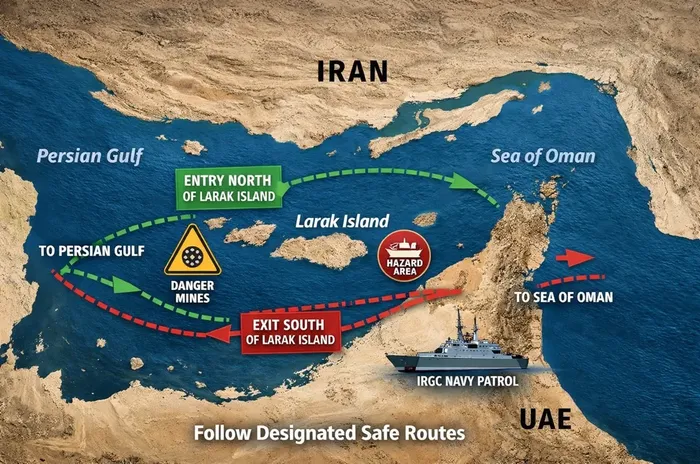
The IRGC Navy recently published a map that essentially erases the internationally recognized Traffic Separation Scheme. In its place lies a massive "danger zone" where Tehran claims unexploded mines make transit suicidal. Whether these mines exist in the quantities claimed is almost irrelevant. In maritime insurance, the mere threat of a "contact mine" is enough to keep a $200 million VLCC (Very Large Crude Carrier) at anchor.
The "alternative route" Iran has graciously provided runs north of Larak Island, hugging the Iranian coast. This shift is a masterstroke of asymmetric geography. By moving the lanes, Iran has achieved three specific strategic goals:
- Total Surveillance: Ships are now forced into waters where Iranian coastal batteries and IRGC fast-attack boats can monitor every deckhand and cargo manifest.
- Sovereign Encroachment: The new route effectively forces international shipping to acknowledge Iranian domestic authority over waters that were previously treated as international transit corridors.
- The Toll System: Reports from the ground indicate that "coordination" with IRGC authorities—a requirement for the new route—now involves mandatory "transit fees" and "security deposits" that function as a de facto toll on global oil.
Why Conventional Minesweeping Fails Here
The U.S. Fifth Fleet and its allies face a technical nightmare. Clearing the Strait of Hormuz isn't like sweeping the English Channel. The strait is shallow, congested, and characterized by erratic currents. More importantly, Iran’s mine inventory isn't limited to old-fashioned contact spheres. They possess sophisticated bottom-dwelling "influence mines" that can be programmed to ignore a hundred small vessels and only detonate when the specific acoustic or magnetic signature of a massive oil tanker passes overhead.
During the height of Operation Epic Fury, the U.S. military claimed to have destroyed 16 mine-laying vessels. But mining is a low-tech, high-impact endeavor. A simple dhow or a converted fishing boat can drop a dozen mines under the cover of darkness. For every mine-layer the U.S. eliminates, ten more potential delivery platforms remain in the Iranian "shadow fleet."
The psychological impact of a single explosion would be catastrophic. If a tanker hits a mine tomorrow, the April 8 ceasefire will vanish, and oil will likely blow past the $150 mark. Tehran knows this. They don't need to sink an entire fleet; they only need to maintain the possibility of a sinking.
The Insurance Deadlock
Global shipping giants like Maersk and Hapag-Lloyd are not rushing back into the Gulf. The math doesn't work. Even with the ceasefire, war risk insurance premiums have remained at four to six times their pre-conflict levels. The U.S. government’s attempt to backstop these costs under the Terrorism Risk Insurance Act has provided some cushion, but it doesn't solve the "toll" problem.
Industry insiders confirm that the IRGC is demanding payments through a network of opaque front companies to "guarantee" that the new routes are mine-free. For a captain, the choice is between a $1 million bribe or risking a hull-breach in a "danger zone" that their insurance specifically excludes. Most are choosing to wait. This has created a massive backlog of over 150 ships anchored outside the strait, a floating monument to the limits of American naval power.
The Geopolitical Protection Racket
This strategy reveals the long-term Iranian play. By killing the Supreme Leader and launching Operation Epic Fury, the U.S. and Israel intended to break Iran’s grip on the region. Instead, they have forced Tehran to refine its leverage. Iran has learned that it does not need to win a naval battle against a carrier strike group. It only needs to make the cost of "peace" higher than the cost of "war."
The ceasefire talks currently happening in Islamabad are focused on a permanent end to hostilities, but Iran has already changed the "ground truth" of the strait. They are betting that the world’s thirst for 20 million barrels of oil per day will eventually force the international community to accept their new maritime rules.
The Strait of Hormuz is not open. It has been transformed into a gated community where the IRGC holds the only set of keys and charges a premium for every turn of the lock. The global economy is no longer navigating a waterway; it is navigating a hostage situation.
If the U.S. and its allies do not find a way to clear the "danger zones" independently and re-establish the international traffic lanes, the "Hormuz Toll" will become a permanent fixture of the global energy landscape. The mines in the water are a threat to ships, but the precedent being set is a threat to the very concept of free navigation.
Every barrel of oil that moves through the Larak Island corridor today carries with it a hidden tax that funds the very IRGC apparatus the West spent the last two months trying to dismantle.


