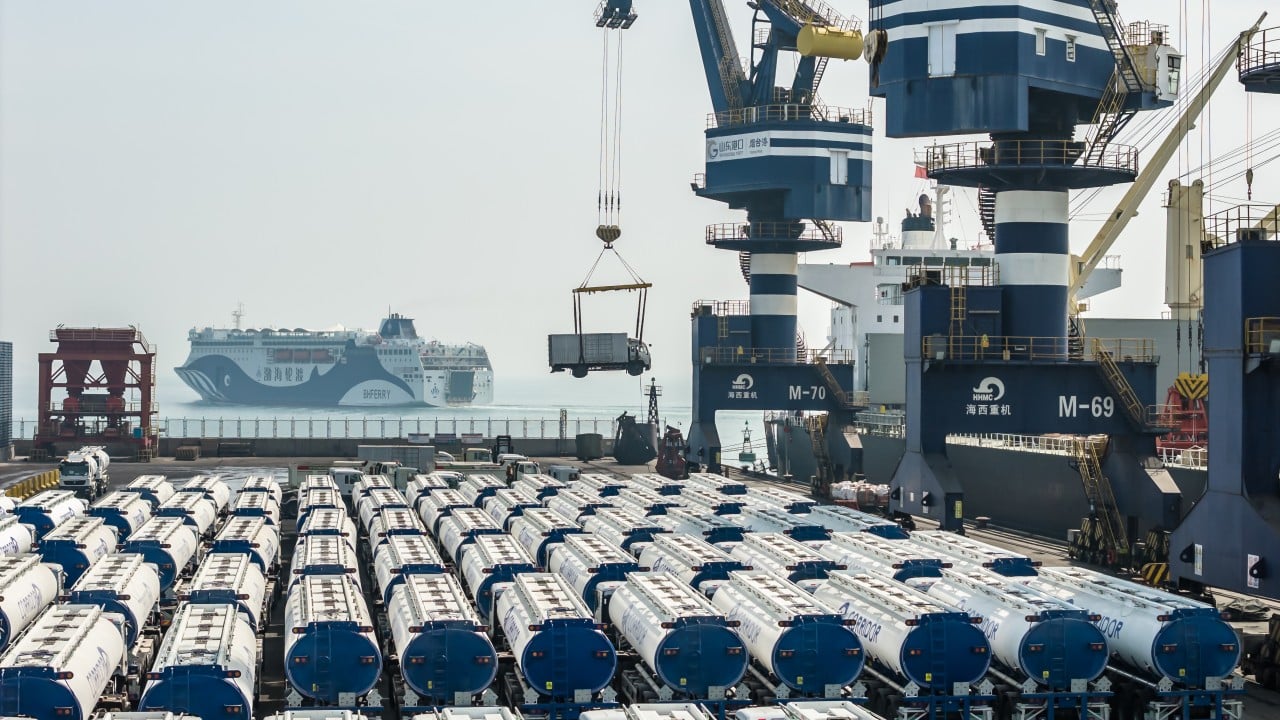
The withdrawal of stable United States trade policy creates a vacuum that is not merely being filled by China, but is being structurally re-engineered to exclude Western competitors. Policy volatility in Washington acts as a high-frequency tax on long-term capital investment. When the U.S. oscillates between aggressive engagement and isolationist protectionism, it disrupts the "Certainty Premium" required for infrastructure-scale projects. China’s comparative advantage in Africa is not rooted in cheaper labor or better technology, but in Institutional Consistency and Risk Absorption Capabilities.
The current shift in the Afro-Sino-American triad is governed by three primary economic drivers: the erosion of the African Growth and Opportunity Act (AGOA) as a credible signal, the transition from sovereign lending to equity-based infrastructure ownership, and the synchronization of African supply chains with the Belt and Road Initiative (BRI) digital architecture.
The Cost of Policy Volatility: Why AGOA is Failing
AGOA was designed to provide duty-free access to the U.S. market, yet its effectiveness is tied to its predictability. The threat of removal—driven by political misalignment or changing U.S. trade priorities—introduces a terminal risk into the valuation models of African exporters.
- Investment Horizon Mismatch: Manufacturing facilities require a 10-to-15-year window to achieve ROI. If the trade preferences governing that facility are subject to four-year electoral cycles, the weighted average cost of capital (WACC) for these projects spikes.
- Regulatory Divergence: As the U.S. pivots toward domestic industrial policy, African nations find it increasingly difficult to meet stringent "Rules of Origin" requirements. This creates a technical barrier to entry that functions as a de facto tariff.
China exploits this by offering "Agnostic Engagement." Beijing’s trade terms are largely decoupled from the domestic governance or social policies of the partner state. This reduces the Political Risk Discount that African leaders must apply when negotiating deals. While the U.S. offers conditional access, China offers unconditional infrastructure.
The Infrastructure-Resource Swap: Beyond Sovereign Debt
The narrative that China is simply "lending" to Africa misses the evolution of the financing model. We are seeing a move away from the "Angola Model" (oil-backed loans) toward the Operational Control Model.
- Asset-Backed Financing: Instead of seeking repayment in cash, Chinese state-owned enterprises (SOEs) increasingly take equity stakes in the assets they build. This secures long-term cash flows from ports, toll roads, and power grids.
- The Circular Capital Loop: Chinese loans are frequently "tied," meaning the capital never leaves the Chinese ecosystem. The loan is issued by the Export-Import Bank of China, paid directly to a Chinese construction firm, using Chinese steel and equipment. Africa receives the physical asset and the debt, while China realizes the immediate economic activity and the long-term strategic footprint.
This creates a Dependency Lock-in. Once a nation’s primary logistics corridor is built to Chinese technical standards and managed by Chinese software, the switching costs to transition to Western alternatives become prohibitively expensive.
The Digital Silk Road: Standardizing the Future
Infrastructure is no longer just concrete and rebar; it is data and connectivity. China’s dominance in Africa’s telecommunications sector (estimated at 70% of the 4G/5G market share) provides a structural layer of influence that the U.S. cannot easily disrupt with policy shifts.
The Stack of Influence
- Hardware Layer: Huawei and ZTE provide the physical backbone of African internet.
- Service Layer: Platforms like Transsion (the leading smartphone provider) pre-load apps that prioritize Chinese-backed digital ecosystems.
- Financial Layer: The integration of mobile money systems with Chinese payment gateways facilitates trade that bypasses the SWIFT system and the U.S. dollar.
This technological synchronization ensures that even if U.S. policy becomes favorable again, the underlying technical architecture of African business will be optimized for Chinese interaction.
Geopolitical Realignment and the Africa-China Trade Surplus
The trade relationship is fundamentally asymmetrical. Africa remains primarily an exporter of raw materials (crude oil, copper, cobalt) and an importer of finished goods. This maintains a classic colonial trade structure, but with a different metropole.
- Critical Mineral Monopolies: China’s control over African mining, particularly in the Democratic Republic of Congo (DRC) for cobalt and Zimbabwe for lithium, is a strategic play for the global energy transition.
- Market Expansion: As Chinese domestic wages rise, Africa serves as the ultimate "Vent for Surplus." It is the destination for Chinese excess industrial capacity and the next frontier for low-cost manufacturing relocation.
The U.S. focus on "Value-Based Partnerships" lacks a corresponding mechanism for physical de-risking. Without a viable alternative to the massive capital injections provided by the BRI, African states are making the rational choice to prioritize the partner that provides the hardware of development over the partner that provides the rhetoric of reform.
Operational Limitations of the Chinese Model
While China currently leads, its strategy faces two structural headwinds:
- Local Labor Friction: The tendency to use Chinese labor and managers creates social tension and limits the "Knowledge Transfer" promised to African nations. This leads to periodic populist backlashes against Chinese presence.
- Debt Sustainability: Several African nations are reaching the ceiling of their borrowing capacity. China is now forced to act as a debt negotiator—a role it is traditionally uncomfortable with—balancing its need for repayment with its desire for diplomatic goodwill.
The U.S. could theoretically counter this by leveraging its strength in the Services and High-Value Tech sectors. However, this requires a decoupling of trade policy from short-term geopolitical posturing—a shift that remains unlikely in the current polarized environment.
Strategic Forecast: The Emergence of the "Multiplex" Market
The outcome of this competition will not be a total victory for one side, but a fragmented African market where different sectors operate under different geopolitical gravities.
- The Security Sector: Likely to remain a battleground, with the U.S. maintaining an edge in counter-terrorism and elite military training.
- The Commercial/Logistics Sector: Firmly in the Chinese orbit for the next two decades due to the lifecycle of current infrastructure projects.
- The Financial Sector: A split system where the U.S. dollar remains the reserve currency of choice, but the Chinese Yuan becomes the primary transactional currency for regional trade.
The optimal strategy for African nations is Strategic Ambiguity. By refusing to align exclusively with either power, they can maximize their "Auction Value," forcing both the U.S. and China to compete on terms of actual economic utility rather than ideological loyalty. For the U.S. to regain relevance, it must shift from a "Policy of Permission" (granting trade access based on behavior) to a "Policy of Provision" (investing in the physical foundations of the African economy). Failure to do so will result in a permanent shift where the U.S. is not "said goodbye to," but simply becomes irrelevant to the daily mechanics of African growth.